
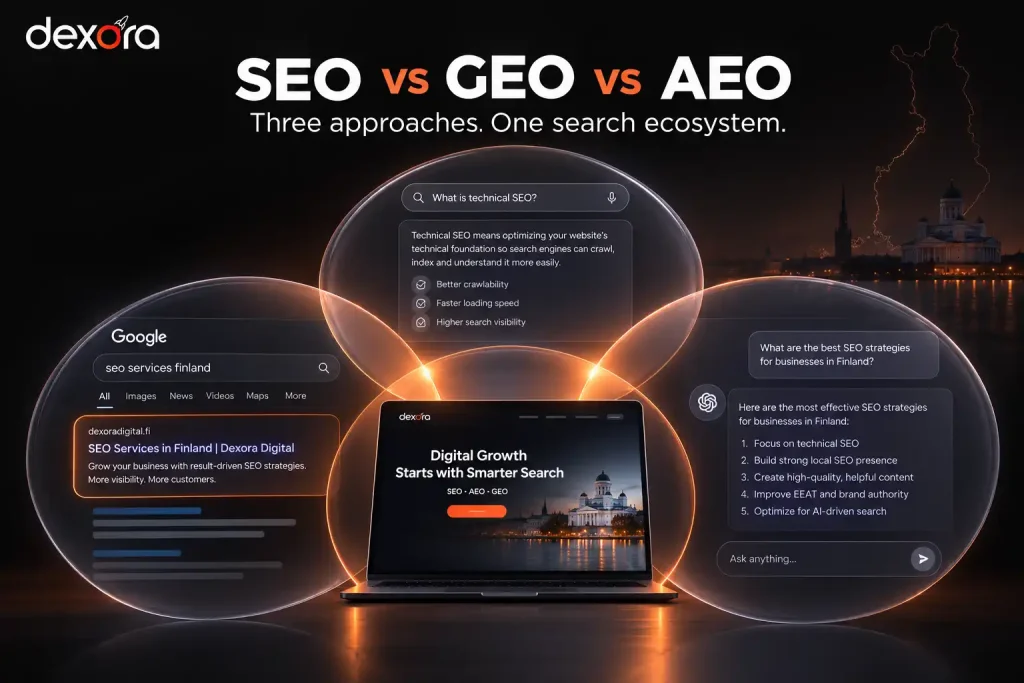
SEO, GEO and AEO are not three completely separate marketing systems. They describe overlapping approaches to making a business discoverable when people search, ask questions or use AI-generated answers. SEO, or Search Engine Optimization, is the broad foundation.
AEO, or Answer Engine Optimization, emphasizes making information easy to use when a system needs to answer a specific question. GEO, or Generative Engine Optimization, is the industry term commonly used for improving visibility when generative systems synthesize information from multiple sources.
The distinction is useful for planning, but businesses should not assume that Google operates one SEO ranking system, another AEO system and a third GEO ranking system.
Google’s current guidance is explicit: its generative AI Search features are built on core Search ranking and quality systems, and Google considers optimization for these experiences part of SEO. For Finnish businesses, the practical question is therefore not “Which acronym should we choose?”
It is:
“How do we make our business discoverable, understandable and trustworthy across both traditional and AI-assisted search?”
SEO, GEO and AEO in One Simple Comparison
The easiest way to understand the differences of SEO vs GEO vs AEO is to look at what each term emphasizes.
| Area | SEO | AEO | GEO |
| Full name | Search Engine Optimization | Answer Engine Optimization | Generative Engine Optimization |
| Primary emphasis | Organic search visibility | Clear answers to specific questions | Visibility in generated AI responses |
| Typical surfaces | Google and Bing organic results | Featured answers, conversational results, Q&A experiences | ChatGPT, Perplexity, Gemini and generative search features |
| Content focus | Pages that satisfy search intent | Direct, clear responses | Useful information that can support synthesized responses |
| Technical foundation | Crawlability, indexing, architecture | Usually depends on SEO accessibility | Usually depends on discoverable, accessible web content |
| Main measurement | Rankings, impressions, clicks, conversions | Answer visibility, impressions, conversions | Mentions, citations, referral traffic, share of visibility |
| Separate Google ranking system? | Core Search | No separate AEO system disclosed | No separate GEO system disclosed |
That last row matters. Some marketing content presents GEO as though Google has introduced a completely independent ranking algorithm for AI results.
Google does not describe it that way. Its 2026 guidance says generative AI experiences such as AI Overviews and AI Mode still rely on core Search ranking and quality systems. This is why a solid SEO strategy in Finland remains the starting point.
What Does SEO Mean in 2026?
SEO remains the discipline of improving how search engines discover, understand and evaluate web content. The fundamentals have not disappeared simply because generative AI has been added to search.
A technically inaccessible page cannot become a reliable search asset. A weak service page does not become stronger merely because it contains “AI-friendly” formatting. Poor information does not become authoritative because it has an FAQ section.
Modern SEO still depends on relevant content, technical accessibility, internal linking, useful site architecture, authority and a strong user experience.
Google’s official generative-AI guidance reinforces this point. It recommends continuing to follow foundational SEO practices, creating unique non-commodity content and making sure important information is accessible to Search.
For Dexora, this means work such as technical SEO and conventional search engine optimization remains part of AI-search readiness rather than becoming obsolete.
SEO is broader than ranking a keyword
It is tempting to define SEO as “getting position one on Google.” That is too narrow. SEO includes helping the right pages become discoverable, matching search intent, establishing clear website relationships and turning organic visibility into meaningful business outcomes.
In 2026, those same foundations can also support visibility within generative search experiences.
What Is AEO?
Answer Engine Optimization focuses on making information easy to understand when a user asks a direct question. Consider the difference between these two queries:
“technical SEO Finland”
and
“How do I know whether technical SEO problems are stopping Google from indexing my website?”
The second query demands an answer rather than simply a list of pages. AEO encourages businesses to provide that answer directly and then support it with useful context. This often means stronger question coverage, precise definitions and clearer page structure. It does not mean every paragraph must be reduced to a robotic 30-word block.
Google’s current guidance specifically warns against several supposed AI-search “hacks,” including unnecessary content chunking designed only for generative systems. Good AEO is therefore mostly good communication.
The user asks something. Your page answers it accurately. Then it provides enough evidence and context for the answer to be useful.
What Is GEO?
Generative Engine Optimization is the term marketers commonly use for increasing a brand’s visibility within generative AI experiences. A generative system may answer a question by synthesizing information rather than presenting only a traditional ranked list.
That creates a different visibility outcome. A company may care not only about whether its page ranks, but also whether its brand, expertise or information appears within the generated response.
This is where Dexora’s AI Search Optimisation Finland service fits into the wider search strategy. However, GEO needs careful language because different systems work differently.
GEO for Google is still built on SEO
Google says that its generative Search features use core Search ranking and quality systems and that its established SEO best practices remain relevant.
Google also says websites do not need special AI files, special markup or rewritten “AI versions” of pages to appear in these experiences. That means a company should be skeptical when a provider promises a secret Google GEO formula.
Other AI search platforms have their own mechanisms
ChatGPT Search should not automatically be treated as identical to Google.
OpenAI documents OAI-SearchBot as the crawler used to surface websites within ChatGPT’s search features. A site that opts out of OAI-SearchBot will not be surfaced as a search result in ChatGPT answers, although navigational links may still appear.
OpenAI also states that ChatGPT search referral URLs can carry utm_source=chatgpt.com, allowing publishers to measure referral traffic through analytics.
This is why genuine AI-search work needs platform-specific validation rather than assuming all systems behave like Google.
Where SEO, AEO and GEO Actually Overlap
Most of the work required for these three areas overlaps heavily. A technically healthy website helps SEO because crawlers can access important pages. The same accessibility also helps search systems retrieve useful information.
A detailed service page can rank for commercial queries, answer common questions and provide information that AI systems may reference. Strong authorship and original evidence can improve user trust while also making content more useful than generic summaries.
Clear entity information can help both users and machines understand who the business is and what it actually does. This is why Finnish competitors such as Digizer have increasingly adopted the position that GEO and AEO should not be treated as replacements for SEO.
The better model is:
SEO builds the foundation. AEO improves answer clarity. GEO expands the visibility objective toward generative discovery.
A business that tries to implement GEO without fixing its underlying website may therefore be optimizing the wrong layer first.
The Dexora Technical SEO Checker can be used to identify some of those foundational problems before deeper AI-search work begins.
What Changes When You Optimize for AI Search?

The main change is not that traditional SEO disappears. The change is what businesses measure and what types of questions they prepare for.
Traditional SEO often starts with a query set, identifies relevant pages and measures rankings, impressions, clicks and conversions.
AI search introduces additional questions:
Does the brand appear in relevant generated answers?
Which sources are being cited?
Which competitors appear repeatedly?
What factual information about the company is being represented?
Does the AI system understand the business correctly?
Are users reaching the site from AI-search referrals?
Those questions create a wider visibility model.
Finnish competitor Niko Alho, for example, makes measurement a major part of his GEO content, emphasizing mention and citation tracking rather than relying only on conventional keyword rankings.
That is a useful principle, although no single AI visibility check should be treated as a permanent “ranking.”
Generative outputs can vary with phrasing, context and repeated runs. Recent research also shows meaningful differences between traditional search retrieval and generative systems, reinforcing the need to measure AI search separately rather than assuming a Google ranking automatically predicts every AI response.
Should Finnish Businesses Invest in SEO, AEO or GEO First?
For most Finnish businesses, SEO should remain the first layer. If Google cannot reliably crawl important pages, the website architecture is unclear or service content is thin, jumping directly into GEO usually avoids the real problem.
Once the SEO foundation is sound, AEO and GEO considerations can be integrated naturally. A service company in Helsinki, Tampere, Turku or Oulu might first establish technically sound service pages and location relevance. It can then improve how those pages answer commercial questions.
Finally, it can measure whether the business is appearing across relevant AI-assisted discovery journeys.
A SaaS company may follow a slightly different path. Its strongest GEO opportunities could involve detailed product information, comparison pages, original research, use cases and expert documentation.
An established B2B company may need stronger third-party authority and clearer entity consistency rather than simply publishing more articles. There is no universal “GEO checklist” that fixes every company. The correct strategy depends on what the existing search footprint is missing.
That is why evidence from a company’s existing portfolio and results and clear information about who is behind the business matter when evaluating search visibility.
What Should You Avoid in AI SEO in 2026?
The biggest mistake is treating a new acronym as permission to forget established search principles. You do not need to rebuild every page around artificial “AI chunks.”
You should not chase fake third-party mentions.
You should not assume llms.txt is required for Google AI visibility.
And you should not accept a claim that a provider has discovered a guaranteed way to “rank number one in ChatGPT.”
Google directly states that special AI text files and artificial content chunking are not required for its generative Search features. It also warns against pursuing inauthentic mentions as an AI-search tactic.
The better strategy is less exciting but more defensible: make the site accessible, publish information worth using, demonstrate genuine expertise, build legitimate authority and measure how each search surface actually treats the business.
Frequently Asked Questions About SEO vs GEO vs AEO
What is the main difference between SEO, GEO and AEO?
SEO focuses broadly on search visibility, AEO emphasizes answering questions clearly, and GEO describes efforts to improve visibility within generative AI responses. Their underlying optimization work overlaps significantly.
Is GEO replacing SEO in 2026?
No. Google explicitly says traditional SEO best practices remain foundational for its generative AI Search experiences, so GEO should be treated as an additional visibility objective rather than an SEO replacement.
Is AEO the same as GEO?
Not exactly. AEO emphasizes becoming a useful direct answer, while GEO focuses more broadly on generative AI visibility. In practice, the techniques frequently overlap and terminology varies between providers.
Does Google have a separate GEO ranking algorithm?
Google has not presented GEO as a separate ranking system. Its official guidance says generative AI Search features are rooted in existing core Search ranking and quality systems.
What is AI SEO?
AI SEO is a practical umbrella term for optimizing search visibility as AI-assisted discovery expands. It can include conventional SEO, answer-focused content and generative search visibility work.
Can strong SEO help a website appear in AI answers?
Yes, particularly within Google’s ecosystem, because Google states that foundational SEO supports visibility in generative Search. Other AI platforms have their own retrieval and crawler mechanisms.
Do I need an llms.txt file for Google GEO?
No. Google’s current documentation says llms.txt and similar special AI files are not required for Google Search or its generative AI features.
How can my website become eligible for ChatGPT Search?
OpenAI recommends allowing OAI-SearchBot to access the site. It states that this crawler is used to surface websites within ChatGPT’s search features.
Is schema markup required for GEO?
There is no universal GEO schema. Relevant structured data can still help search engines understand content when correctly implemented, but adding unnecessary markup does not guarantee AI citations.
How should GEO performance be measured?
Measure relevant brand mentions, citations, source visibility, AI referral traffic and competitor appearance across repeated query sets. Combine these with normal SEO metrics rather than replacing traditional measurement entirely.
Can Dexora guarantee AI citations?
No responsible AI-search strategy should guarantee a specific citation. Generative responses can change between platforms, prompts and runs, so visibility should be monitored statistically rather than promised absolutely.
Should a Finnish company focus on GEO now?
Businesses should consider GEO when customers are using AI-assisted discovery, but it should sit on top of a strong technical, content and authority foundation rather than replace proven SEO work.
Find Out Which Search Layer Is Limiting Your Visibility
Your business does not need three disconnected strategies for SEO, AEO and GEO. It needs one search visibility strategy that works across traditional search, direct answers and emerging AI discovery.
Dexora Digital can assess whether your current limitation is technical SEO, content relevance, authority, answer coverage or AI visibility.
Book your free SEO and AI search audit and see where your business is currently being found—and where competitors are being selected instead.
For a tailored AI-search strategy for the Finnish market, contact Dexora Digital and discuss your current Google and AI visibility.