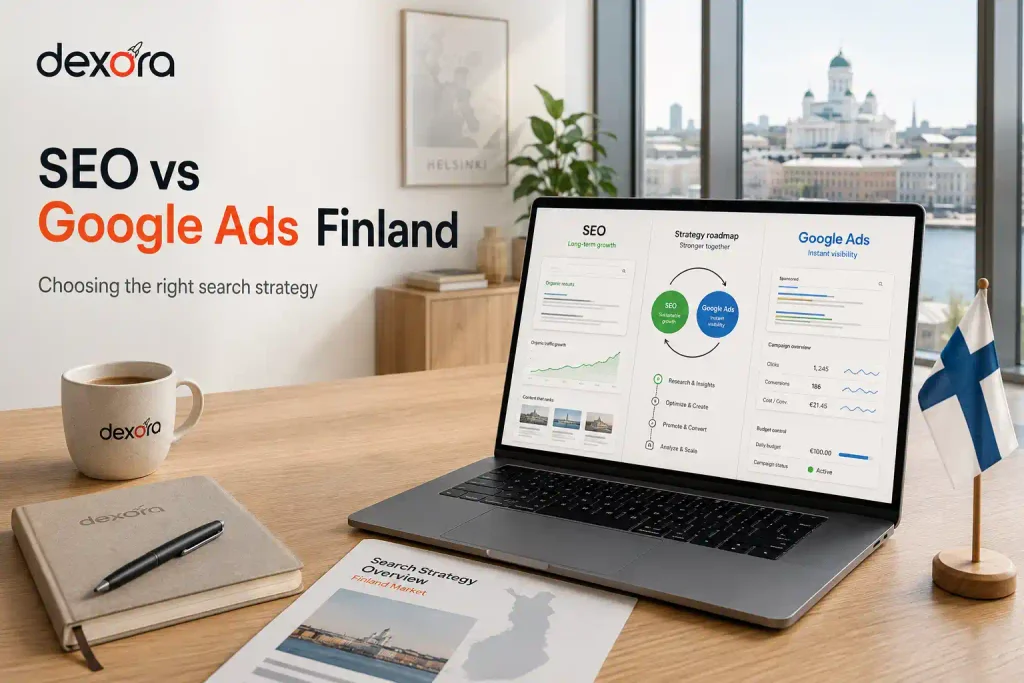
SEO and Google Ads can both generate search visibility in Finland, but they solve different business problems.
Google Ads is usually the stronger option when a company needs controlled paid visibility quickly, wants to test demand or needs traffic for a time-sensitive campaign.
SEO is usually the stronger foundation when a company wants to build organic visibility around services and topics that can continue attracting potential customers without paying Google for every individual ad click.
For many businesses, the best decision is not SEO or Google Ads. It is deciding which channel should lead first and how the two should support each other.
Google itself recommends thinking beyond a simple SEO-versus-PPC decision because the correct mix depends on what a business wants to achieve. It also confirms that Google Ads does not directly improve organic search rankings.
For companies entering or expanding within Finland, the decision also needs to account for Finnish-language search demand, competition, location, sales cycle and existing website authority.
SEO or Google Ads: The Short Answer
Choose Google Ads first when you need search visibility quickly and have a clear offer, conversion-ready landing page and budget for paid clicks.
Choose SEO first when your customers repeatedly search for your services and you want to build an organic acquisition asset over time.
Use both when you need immediate demand capture while building longer-term organic visibility.
That distinction closely matches how Finnish search-marketing specialists currently position the two channels. eLuotsi describes Google Ads as purchased visibility that can begin when a campaign starts, while SEO builds visibility through improvements to technical quality, content and authority.
SEOvelho similarly presents SEO and Google Ads as complementary channels for companies targeting Finnish searchers rather than competing products where one universally replaces the other.
The important question is therefore not:
“Which channel is better?”
It is:
“Which channel matches our current business objective?”
SEO vs Google Ads Finland: Decision Matrix
The following matrix provides a more useful comparison than simply calling one channel cheaper or faster.
| Business Consideration | SEO | Google Ads | Better Fit Depends On |
| Initial visibility | Usually develops progressively | Can begin once eligible campaigns are active | How quickly leads are required |
| Traffic cost model | No payment to Google for each organic click | Advertiser pays according to campaign/ad model | Budget and acquisition economics |
| Control over targeting | Indirect through pages, topics and optimization | Strong control over targeting, bids, ads and budgets | Need for campaign control |
| Long-term value | Strong pages can continue receiving organic traffic | Paid visibility depends on continued campaign participation/budget | Investment horizon |
| Demand testing | Slower feedback loop | Useful for rapidly testing keywords and offers | Market uncertainty |
| Competitive queries | Requires authority and strong organic execution | Can compete through auctions with sufficient relevance/budget | Search competition |
| Content requirement | Significant | Strong landing pages still important | Existing website quality |
| AI-search benefit | Strong content can also contribute to broader organic/AI discoverability | Ads and organic/AI visibility are separate systems | Wider visibility strategy |
| Measurement | Search Console + analytics | Ads platform + analytics | Tracking maturity |
| Best role | Compounding search asset | Controlled demand capture | Business objective |
Google’s own paid-and-organic reporting documentation supports viewing the channels together. It suggests using organic-query performance to uncover advertising opportunities and paid data to strengthen presence on valuable queries where organic visibility is weak.
That makes SEO vs Google Ads Finland a resource-allocation decision rather than a winner-takes-all competition.
When SEO Should Be the Priority in Finland
SEO deserves priority when search demand is established and the business has enough time to build durable visibility.
Consider a Finnish accounting company that provides bookkeeping, VAT support, payroll and financial reporting.
Potential clients may search for these services every month throughout the year.
Instead of purchasing every visit indefinitely, the company can build strong service pages, supporting content and topical authority around those recurring searches.
That is where a professional SEO strategy for Finland becomes valuable.
Scenario: an established Finnish B2B company
Imagine a B2B consultancy already receives referrals but has poor organic visibility.
Its website is several years old, commercial pages are weak and competitors dominate relevant service searches.
Launching paid campaigns may produce visibility faster, but it does not fix the underlying organic gap.
The company may benefit more from investing first in keyword mapping, content improvement, technical SEO, internal linking and authority development.
This is especially important when valuable searches occur consistently rather than around a short campaign.
Finland competitor SEOvelho also emphasizes the role of native Finnish keyword research and local search behaviour when targeting the Finnish market.
Simply translating an international keyword strategy word for word may therefore miss how Finnish customers actually describe the service.
SEO can support more than traditional blue links
Strong SEO work also creates assets that can contribute to broader search discovery.
Google has made clear that its generative AI Search experiences continue to rely on core Search systems and established SEO practices. That means useful, accessible and authoritative content can have value beyond conventional organic listings.
Businesses considering that wider opportunity can connect traditional search work with AI Search Optimisation in Finland.
SEO is therefore particularly attractive when the business is building a long-term digital presence, not simply buying traffic for the next campaign.
When Google Ads Should Be the Priority
Google Ads becomes attractive when the business needs visibility before organic rankings have had time to develop.
Google describes PPC advertising as a way to reach potential customers more immediately and adjust campaigns as business needs change.
This can be particularly useful for a new company, new service, seasonal offer or market-entry campaign.
Scenario: launching a new service in Helsinki
Suppose a company launches a high-value professional service in Helsinki.
The website has no established organic rankings for the service because the page was only recently published.
Waiting exclusively for SEO may delay useful market feedback.
A targeted Google Ads campaign can test whether people searching relevant terms actually click, enquire and convert.
That data can answer commercially important questions.
Do customers respond to the offer?
Which search themes produce qualified enquiries?
Which landing-page message works?
Which locations generate demand?
The company can then use those findings alongside organic keyword research instead of building SEO pages entirely from assumptions.
Google explicitly recommends using paid and organic performance together to identify valuable search queries and opportunities.
Google Ads gives businesses more immediate control
Paid campaigns offer direct controls that SEO does not.
A business can define campaign budgets, geographic targets, campaign schedules, keyword targeting and advertising messages.
That makes Google Ads particularly useful where timing matters.
However, rapid visibility should not be confused with guaranteed profitability.
A campaign can generate clicks while still losing money if targeting is poor, tracking is inaccurate or the landing page fails to convert.
The website itself remains part of the acquisition system.
Where the landing experience is weak, improving the website and conversion foundation may deserve attention before significantly increasing media spend.
When SEO and Google Ads Work Better Together
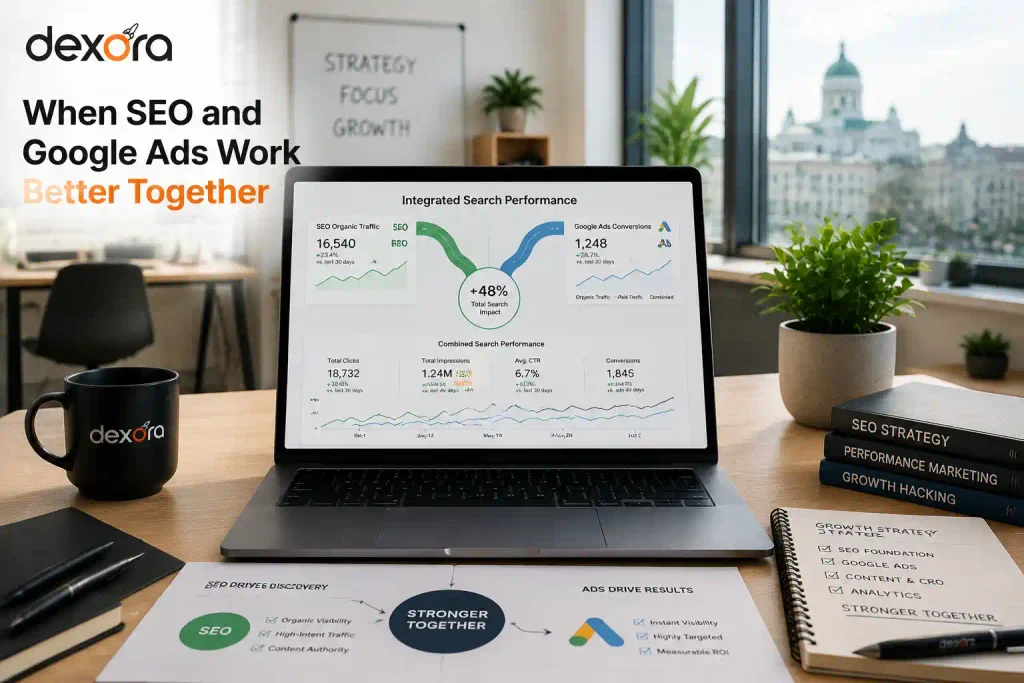
For many Finnish businesses, this is the strongest model.
Argnode describes SEO, analytics and paid advertising as a connected system: SEO creates earned visibility, advertising purchases additional visibility and analytics determines what is actually working.
Google’s own reporting tools are built around a similar principle. Paid and organic data can be reviewed together to discover additional keywords, strengthen visibility around high-value queries and measure combined search activity.
Scenario: new company entering Finland
Consider an international company entering the Finnish market.
Its domain may already have authority internationally but little Finnish-language relevance.
A sensible rollout could use Google Ads to test Finnish commercial search demand while simultaneously developing localized SEO pages.
Paid search provides faster market feedback.
SEO develops the long-term search asset.
The company can then reduce, maintain or expand advertising around individual query groups according to organic performance and commercial return.
Scenario: SEO ranks well but not for every commercial query
A company may already rank organically for many important terms.
That does not automatically mean Google Ads has no role.
Google recommends considering paid coverage for high-value queries where organic traffic is weak and using differentiated ad messaging where it adds value.
The opposite is equally useful.
If paid campaigns repeatedly demonstrate that a search term generates high-quality leads, that query may deserve a stronger organic landing page or supporting content.
The two channels can therefore exchange data instead of competing for budget blindly.
What Changes the Decision for a Finnish Business?
There is no fixed rule such as “start with SEO if your budget is €2,000” or “Google Ads always wins for local businesses.”
The right decision changes according to business economics.
A Helsinki legal firm competing for high-value enquiries may tolerate a very different acquisition cost from a small ecommerce retailer selling low-margin products.
A SaaS business with a six-month buying cycle requires a different strategy from an emergency repair company where the customer needs help immediately.
Finland also introduces language considerations.
SEOvelho emphasizes that companies targeting Finnish consumers need Finnish keyword strategy and Finnish-language content where the audience searches in Finnish. SEO Helsinki similarly offers both Finnish SEO and paid-search campaigns and describes the strategy as dependent on the client’s situation rather than a standardized formula.
That means the planning process should examine the actual market before allocating budget.
A company targeting English-speaking technology buyers in Helsinki may need a very different keyword mix from a home-service provider targeting Finnish households in Tampere.
This is also why reviewing completed digital projects and results matters when selecting a search partner. The provider should be able to connect channel strategy with the type of business rather than repeating generic SEO-versus-PPC rules.
How Should SEO and Google Ads Performance Be Compared?
Do not compare SEO clicks and ad clicks in isolation.
The meaningful comparison is what those channels contribute to the business.
For Google Ads, useful measures can include spend, qualified conversions, cost per acquisition and eventual revenue.
For SEO, the evaluation can include qualified organic traffic, non-brand search visibility, leads, assisted conversions and revenue generated from organic landing pages.
The timeframe also matters.
A one-month SEO campaign should not be evaluated against a mature advertising account as though both started from the same position.
Likewise, a three-year SEO program should not be called “free traffic.” SEO requires investment in strategy, content, technical work and authority even though Google does not charge the business for each organic click.
A stronger measurement model asks:
What did we invest? What qualified demand did the channel generate? What did those users do? What revenue or pipeline resulted? What would happen if investment stopped tomorrow?
The last question helps expose the strategic difference between an owned organic asset and paid campaign visibility.
Google also confirms one important point that businesses should keep separate when reporting: spending more on Google Ads does not increase your organic Google ranking.
That prevents misleading attribution.
For businesses unsure whether tracking or technical setup is reliable, a technical website check can uncover foundational issues before marketing performance is judged.
Which Strategy Should Your Business Choose in 2026?

Use the business situation as the decision-maker.
A new business needing leads immediately: Google Ads may deserve the initial budget while SEO is built in parallel.
An established business with recurring search demand but poor rankings: SEO may deserve the larger strategic investment.
A company launching a new product or market: Ads can test demand before committing heavily to organic content.
A business already receiving strong paid-search conversions: use that conversion data to identify SEO opportunities.
A company ranking organically but missing strategic high-value searches: targeted Google Ads may fill the gap.
The most effective strategy may change over time.
That is why Dexora Digital approaches search engine optimization as part of a wider acquisition strategy rather than treating channel selection as permanent.
Before investing heavily in either channel, businesses should know their current technical condition, existing visibility, competitors, search demand, conversion rate and acquisition economics.
A free SEO audit can provide the organic baseline before a broader growth plan is built.
Frequently Asked Questions About SEO vs Google Ads Finland
Is SEO better than Google Ads in Finland?
Neither is universally better. SEO is suited to building organic visibility over time, while Google Ads provides paid visibility and greater campaign control. The best choice depends on goals.
Which works faster, SEO or Google Ads?
Google Ads can begin generating eligible paid visibility after a campaign goes live, while SEO generally requires search engines to crawl, evaluate and rank improved pages over time.
Does Google Ads improve SEO rankings?
No. Google explicitly states that paid-search investment has no impact on organic search ranking because its advertising and organic Search systems are kept separate.
Is SEO cheaper than Google Ads?
Not automatically. SEO requires investment in expertise, content, technical improvements and authority, while Google Ads requires campaign management plus advertising spend. Compare total acquisition cost rather than click price alone.
Should a new Finnish business start with Google Ads?
Google Ads can be useful when a new company needs demand data and visibility quickly. SEO should still be developed when recurring organic search demand exists.
Can SEO and Google Ads run together?
Yes. Google itself provides paid-and-organic reporting specifically to help advertisers compare both channels and identify queries where combined visibility may provide additional value.
Should I use Google Ads while waiting for SEO results?
This can be sensible when immediate demand exists and paid acquisition is commercially viable. Ads can provide search data while technical, content and authority improvements develop organic visibility.
Does SEO traffic stop if I stop paying Google?
Google does not charge per organic click. However, SEO performance still requires maintenance and can change due to competitors, website changes and Google’s search systems.
How much should I spend on Google Ads in Finland?
There is no universal budget. Required spend varies according to industry, query competition, geography, conversion rate, customer value and campaign objectives.
Is Finnish-language SEO necessary in Finland?
It is important when target customers search in Finnish. Finnish-market competitors emphasize native-language keyword research and localized content rather than relying solely on translated international strategies.
Can Google Ads help identify SEO keywords?
Yes. Google recommends comparing paid and organic search data to discover additional keywords and identify high-value queries where one channel currently has weaker coverage.
Is SEO useful for AI search as well?
A strong SEO foundation remains relevant to Google’s AI-assisted Search experiences because Google’s generative features continue to rely on its broader Search ranking and quality infrastructure.
What should I measure besides traffic?
Measure qualified enquiries, conversions, customer acquisition cost, revenue and pipeline contribution. Traffic without commercial value should not determine which channel receives more investment.
Build the Right Search Mix for Your Business
You do not need to choose SEO or Google Ads based on generic advice.
You need to know where demand exists, how quickly you need results, what a customer is worth and which search opportunities your competitors already control.
Dexora Digital can review your current organic visibility, technical SEO, search competition and conversion opportunities and use that baseline to determine where SEO, paid search or a combined strategy makes the most sense.
Request your free SEO audit as the first step.
For a tailored SEO + paid-search growth plan for Finland, contact Dexora Digital and build the channel mix around your actual business goals rather than assumptions.