
Why does one business appear near the top of Google Maps while another similar business barely appears at all?
Google gives a surprisingly direct answer.
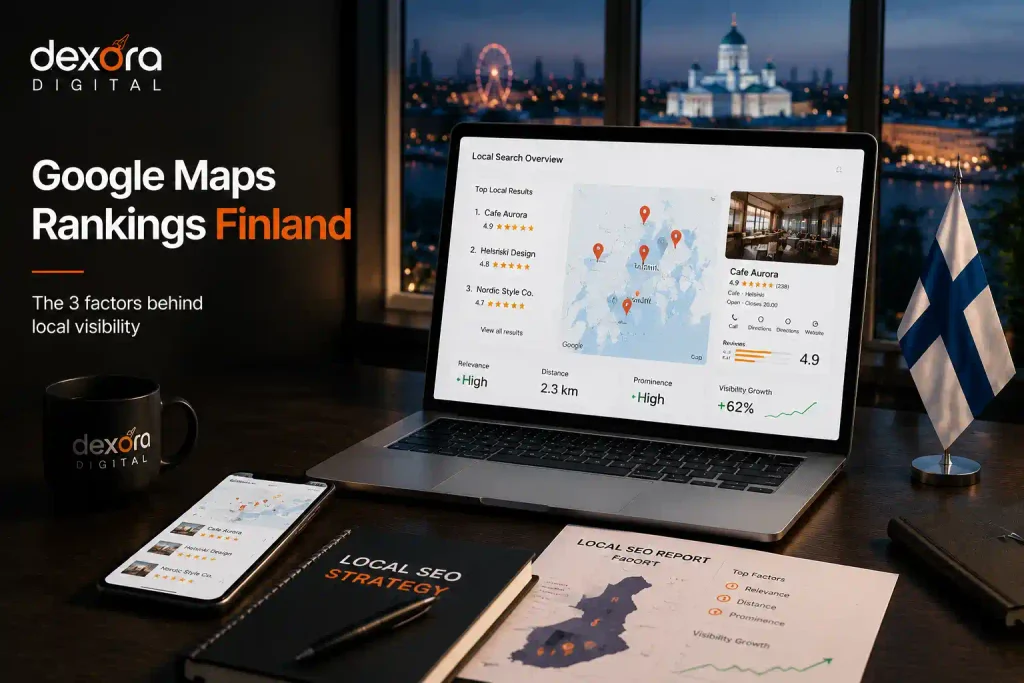
For local results, Google says it mainly evaluates relevance, distance and prominence. These factors work together to determine which businesses are the best match for a local search.
For businesses using Google Maps SEO in Finland, understanding these three factors is more useful than chasing hundreds of supposed ranking hacks.
A Helsinki dentist, Tampere electrician, Turku restaurant and Oulu accounting firm can all compete in local search, but their rankings will vary according to how closely they match the query, where the searcher is located and how established Google considers the business.
That makes Google Maps Ranking Factors optimization an important part of a wider SEO strategy in Finland, rather than a separate shortcut for reaching position one.
What Are Google’s 3 Local Ranking Factors?
Google’s three local ranking factors are relevance, distance and prominence.
Relevance measures how closely a Business Profile matches what the user wants.
Distance considers how far the business is from the searcher or specified location.
Prominence reflects how well-known and established the business appears.
Google says these factors are combined to find the best local match. It also states there is no way to request or pay Google for a better local ranking.
This is important because Maps SEO is sometimes marketed as though one action—adding keywords, posting every week or collecting a certain number of reviews—automatically produces top-three rankings.
Google does not describe the system that way.
A useful way to think about it is:
| Google Factor | Core Question | What You Can Influence | What You Cannot Fully Control |
| Relevance | Does this business match the search? | Categories, services, website content, accurate profile information | The user’s exact intent |
| Distance | Is this business geographically appropriate? | Accurate address, map pin and legitimate service-area information | Where the searcher is physically located |
| Prominence | How established is this business? | Reviews, website authority, links, mentions and reputation | Google’s complete weighting of those signals |
The remainder of this guide explains each factor separately and shows where optimization actually makes sense.
1. Relevance: How Well Does Your Business Match the Search?
Google defines relevance as how closely a Business Profile matches what someone is searching for. It recommends providing complete and detailed business information so Google can better understand the company and connect it with relevant searches.
Suppose someone in Espoo searches:
“emergency dentist near me”
Google needs to determine which profiles genuinely represent dentists, which provide emergency care and which are appropriate for that search. The business category therefore matters.
Google’s Business Profile guidelines advise businesses to choose the fewest categories necessary to describe the core business and to select categories that accurately represent what the company actually is. That means categories should not be used simply as a place to add keywords.
Your primary category deserves careful selection
Practitioner research supports the importance of categories.
The 2026 Local Search Ranking Factors survey places the primary Google Business Profile category among the most influential observed Local Pack factors. However, this is an expert survey rather than confirmation of Google’s exact algorithmic weights.
The practical lesson is straightforward. If a business’s primary category poorly represents its core service, Google receives a weaker relevance signal. The solution is not to add every possible category. Google specifically advises using as few categories as possible while accurately describing the overall business.
Relevance also comes from the website
The Business Profile does not exist in isolation. The linked website should clearly explain what the company provides, where it operates and which customers it serves.
A vague homepage saying “we provide innovative solutions” tells both users and search engines much less than clear service information. This is where conventional search engine optimization supports local Maps visibility.
Finnish competitor Digiverstas takes a similar approach, connecting Google Business Profile optimization with website content, technical foundations, reviews, links and consistent local information.
For Dexora, the stronger strategy is to ensure the profile and website tell the same factual story.
2. Distance: Why Location Changes Google Maps Rankings
Distance is the factor businesses have the least ability to manipulate legitimately. Google defines it as the distance between a business and the person performing the search. When the user does not specify a location, Google can estimate distance using what it knows about that user’s location. This explains why Google Maps rankings are not fixed.
A plumber might appear highly for one person in Tampere but much lower for someone searching the same phrase from the other side of the city.
Nothing necessarily changed about the business. The searcher’s location changed.
You cannot SEO your way out of geography
This is an important limitation to communicate honestly.
A company cannot simply optimize its profile until physical distance stops mattering. Industry research continues to identify proximity to the point of search as one of the strongest observed Maps factors. That makes local rank tracking very different from normal national keyword tracking.
Instead of checking “plumber Tampere” from one browser and recording a single ranking position, businesses should evaluate visibility across the geographic area they actually serve. Waahtera Web Designs makes this distinction in its Finnish local SEO offering by tracking rankings specifically within Maps results.
Keep your location information legitimate
Google’s guidelines require businesses to use accurate addresses and service areas. Virtual offices are generally not eligible unless the business genuinely operates there under Google’s stated conditions, and businesses should not create duplicate profiles merely to target additional areas.
That means creating fake Helsinki, Espoo and Vantaa offices to manipulate distance is not a defensible local SEO strategy. For service-area businesses, Google allows companies that travel to customers to define legitimate service areas and, where appropriate, hide residential addresses.
The correct approach is to represent the real business accurately and strengthen the factors you can control.
3. Prominence: How Established Does Google Think Your Business Is?
Prominence is where local SEO becomes broader than Business Profile configuration. Google describes prominence as how well-known a business is.
Its official guidance specifically mentions information such as websites linking to the business and the number of reviews, and Google states that more reviews and positive ratings can help local ranking.
This means prominence develops across the wider web. A company with a strong reputation, useful website, legitimate external mentions, customer reviews and relevant links gives Google more evidence that it is an established business.
Reviews contribute to prominence
Reviews matter for potential customers and local visibility. The goal should be a steady process of requesting genuine reviews from real customers rather than suddenly manufacturing large volumes of feedback.
VisibleLocal places review management at the center of its Finland-focused local SEO work, while Google’s own guidance recommends responding to customer reviews and keeping profile information useful for customers.
Businesses should also remember that a review strategy is not only about star ratings. Detailed genuine feedback can help future customers understand what the business actually does and what previous customers experienced.
Website authority supports local prominence
Google explicitly includes links from other websites when explaining prominence. A business should therefore build authority through legitimate relationships, relevant industry directories, useful content, partnerships, press coverage and other genuine references. That is very different from purchasing hundreds of irrelevant directory links.
A company’s own website also needs a credible foundation. An informative About Us page and documented portfolio or case studies provide stronger evidence of a real organization than unsupported claims such as “Finland’s leading company.”
How to Optimize a Google Business Profile Around the 3 Factors
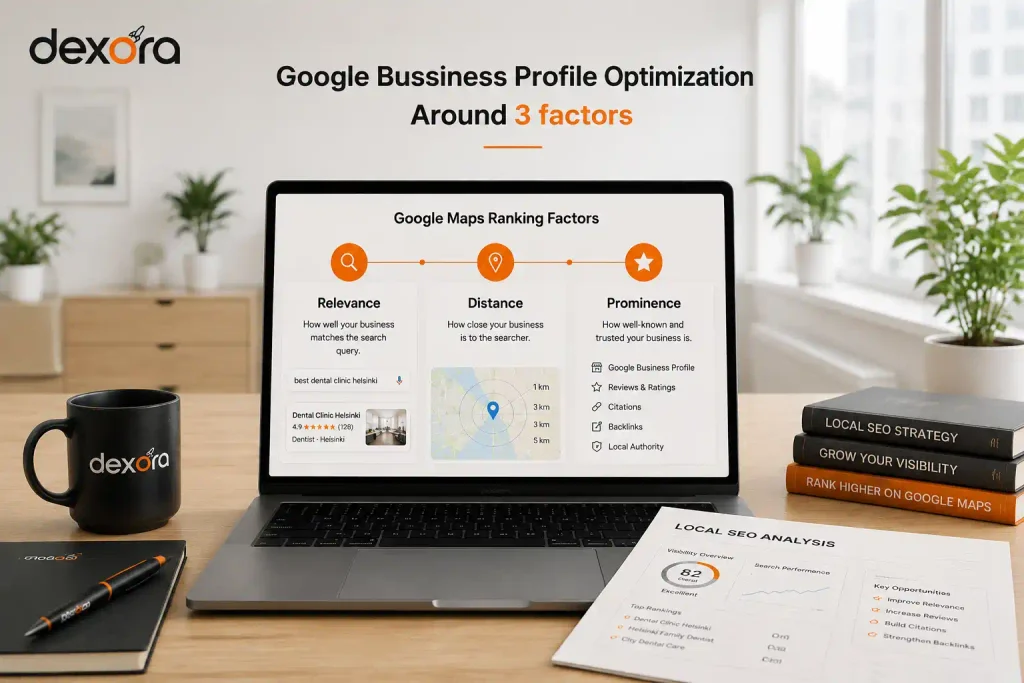
Once relevance, distance and prominence are understood, optimization becomes much easier to prioritize.
Start with relevance. Confirm the real business name, primary category, additional categories, services, address or service area, opening hours, phone number and website.
Google’s guidelines are explicit that the Business Profile should represent the company as it exists in the real world. Unnecessary keywords in the business name can violate Business Profile guidelines.
Then check distance-related accuracy. Make sure the map location, address and service area reflect real operations. Do not create artificial locations just to expand Maps coverage.
Finally, work on prominence over time through genuine reviews, stronger website content, relevant links, business mentions and reputation development. The underlying website also needs to remain technically accessible.
If Google encounters broken pages, incorrect redirects, poor architecture or indexation problems, those issues can weaken the overall search foundation. Dexora’s technical SEO service and Technical SEO Checker can help identify those underlying issues. This integrated approach is also what separates mature local SEO from basic GBP setup.
What Google Does Not Say Is a Ranking Factor
Google’s official documentation is valuable partly because of what it does not claim. It does not publish a percentage weighting for relevance, distance and prominence.
It does not say publishing a certain number of Google Posts guarantees higher rankings. It does not say adding keywords repeatedly to the Business Profile description will move a company into the Local Pack.
And it does not provide a formula such as “50 reviews equals position three.”
Industry studies can help identify patterns, but they need to be labeled correctly.
For example, the Whitespark 2026 Local Search Ranking Factors report evaluates Google Business Profile, reviews, on-page signals, links, behavior, citations and personalization. Its authors explicitly state that participating experts do not have special access to Google’s internal algorithm; the findings come from professional testing and observation.
That makes the study useful evidence, but not Google documentation.
BrightLocal’s January 2026 analysis similarly uses the Whitespark survey to highlight primary categories, proximity, ratings, review text and other observed factors.
A professional local SEO strategy should use both sources appropriately:
Google documentation tells us what Google officially confirms. Industry testing helps us decide what deserves practical attention within those broad factors.
How Should Google Maps Rankings Be Measured?
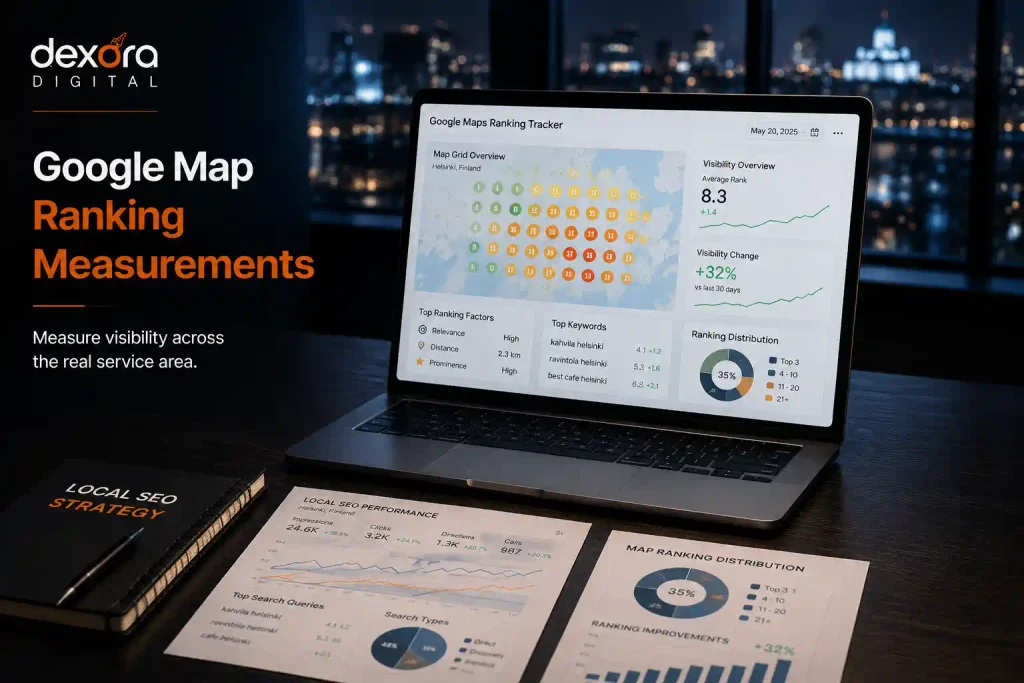
Searching your own business name from the office is not a reliable local SEO report. Distance means rankings can vary significantly across a city or service area. A business should therefore measure relevant non-branded searches across the geographic market rather than relying on one fixed location.
For example, an Oulu company may want to understand visibility across multiple points within Oulu rather than recording a single result for “service + Oulu.”
The measurement should also separate:
Maps visibility from organic website rankings.
A company can perform strongly in normal organic results while having weak map visibility, or the reverse.
Waahtera specifically emphasizes Maps-specific ranking measurement in its local SEO approach, while VisibleLocal focuses its reporting on changes in local visibility and where customers find the business.
For companies also monitoring emerging discovery surfaces, local entity clarity and website authority can feed into a broader AI Search Optimisation Finland strategy, although Maps rankings and generative AI visibility should still be measured separately.
Common Google Maps SEO Mistakes in Finland
The first mistake is trying to manipulate relevance by stuffing extra keywords into the business name. Google requires the profile name to match the company’s real-world name and warns that unnecessary information can lead to profile problems or suspension.
The second mistake is trying to manipulate distance using fake offices or duplicate locations. Google requires accurate real-world addresses and has specific eligibility rules for virtual offices, co-working locations and service-area businesses.
The third mistake is focusing entirely on the Business Profile while neglecting the website. Your website supports service relevance, local content, authority, internal linking and conversion after someone discovers the company.
A fourth mistake is obsessing over one Maps ranking. Because location affects results, a single manually checked position tells you very little about visibility across the wider market.
Finally, businesses should avoid believing anyone who guarantees a particular Maps position. Google itself states there is no way to request or pay for better local rankings.
Frequently Asked Questions About Google Maps Ranking Factors
What are the three Google Maps ranking factors?
Google says local results are mainly determined by relevance, distance and prominence. Together, they help Google decide which eligible businesses provide the strongest match for a user’s local search.
What does relevance mean in Google Maps?
Relevance describes how closely a Google Business Profile matches what someone searches for. Complete business information, appropriate categories and clear service information help Google understand what the company actually provides.
What does distance mean for local SEO?
Distance considers how far a business is from the searcher or location specified in the query. When no location is stated, Google can estimate location using available information.
What does prominence mean in Google Maps?
Prominence describes how established or well-known a business appears. Google says factors can include links from other websites, review quantity and positive ratings, alongside broader information about the business.
Do Google reviews improve Maps rankings?
Google states that more reviews and positive ratings can help local ranking. Reviews should still come from genuine customer experiences rather than artificial campaigns designed only to manipulate visibility.
Does the Google Business Profile category affect rankings?
Categories strongly affect how accurately a business can be matched to relevant searches. Google recommends selecting specific categories that describe the core business rather than using categories simply as keywords.
Can I rank in Google Maps far from my business address?
Possibly, but distance remains an important factor. Visibility can change across a city, and strong relevance or prominence does not give businesses complete control over geographic proximity.
Can I add keywords to my Google Business Profile name?
Only when those words are genuinely part of the real-world business name. Google prohibits unnecessary service, location or marketing information added merely to expand the Business Profile name.
Do Google Posts improve Maps rankings?
Google does not officially identify posting frequency as one of its three local ranking factors. Posts can still communicate useful information to customers even without a confirmed direct ranking benefit.
Does my website affect Google Maps SEO?
Yes, website content and authority contribute to the wider local-search ecosystem. Google explicitly references links to a business when discussing prominence, while practitioner research also identifies on-page factors as important.
How should a service-area business optimize Google Maps?
Use one legitimate Business Profile for the real operating location, define accurate service areas and hide the address when customers are not served there, following Google’s eligibility guidelines.
Can an SEO agency guarantee top-three Google Maps rankings?
No. Google says businesses cannot request or pay for improved local ranking, and distance varies by searcher. A credible provider can improve controllable signals but cannot guarantee a fixed Maps position.
How can I check my Google Maps visibility properly?
Track relevant non-branded searches from multiple geographic points across the actual service area. Compare Maps visibility separately from normal organic rankings and monitor calls, enquiries and other customer actions.
Improve the Google Maps Factors You Can Actually Control
You cannot move every searcher closer to your business.
But you can improve how clearly Google understands your services, how accurately your Business Profile represents the company and how much genuine authority supports your business online.
That is where local SEO should focus.
Request a free SEO audit from Dexora Digital to identify the website, technical and local-search issues that may be limiting your visibility.
For a tailored Google Business Profile and Finland local-search strategy, contact Dexora Digital and build your growth plan around relevance, distance and prominence—not unverified ranking hacks.