
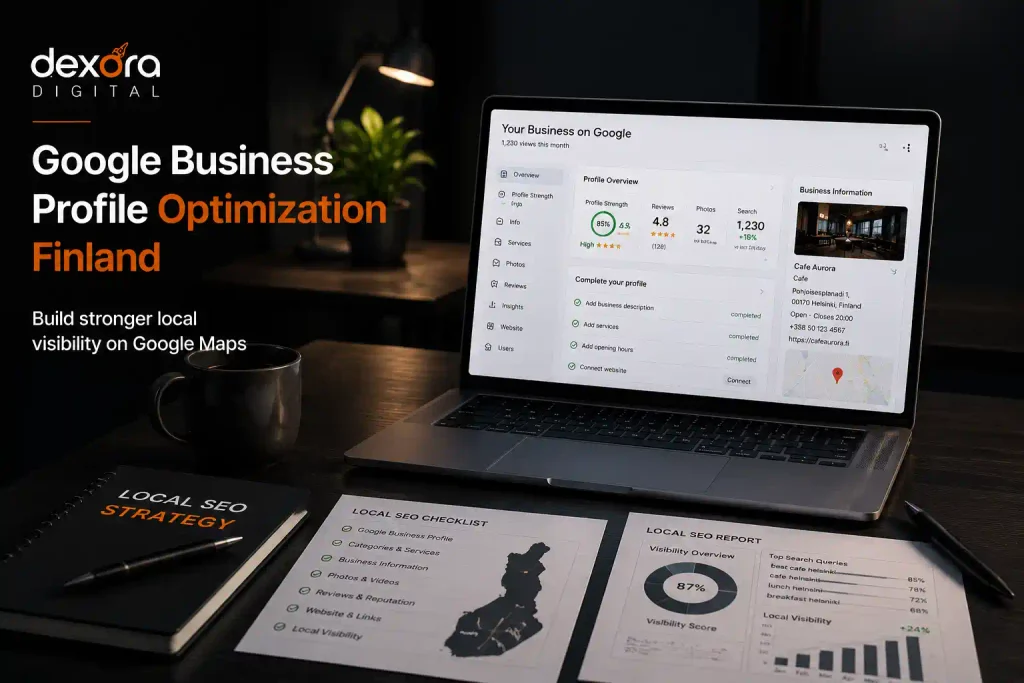
Google Business Profile optimization Finland means making your business information complete, accurate and useful so Google and potential customers can clearly understand what you offer, where you operate and how customers can engage with you.
For an eligible local business, the profile can appear across Google Search and Maps and may display information such as your category, location, service area, hours, phone number, website, services, photos and customer reviews. Google recommends verification, complete information, review responses, and useful photos and videos as part of maintaining a strong local presence.
The optimization goal is not to fill every field with keywords.
Google says local results are mainly determined by relevance, distance and prominence. A well-maintained profile can strengthen the information Google uses to understand the business, but no legitimate optimization can simply remove the geographic effect of distance or guarantee a top-three Maps position.
For Finnish businesses, GBP should therefore operate together with broader SEO services in Finland rather than being treated as an isolated listing.
What Does Google Business Profile Optimization Mean in Finland?
A complete profile should answer the same questions a potential customer would ask before contacting a business:
Who are you? What do you provide? Where do you operate? When are you available? How can I contact or visit you? Why should I trust the information?
This is particularly important for searches such as:
“dentist Espoo”
“accountant Oulu”
“hair salon Turku”
“plumber Tampere”
or a generic “near me” search where Google already has location context.
Finnish competitor Miia Kuisma uses city and neighbourhood examples effectively to explain this intent, while Design Inspis demonstrates how local profiles can occupy prominent visual space in searches such as “kahvila Helsinki.”
A professional optimization strategy should therefore focus on business accuracy first, relevance second, conversion quality third and ongoing measurement after that.
That approach also aligns GBP work with wider search engine optimization instead of creating two disconnected strategies.
Complete Google Business Profile Optimization Checklist
Google currently allows businesses to manage a substantial set of profile information. Some options vary by category, region or eligibility, so not every field will appear for every Finnish company.
Use this table as the main audit checklist.
| GBP Field or Check | What to Review | Recommended Optimization |
| Ownership | Is the correct company controlling the profile? | Claim and verify the legitimate business profile |
| Business name | Does it match real-world branding? | Use the actual business name without adding promotional keywords |
| Primary category | Does it describe the core business? | Select the most specific accurate primary category |
| Additional categories | Are genuine secondary activities covered? | Add only relevant categories; Google currently supports up to nine additional categories |
| Address | Is the customer-facing location accurate? | Use a precise real-world address where customers are actually served |
| Map pin | Does the pin identify the correct premises? | Correct inaccurate pin placement |
| Service area | Does the company travel to customers? | Define genuine cities, postal codes or other areas served |
| Main hours | Are normal operating hours correct? | Update whenever business hours change |
| Special hours | Are holidays and temporary changes covered? | Add special hours before Finnish holidays or exceptional closures |
| Phone | Is the main contact number current? | Use the authoritative business phone number |
| Website | Does the URL lead to the best local page? | Link to the most appropriate crawlable website page |
| Appointment/order links | Are category-specific links available? | Use relevant booking, reservation or order links when eligible |
| Business description | Does it clearly explain the company? | Describe real services, differentiators and history naturally |
| Services | Are actual services represented? | Add and maintain accurate service names and available prices where appropriate |
| Attributes | Are relevant customer features shown? | Complete factual attributes available for the category |
| Opening date | Is company history accurate? | Add the real month and year when useful |
| Social links | Are supported profiles available? | Add legitimate social profiles where the feature is available |
| Photos | Do images accurately represent the business? | Add current exterior, interior, team, service or product images |
| Videos | Can visual content improve customer understanding? | Add genuine, policy-compliant videos where relevant |
| Reviews | Is there a sustainable review process? | Request genuine feedback and respond professionally |
| Posts | Does the business have timely updates? | Publish useful offers, events or announcements where appropriate |
| Q&A | Is the feature available for your profile? | Answer genuine customer questions accurately |
| NAP consistency | Do external business references agree? | Correct conflicting name, address and phone information |
| Performance | Are customer interactions measured? | Monitor searches, views, calls, clicks, directions and other available actions |
Google specifically says the business name should match real-world signage and branding, categories should represent what the business actually does, service areas should be accurate, and the business description should focus on useful company information rather than promotional gimmicks.
Categories and Services: Get Relevance Right First
Among all editable fields, category selection deserves particularly careful attention.
Google tells businesses to select the category that best matches what they do and not to use categories merely as keywords. The first selected category becomes the primary category, while up to nine additional categories can currently be added.
Practitioner evidence points in the same direction. Whitespark’s 2026 Local Search Ranking Factors survey places the primary GBP category at the top of its observed Local Pack factors, while relevant additional categories also score highly. Whitespark clearly notes, however, that the study reflects expert testing and observations rather than Google’s internal algorithm.
Primary category example
Suppose a business in Helsinki primarily operates as an orthodontic clinic but also provides broader dental services.
The primary category should represent the main real-world business, not whichever phrase appears to have the highest keyword volume. Additional accurate categories can then cover genuine secondary activities.
The same principle applies to a Tampere electrician, Turku restaurant or Oulu marketing consultancy. Do not make the profile look relevant by making it inaccurate.
Services should match the real offering
Where Google’s services editor is available, describe the services customers can genuinely purchase. This is particularly useful when the business category alone is too broad.
For example, an accounting firm’s profile may distinguish bookkeeping, payroll and VAT-related services if those services are genuinely offered.
The corresponding website should explain those services in greater depth. GBP should not be expected to replace a properly optimized commercial website.
If the underlying site has crawlability or indexation problems, address those through technical SEO before assuming weak Maps performance is purely a profile issue.
Reviews, Photos and Profile Content Should Build Trust
Google explicitly recommends responding to reviews and adding photos and videos. It also states that more reviews and positive ratings can help local ranking as part of prominence. That does not mean a company should chase reviews unnaturally.
A better process is to request genuine feedback consistently after real customer interactions. Google now provides businesses with a direct review link or QR code that can be shared with customers, which makes a compliant review-request process easier to operationalize.
Respond to both positive and negative reviews
A useful response should acknowledge what the customer actually said. Avoid copying the same generic response onto every review.
Finland competitor Fonecta dedicates separate content to review management and emphasizes how strongly reviews influence customer perception, while VisibleLocal similarly makes review collection and responses a central part of its local-search service.
For ranking claims, however, use Google’s guidance as the source of truth: Google confirms review quantity and positive ratings can contribute to local prominence, while it does not publish a formula saying a particular response rate guarantees higher positions.
Use media to answer customer questions visually
A restaurant in Helsinki might show its dining area and dishes.
A dental clinic could show the entrance, reception and facility.
A contractor could show real completed work and recognizable equipment.
A retail business could show the storefront so customers know what to look for when arriving.
Google specifically says an exterior photo can help customers recognize the business when they visit.
Media should be current and representative rather than stock imagery that tells customers little about the actual business.
Posts can also communicate timely information such as offers or events where that profile functionality is available, but Google does not present posting frequency as a guaranteed local-ranking formula. Posts should therefore be created primarily because they are useful to customers.
Your Website Still Matters for Google Maps SEO
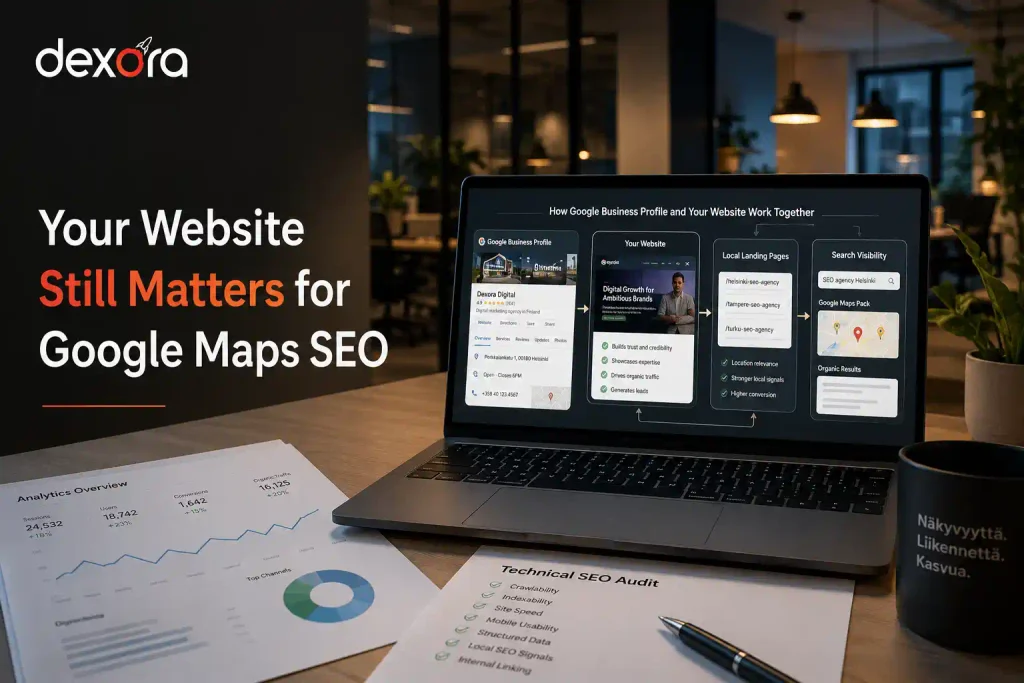
One of the clearest competitor patterns in Finland is that stronger local SEO pages do not treat GBP optimization as a standalone task.
Waahtera combines Business Profile work with regional pages, technical SEO, directories and Maps rank tracking. Netello connects GBP with NAP consistency and localized website optimization. Meio describes local SEO as the interaction between GBP, location signals, website content and trust.
That approach is sound. Google’s prominence explanation specifically references information available across the web, including links to the business. The website should therefore reinforce the same entity information found on the profile.
A local landing page should clearly communicate the service, operating area, company identity and next action.
The site’s technical foundation matters too. A broken canonical, blocked page, incorrect redirect or poor mobile implementation can weaken the website side of the local-search ecosystem. Businesses can use the Technical SEO Checker for an initial diagnosis.
Where the site itself needs structural improvements, website development may be more important than repeatedly editing the Business Profile.
Company information should also be consistent with authoritative first-party pages such as About Dexora Digital, while genuine project evidence belongs within a credible portfolio.
This consistency also supports wider entity clarity as search becomes more AI-assisted, which connects local SEO with broader AI Search Optimisation in Finland.
How Should Different Finnish Business Types Configure GBP?
The correct setup depends on how the company actually serves customers.
Storefront business
Consider a physiotherapy clinic in Espoo where customers visit a permanent clinic.
The profile should show the legitimate physical address, correct pin, opening hours, appropriate category, services, contact details and representative images.
The website should reinforce Espoo relevance naturally rather than inserting the city name into every sentence.
Service-area business
Now consider a plumbing company based in Tampere that travels to customer properties and does not serve customers at its business address.
Google classifies this as a service-area business. Such companies can hide their address and define areas where they deliver or visit customers.
Google’s guidelines say the overall service-area boundaries generally should not extend more than about two hours of driving time from the business base.
Adding Helsinki, Turku, Oulu and every major Finnish city simply to appear nationally would therefore be inappropriate if those areas do not represent genuine operations.
Hybrid business
A hybrid business serves customers at its premises and travels to customers.
An auto repair workshop that also provides roadside assistance is Google’s own type of example for this model.
The profile can represent both the real location and legitimate service coverage.
Multi-location company
If a company genuinely operates in Helsinki, Tampere and Turku through separate staffed locations, each eligible location may need its own properly managed profile.
The website should then connect each real location with appropriate location-specific information.
Avoid creating profiles for virtual offices, mailboxes or locations where the company does not genuinely operate. Google requires accurate real-world representation and has specific eligibility rules for these situations.
How to Measure Google Business Profile Performance
Optimization is incomplete without measurement.
Google Business Profile Performance can provide data about views, clicks and customer interactions across Search and Maps. Google also now supports connecting Business Profile and Google Analytics so interactions such as website clicks, calls, directions, messages, bookings and eligible menu activity can be shared into Analytics.
Do not reduce reporting to one keyword position.
Local rankings change according to location because distance is part of Google’s local-ranking model.
A useful monthly review should instead answer:
Are more relevant customers discovering the profile?
Which searches or areas are improving?
Are calls, website visits, bookings or directions increasing?
Are reviews growing naturally?
Have business details changed?
Are competitors gaining visibility in parts of the service area where we are weak?
Waahtera’s Finland offering makes a useful distinction by tracking Maps positions specifically rather than treating normal organic rankings as interchangeable with local-pack visibility.
For businesses needing a broader diagnosis, Dexora’s free SEO audit can evaluate the profile alongside the website and wider search footprint.
Common Google Business Profile Optimization Mistakes
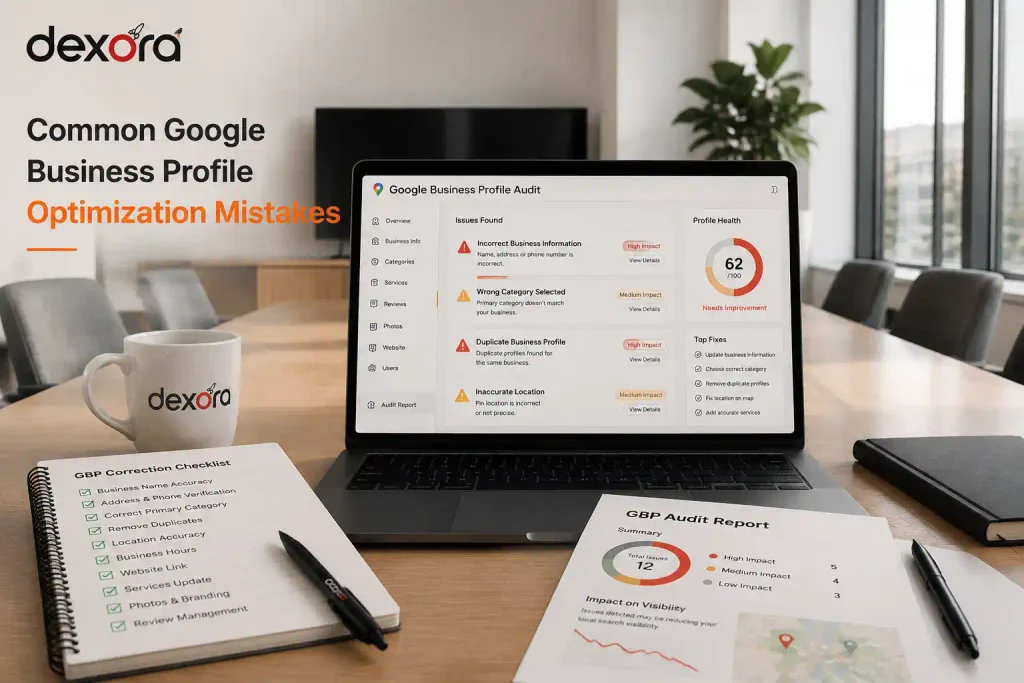
The most serious mistakes usually come from trying to force relevance or proximity instead of accurately representing the business.
Keyword stuffing the company name is one example. Google says the profile name should reflect the real-world business name.
A second problem is using categories that represent services, features or nearby businesses rather than the core company.
A third is maintaining an inaccurate address or artificially wide service area.
A fourth is assuming an optimized profile can compensate for a poor website.
A fifth is neglecting exceptional Finnish operating hours. Christmas, Midsummer and other closures should be reflected through special hours when relevant so users do not arrive at a closed business.
Another common problem is treating profile completion as a one-time project.
Google can review edits before they appear and may also collect or update information from other sources. Businesses therefore need to periodically confirm that profile information remains accurate.
A professional GBP audit should ultimately check accuracy, eligibility, relevance, conversion quality, website alignment and performance, not merely whether the profile has reached an arbitrary completion percentage.
Frequently Asked Questions About GBP Optimization in Finland
What is Google Business Profile optimization?
Google Business Profile optimization is the process of improving the accuracy, completeness and usefulness of a company’s profile so customers and Google can better understand the business in Search and Maps.
Is Google Business Profile free in Finland?
Yes. Eligible businesses can create and manage a Google Business Profile without paying Google for the listing itself, although professional setup or ongoing optimization services may have separate costs.
Does Google Business Profile help local SEO?
Yes. Google uses Business Profile information to understand local businesses, while local results are mainly influenced by relevance, distance and prominence. Complete accurate information can support stronger relevance.
What is the most important GBP category?
The primary category should be the most specific accurate description of the core business. Practitioner research rates it highly, but category choice must still follow Google’s representation guidelines.
How many additional categories can a Business Profile have?
Google currently allows businesses to add up to nine additional categories alongside the primary category. They should represent genuine secondary business activities rather than being added simply as keywords.
Should I add keywords to my Google Business Profile name?
Only when those words are genuinely part of the real business name. Adding service or location keywords solely to influence visibility can violate Google’s Business Profile guidelines.
Do Google reviews help Maps rankings?
Google states that more reviews and positive ratings can help local ranking as part of prominence. Reviews also influence how potential customers evaluate a company before contacting it.
Should businesses respond to every Google review?
Responding consistently is a strong customer-service practice. Google recommends responding to reviews because helpful responses demonstrate that the business values customer feedback and can help the profile stand out.
Are photos important for Google Business Profile optimization?
Yes for customer experience. Google recommends adding photos and videos, and accurate images of premises, products or services help potential customers understand and recognize the real business.
How should a service-area business in Finland set up its profile?
It should use its legitimate business base, hide the address when customers are not served there, and define genuine service areas rather than creating artificial locations across Finland.
Can I create Google Business Profiles for several Finnish cities?
Only when each profile represents a genuinely eligible business location or operation under Google’s guidelines. Virtual locations created mainly to improve Maps visibility can create policy and suspension risks.
Does posting every week improve Google Maps rankings?
Google does not officially state that a specific posting frequency improves Maps rankings. Publish posts when they provide useful, timely information to customers rather than treating frequency as a guaranteed ranking tactic.
How often should a Google Business Profile be audited?
Review important information whenever the business changes and run a structured periodic audit of hours, services, categories, reviews, media, website links and performance so inaccurate information does not remain live.
Can a fully optimized GBP guarantee the Local Pack?
No. Google says local results use relevance, distance and prominence together and explicitly states businesses cannot request or pay for better organic local ranking.
Request a Google Business Profile Audit
A Google Business Profile should do more than simply exist.
It should accurately represent your company, match the searches your real customers make, reinforce your website and give potential customers enough confidence to take the next step.
Dexora Digital can review your profile’s categories, services, location setup, reviews, media, website alignment, local competitors and Maps visibility to identify what deserves attention first.
Request your free SEO and Google Business Profile audit and find out where your local-search visibility is being limited.
For a tailored local SEO and Google Maps strategy for your Finnish business, contact Dexora Digital.