

If your customers use Google to look for products, services or information related to your business, search engine visibility matters. That is where SEO comes in.
SEO, or Search Engine Optimization, is the process of improving a website so search engines can understand it and people can discover it when they search for relevant information, products or services.
Good SEO combines useful content, a strong technical foundation and credible authority signals. The goal is not simply to increase traffic. It is to bring the right people to your website when they already have a relevant need, question or buying intent.
For businesses operating in Finland, that may mean appearing when someone searches for a service in Helsinki, compares suppliers across Finland, researches a product, looks for a local business in Oulu or asks an AI search platform for recommendations.
SEO in 2026 therefore extends beyond traditional rankings. Businesses increasingly need to think about visibility across Google Search, Google Maps, AI Overviews and AI-powered discovery platforms.This guide explains the fundamentals clearly.
What Is SEO and Why Does It Matter?
SEO stands for Search Engine Optimization. It describes the work involved in improving your website’s visibility in unpaid search results. For example, imagine that you run an accounting company in Helsinki.
Potential customers might search for:
- accountant Helsinki
- accounting services Finland
- bookkeeping services Helsinki
- small business accountant Finland
- English-speaking accountant Helsinki
If your website has relevant, useful and technically accessible pages addressing those needs, search engines may consider those pages for relevant results. This is very different from simply repeating keywords.
Search engines increasingly understand:
- topics
- context
- entities
- relationships
- synonyms
- search intent
- location
- content quality
A page targeting what is SEO, for example, can naturally also answer related searches such as:
- what does SEO mean?
- what is search engine optimization?
- how does SEO work?
- what is SEO in marketing?
- how do you do SEO?
- why is SEO important?
That is why modern SEO should focus on satisfying a complete search intent, rather than building separate weak pages for every keyword variation. For Finnish businesses, SEO can be especially valuable because it lets companies compete for highly relevant search demand without paying for every organic click.
Our search engine optimization services are built around that same principle: improve visibility where relevant buyers are already looking.
How Does SEO Work?
SEO works by helping search engines discover, understand and evaluate your website.
The process is commonly simplified into three stages:
- Crawling
- Indexing
- Ranking
Crawling
Search engines use automated programs called crawlers, bots or spiders to discover pages across the web.
They commonly find URLs through:
- internal links
- links from other websites
- XML sitemaps
- previously discovered pages
For example, if you publish a new service page and link to it from your main services page, a search crawler has a clear path to discover it. Strong website architecture therefore matters.
Indexing
After discovering a page, the search engine analyses it.
It may examine:
- written content
- title tag
- headings
- images
- internal links
- external links
- canonical signals
- structured data
- page quality
- overall website context
If the page is useful and eligible, the search engine may include it in its index. However, crawling does not guarantee indexing. Thin, duplicated, blocked, inaccessible or very low-value pages may not be indexed.
Google’s own SEO Starter Guide makes this distinction clear: good SEO helps search engines crawl, index and understand content, but there is no guaranteed formula for receiving a particular ranking.
Ranking
When someone searches, Google evaluates potential results and determines which pages appear and in what order. There is no official public list of exactly 200 fixed ranking factors.
Instead, modern search systems use many overlapping signals relating to:
- relevance
- usefulness
- context
- quality
- authority
- technical accessibility
- location
- freshness
- user needs
This is why there is no single SEO trick that consistently guarantees position one.
What Are the Main Types of SEO?
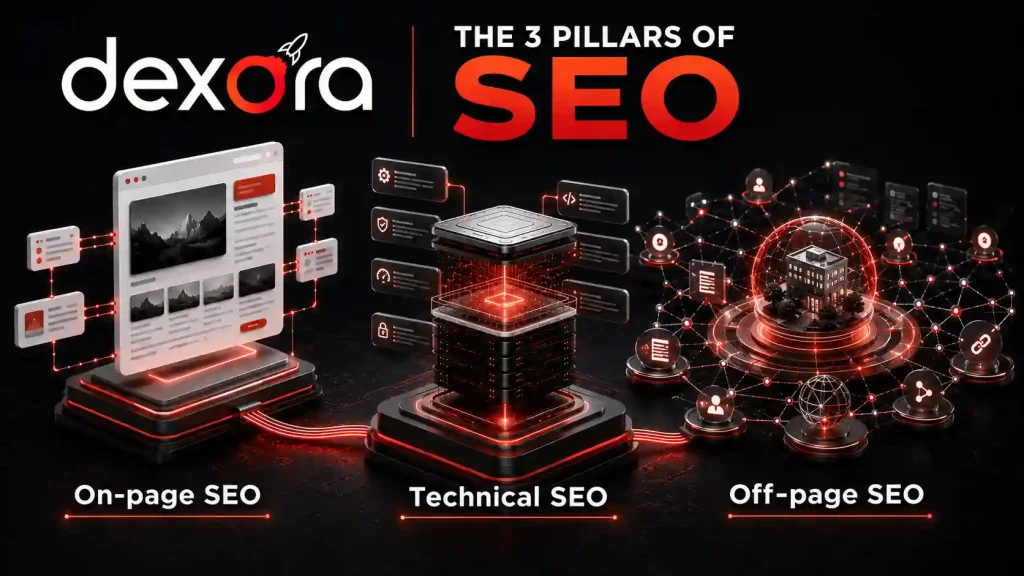
SEO is usually divided into three major areas:
- on-page SEO
- technical SEO
- off-page SEO
Local SEO and ecommerce SEO can then be treated as specialised disciplines that use elements from all three. Search Engine Land uses the same broad framework of on-page, technical and off-page optimization when explaining modern SEO.
On-Page SEO
On-page SEO focuses on the content and elements found on your website.
It includes:
- keyword research
- search intent analysis
- useful content
- titles
- headings
- meta descriptions
- image optimization
- internal linking
- URLs
- content updates
A good page should clearly answer the reason someone searched.
For example, somebody searching “what is SEO” probably does not want to immediately see an agency pricing page.
They want an understandable explanation. But somebody searching “SEO agency Finland” has much stronger commercial intent and should land on a service page. Matching content to intent is one of the foundations of good SEO.
Technical SEO
Technical SEO deals with your site’s infrastructure.
Common areas include:
- crawlability
- indexing
- canonical tags
- robots.txt
- XML sitemaps
- redirects
- broken links
- page speed
- Core Web Vitals
- mobile usability
- structured data
- JavaScript rendering
- website architecture
A technically weak website can prevent otherwise excellent content from performing properly.
Businesses can use our Technical SEO Checker to identify some of these foundational issues before investing heavily in new content.
Off-Page SEO
Off-page SEO focuses on authority and trust signals outside your own website.
Examples include:
- backlinks
- editorial mentions
- digital PR
- business citations
- directory listings
- reviews
- relevant partnerships
- brand mentions
The objective should not be collecting the largest possible number of backlinks.
Quality and relevance matter more than raw volume.
A legitimate mention from an established Finnish publication, industry organisation, professional directory or relevant business website can contribute far more value than dozens of low-quality links created only for SEO.
Why Is SEO Important for Businesses in Finland?
Businesses in Finland do not necessarily need enormous worldwide traffic. They need relevant visibility. Consider three different examples. A plumber in Oulu may want people nearby searching for emergency plumbing services.
A B2B software company in Espoo may want decision-makers across Finland or Northern Europe. An ecommerce company may want customers searching nationally for specific products or product categories. Each business needs a different SEO strategy.
| Business Type | Main SEO Opportunity |
| Local service business | Google Search, Maps, location relevance |
| B2B company | Service pages, expertise content, authority |
| Ecommerce business | Category pages, product SEO, technical SEO |
| SaaS company | Problem-led content and product queries |
| Professional services | Commercial services + trust content |
| Multi-location company | Location architecture + local SEO |
English searches still matter in Finland
Not every person in Finland searches exclusively in Finnish.
Depending on the industry, searchers may use:
- Finnish
- English
- Swedish
- branded terms
- international terminology
Technology, SaaS, engineering, digital marketing, startups and international B2B sectors commonly include English terminology in buying journeys. That means a Finnish business should research how its actual customers search, rather than assuming one language automatically serves every audience.
Geographic intent changes the SERP
Someone searching:
“what is SEO”
has informational intent.
Someone searching:
“SEO company Finland”
has commercial intent.
Someone searching:
“SEO agency Helsinki”
adds strong geographic intent. SEO works best when your website architecture reflects those differences.
How to Start SEO: A Practical 7-Step Process
Understanding SEO is useful, but businesses usually want to know what to do next.
A practical SEO process should follow a logical order.
1. Audit the current website
Before creating dozens of new pages, identify existing problems.
Check:
- indexability
- crawl errors
- duplicate content
- redirects
- canonicalization
- site speed
- broken pages
- internal links
- metadata
- mobile usability
Fixing major technical issues first makes future SEO work more effective.
2. Understand your target customer
SEO starts with customer demand.
Ask:
- What problem is the customer trying to solve?
- What service are they looking for?
- How do they describe that service?
- What questions occur before purchase?
- Does location matter?
- Are they comparing several companies?
These answers define your content strategy.
3. Research keywords
Keyword research identifies the language people use when searching.
Important factors include:
- relevance
- search intent
- commercial value
- difficulty
- search demand
- location
- SERP competition
Do not automatically choose the keyword with the biggest volume. A highly targeted query with lower volume may produce much more business.
4. Match each keyword to the correct page
A common SEO mistake is trying to rank every keyword with blog posts.
Different searches need different page types.
| Search | Best Page Type |
| what is SEO | Educational article |
| SEO Finland | Service page |
| technical SEO audit | Service or tool page |
| SEO cost Finland | Commercial guide |
| SEO agency Helsinki | Location/service page |
| how to improve website rankings | Educational guide |
Matching page format to search intent reduces cannibalization and improves relevance.
5. Create genuinely useful content
Search results already contain millions of generic articles. Publishing another version of exactly the same information is rarely enough.
Your content should contribute something useful such as:
- original examples
- proprietary data
- case studies
- checklists
- screenshots
- expert commentary
- local information
- tools
- comparisons
- firsthand experience
Google specifically recommends creating unique, useful and people-first content rather than simply rehashing material that already exists.
6. Strengthen authority
Great content needs distribution and credibility.
Authority can grow through:
- relevant backlinks
- partnerships
- digital PR
- directories
- industry participation
- original research
- trusted citations
- useful resources
Do not confuse authority building with buying hundreds of unrelated links.
7. Measure results
Use tools such as Google Search Console and analytics to track:
- impressions
- clicks
- search queries
- ranking changes
- organic landing pages
- leads
- conversions
- revenue
SEO should ultimately connect to business outcomes.
What Is Local SEO?
Local SEO helps businesses become more visible when search intent includes a geographic component.
Examples include:
- restaurant Helsinki
- electrician Tampere
- SEO agency Oulu
- dentist Espoo
- plumber Turku
Local SEO can involve:
- Google Business Profile
- business categories
- service descriptions
- consistent name, address and phone details
- reviews
- location content
- local citations
- relevant links
- Maps visibility
For companies serving one city or region, local SEO can be more commercially valuable than trying to rank nationally for broad terms. It is also important for businesses operating in competitive Finnish cities such as Helsinki, Espoo, Tampere, Turku and Oulu.
A national SEO strategy and a local SEO strategy should therefore work together rather than compete with each other.
How Is SEO Changing With AI Search in 2026?
SEO is changing because customers have more ways to search.

People now discover information through:
- Google Search
- Google AI Overviews
- Google AI Mode
- ChatGPT
- Gemini
- Perplexity
- Google Maps
- video platforms
This has led to terms such as:
- AI SEO
- AEO
- Answer Engine Optimization
- GEO
- Generative Engine Optimization
- AI Search Optimization
However, businesses should not treat AI search as a completely separate replacement for traditional SEO. The foundations still matter.
AI-powered systems benefit from content that is:
- accessible
- clear
- factual
- well structured
- authoritative
- useful
- externally validated
Search Engine Land’s 2026 SEO definition has already broadened SEO beyond traditional rankings to include brand visibility across both search engines and AI search. That is a major change.
A modern SEO programme should therefore ask two questions:
Can customers find us through traditional search?
and:
Can AI search systems accurately understand and surface our business?
Businesses interested in this second layer can explore our AI Search Optimisation services for Finland.
What should businesses measure now?
Traditional SEO metrics still matter:
- rankings
- impressions
- clicks
- leads
- revenue
But businesses should increasingly also monitor:
- AI citations
- branded mentions
- ChatGPT referral traffic
- AI recommendation visibility
- entity accuracy
- share of voice across AI answers
The goal is increasingly broader than ranking one webpage. It is about creating search visibility around the business as an entity.
SEO Checklist for Businesses in Finland
Use this checklist when evaluating your current SEO foundation:
- Make sure important pages can be crawled.
- Confirm important pages are indexed.
- Install Google Search Console.
- Configure analytics correctly.
- Define your main services and products.
- Research the queries customers actually use.
- Understand Finnish versus English search behaviour.
- Separate commercial and informational intent.
- Create strong pages for your main services.
- Improve title tags and meta descriptions.
- Use descriptive URLs.
- Create clear page headings.
- Improve internal linking.
- Remove unnecessary duplicate content.
- Fix broken pages and redirects.
- Improve mobile usability.
- Review Core Web Vitals.
- Optimize Google Business Profile if relevant.
- Maintain consistent business information.
- Build relevant Finnish and industry citations.
- Earn legitimate backlinks.
- Publish useful supporting content.
- Demonstrate real experience and expertise.
- Monitor search performance.
- Track leads and conversions.
- Monitor AI search visibility.
- Update important content regularly.
Do not try to implement everything at once. Start with the highest-impact problems and build from there. If you are unsure where your website currently stands, request a free SEO audit to identify the technical, content and visibility issues worth addressing first.
Frequently Asked Questions About SEO
What does SEO stand for?
SEO stands for Search Engine Optimization. It is the process of improving website content, technical accessibility and authority so relevant users can discover the site through unpaid search results.
What is SEO and how does it work?
SEO helps search engines discover, understand and evaluate website pages. Strong relevance, useful content, technical accessibility and authority can help pages appear for searches matching their purpose.
What is SEO in digital marketing?
SEO is an organic digital marketing discipline focused on increasing visibility through search. It can support traffic, brand discovery, leads and sales without paying for each organic click.
How do beginners start SEO?
Start by checking whether your website can be crawled and indexed. Then research your customers, identify relevant search queries, build useful pages, improve on-page elements and monitor results.
Is SEO free?
Organic clicks do not require payment to Google. However, SEO itself may require investment in content, development, research, specialist support, software, digital PR and ongoing optimization.
How long does SEO take to work?
SEO has no fixed timeline. Some changes can appear quickly, while competitive improvements can take several months. Website authority, competition, technical condition and content quality all affect progress.
What are the three main types of SEO?
The three main areas are on-page SEO, technical SEO and off-page SEO. Local SEO, ecommerce SEO and international SEO combine techniques from these broader disciplines.
What is an example of SEO?
An example is creating a detailed service page around a genuine customer search, improving its title and structure, linking it logically within the site and earning relevant external mentions.
What is local SEO?
Local SEO improves visibility for searches connected to a geographic area. It commonly involves Google Business Profile, reviews, local content, accurate business details, citations and location relevance.
Does SEO work for small businesses in Finland?
Yes. Small Finnish businesses can often compete effectively by focusing on relevant service, location and long-tail searches rather than broad keywords dominated by large international websites.
What is technical SEO?
Technical SEO improves how search engines access and process a website. It covers crawlability, indexing, architecture, redirects, canonical tags, performance, structured data, mobile usability and related infrastructure.
What is the difference between SEO and Google Ads?
SEO earns organic visibility through relevance, quality and authority. Google Ads buys advertising placement. Paid ads can generate immediate exposure, while SEO usually builds value over a longer period.
Is keyword research still important in 2026?
Yes, but keyword research now involves more than finding search volume. It should uncover intent, topics, customer language, commercial value and the questions users ask across modern search environments.
Will AI search replace SEO?
AI search changes how results are delivered, but it still depends heavily on understandable, accessible and trustworthy information. SEO fundamentals therefore remain important as search interfaces continue evolving.
How do I know if SEO is working?
Measure impressions, organic clicks, relevant keyword visibility, conversions, leads and revenue. Increasingly, businesses should also monitor brand mentions and visibility across AI-powered search platforms.
Conclusion
SEO is the process of making your business easier to discover when people search for the information, products or services you provide. But effective SEO in 2026 is no longer about putting keywords into a page and waiting for rankings.
It requires:
- understanding search intent
- creating useful content
- maintaining a strong technical foundation
- building authority
- improving local relevance
- measuring business outcomes
- adapting to AI-powered search
For businesses in Finland, the strongest SEO strategy is one based on the real way your target customers search, not a generic international template.
Start with the fundamentals.
Fix technical problems.
Build strong commercial pages.
Publish genuinely helpful content.
Develop authority.
Then measure what actually generates visibility, leads and revenue.
That is what sustainable SEO looks like.