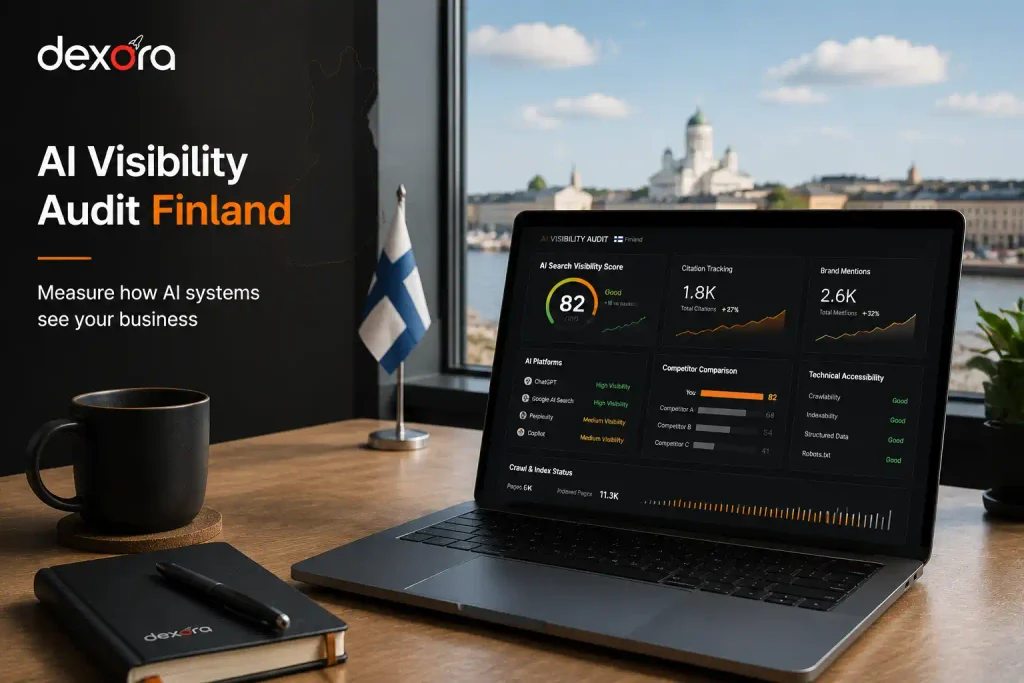
An AI visibility audit Finland measures whether AI-assisted search systems can discover your website, understand your business, use your information as a source and surface your brand when Finnish customers ask commercially relevant questions.
It should go much further than asking ChatGPT, “Do you know my company?”
A useful audit examines the exact questions buyers ask, which competitors appear, which sources AI systems cite, whether your company is understood correctly, whether crawlers can access important pages and whether AI-driven visibility contributes to enquiries or sales.
That distinction is important because AI visibility is not one universal ranking.
Google AI Overviews, AI Mode, ChatGPT and other answer systems operate differently. Google says its generative Search experiences remain grounded in its core Search ranking and quality systems, while OpenAI separately documents OAI-SearchBot for ChatGPT Search discovery.
For Finnish companies, an AI audit should therefore complement a broader SEO strategy in Finland rather than replace it.
What Should an AI Visibility Audit Actually Measure?
A professional GEO audit needs to separate technical eligibility from actual visibility.
A page may be crawlable but never cited. A brand may be mentioned but inaccurately described. A company may appear frequently for informational questions while being completely absent from high-value buying questions.
The audit should answer five business questions.
| Audit Layer | What We Are Testing | Business Question |
| Prompt visibility | Where the company appears in relevant AI answers | Are buyers encountering us? |
| Citation visibility | Which pages and sources are used | Is our information trusted enough to support answers? |
| Entity clarity | How systems understand the brand | Do AI systems understand who we are and what we offer? |
| Technical accessibility | Whether important content can be retrieved | Can search and AI crawlers reach the information? |
| Measurement | Visibility against competitors and conversions | Is AI discovery creating commercial value? |
This is also why Dexora’s AI Search Optimisation Finland work should begin with a baseline rather than immediately publishing additional content.
The following 25 checks create that baseline.
Prompt and Recommendation Checks
1. Build a Buyer-Intent Prompt Set
An audit should begin with real customer questions, not randomly generated prompts.
Use sales questions, Search Console queries, service terminology, comparison questions and objections that occur before someone purchases.
For a Finnish B2B software company, “best software” is less useful than a prompt describing company size, integration requirements, market and use case.
2. Test Finnish and English Queries Separately
Many Finnish businesses serve both domestic and international audiences.
Do not assume that an English prompt and its Finnish translation produce the same brands or sources.
Run separate Finnish and English prompt sets when both languages represent genuine customers, then record the results independently.
3. Run Unbranded Discovery Prompts
The most useful visibility test usually excludes your brand name.
Ask the system for providers, products, specialists or solutions within your real market.
If customers ask for “technical SEO agency in Finland” and the system repeatedly recommends competitors but never mentions your business, that is a meaningful discovery gap.
4. Test Commercial Recommendation Prompts
Informational visibility and buying visibility are different.
Test questions involving words and concepts such as best, recommended, provider, agency, alternative, compare, price, suitable for, near me and who should I hire.
These prompts expose whether the business is entering the consideration stage rather than simply appearing as an educational source.
5. Compare Your Brand Against Named Competitors
Run the same meaningful queries using the top competitors identified in the market.
The purpose is not to produce an artificial league table.
Look for patterns. Does one competitor appear mainly for technical expertise? Another for price? Another because third-party websites repeatedly recommend them?
That pattern often reveals the real visibility gap.
Content and Citation Checks
6. Check Whether Important Pages Give Direct Answers
Open your main service and informational pages.
Can a buyer obtain a useful answer to the primary question within the first meaningful paragraph?
This does not mean every section needs artificial “AI chunking.” Google specifically says content does not need to be divided into tiny sections for generative AI Search.
The objective is clarity, not formatting for an imaginary ranking signal.
7. Record Whether Your Website Is Actually Cited
A brand mention and a citation are not the same result.
For each audit prompt, record whether the AI response links to your domain, which URL appears and which claim the page appears to support.
This creates a stronger baseline than simply recording “brand found: yes/no.”
8. Identify Which URLs Earn the Citations
Citation concentration can expose important content gaps.
If one research article receives most AI citations while your service pages never appear, the website may have informational authority but weak commercial source eligibility.
The opposite situation can also occur.
Document the exact cited URL rather than recording only domain-level visibility.
9. Review the Context Around Each Citation
A citation is not automatically positive.
A brand could be cited as a useful authority, as a neutral factual source or in a response that disagrees with its claims.
Review what the AI system says immediately around the citation.
This provides a basic qualitative picture of how the brand’s information is being interpreted.
10. Find Competitor Citation Gaps
When a competitor is repeatedly cited and your company is not, inspect the cited source.
Compare the depth, evidence, publication date, authorship, directness, original data, external references and topic coverage.
The objective is not to copy the competitor.
Identify why their page is a stronger source for that specific question.
This is one of the most important advantages of a competitor-led search engine optimization strategy.
Brand Entity and Trust Checks
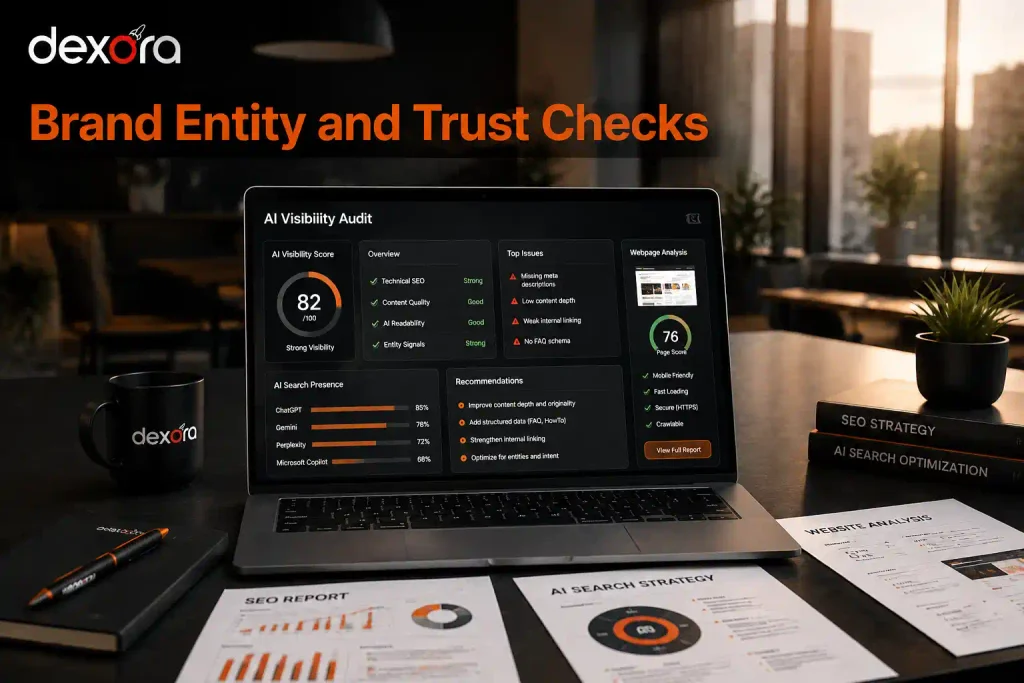
11. Verify Basic Brand Entity Consistency
AI systems should encounter the same basic company identity throughout the web.
Check the business name, services, market, location, founder or expert identities and key company facts across the website and legitimate external profiles.
Conflicting information makes the company harder to understand accurately.
12. Audit Structured Data for Accuracy
Review relevant Organization, Person, Article, Breadcrumb and service-related structured data.
Schema is not a guaranteed AI citation mechanism. Google explicitly says there is no special structured data required for its generative AI features.
Its job is to accurately represent visible information, not manufacture authority.
13. Check Author and Expert Evidence
Important expert content should make it clear who produced or reviewed it.
An author name is only the starting point.
The website should support meaningful claims of expertise through biographies, professional experience, case evidence, portfolio work or other verifiable information.
Dexora’s About Us page should therefore support the same expertise described across service and blog content.
14. Check Service, Market and Location Clarity
An AI system should not need to infer whether your business operates in Finland, whom it serves or which services it provides.
Review the homepage, service pages and company information for explicit factual clarity.
Vague claims such as “we transform businesses digitally” communicate far less than precise service and market descriptions.
15. Review Independent Third-Party Corroboration
Your own website is only one source describing your business.
Look at legitimate business profiles, interviews, customer references, industry publications, directories, partnerships and relevant mentions.
Google warns against pursuing artificial mentions purely for generative Search visibility, so this check should focus on real corroboration, not mass-placement schemes.
Actual project evidence inside the Dexora Digital portfolio is also more persuasive than unsupported claims of expertise.
Crawl, Retrieval and Technical AI Checks
16. Check OAI-SearchBot Access
OpenAI states that OAI-SearchBot is used to surface websites within ChatGPT Search.
Websites that opt out will not be shown as search results in ChatGPT answers, although navigational links can still appear.
Review robots.txt and confirm you have not accidentally blocked the crawler if ChatGPT Search visibility is a goal.
17. Verify Google Index and Snippet Eligibility
Google’s requirements are different.
To appear as a supporting link in Google AI Overviews or AI Mode, a page must be indexed and eligible to appear in normal Google Search with a snippet.
That makes normal crawling and indexing part of every Google AI visibility audit.
18. Test What Crawlers Receive After Rendering
Some websites expose very little meaningful content until JavaScript executes.
Compare the page a visitor sees with the content search and retrieval systems can access.
Important descriptions, answers, links and business facts should not depend on fragile client-side implementations.
A deeper technical SEO audit is appropriate when rendering or indexability problems exist.
19. Check Internal Discovery Paths
Important AI-search content should not exist as isolated pages.
Review whether service pages, supporting guides, case studies and relevant articles link logically to each other.
Strong internal linking helps both users and search systems understand how topics connect.
The Dexora Technical SEO Checker can provide an initial review of site-level technical issues.
20. Review CDN, Firewall and Bot Restrictions
A correct robots.txt file does not guarantee crawler access.
CDN security rules, bot protection, rate limiting and server settings can still block legitimate requests.
OpenAI recommends allowing requests from its published OAI-SearchBot IP ranges in addition to permitting the user agent.
Server logs can provide stronger evidence than relying only on configuration screenshots.
Where needed, the free technical SEO checker can be used as a preliminary site check before deeper server-level investigation.
Measurement and Competitive Visibility Checks
21. Check Google’s Generative AI Performance Report
This is now an important 2026 audit step.
Google launched dedicated Generative AI performance reports in Search Console in June 2026. The reports can show impressions, visible pages, countries, devices and performance over time for Google’s generative Search features, although Google says rollout initially covers a subset of websites.
If the report is available for the audited property, use Google’s first-party data before relying solely on third-party estimates.
22. Measure ChatGPT Referral Traffic
OpenAI states that ChatGPT Search automatically adds:
utm_source=chatgpt.com
to referral URLs.
Check analytics for these visits and identify which pages receive them.
Referral volume should not be confused with total ChatGPT visibility because many AI interactions produce no website click.
23. Connect AI Referrals to Conversions
Traffic by itself is not a business result.
Determine whether visitors arriving through AI discovery complete contact forms, request consultations, call the business, view important service pages or generate other meaningful conversions.
An AI visibility report becomes far more valuable when it connects discovery with commercial intent.
24. Calculate AI Share of Voice
For a fixed prompt set, compare your business with named competitors.
A simple share-of-voice metric can record how frequently each brand is mentioned or cited across the same prompts and platforms.
The trend is more useful than declaring a permanent “ChatGPT ranking,” because generated answers can vary.
25. Repeat the Same Audit Before Drawing Conclusions
One test is not a reliable trend.
Retain the exact prompt wording, date, language, location context, platform, results, citations and competitors.
Repeat the baseline on a defined schedule.
This separates a real visibility pattern from normal response variation and gives future optimization work something measurable to compare against.
How We Prioritize the 25 Findings
A 25-point GEO audit should not end with 25 equally urgent tasks.
The findings need to be sorted by impact.
A blocked search crawler affecting the entire website deserves more attention than a missing optional schema field.
Likewise, being absent from five high-intent buying prompts is normally more commercially significant than being absent from fifty unrelated informational questions.
At Dexora Digital, the priority should be based on four factors:
Eligibility: Is something technically preventing discovery?
Commercial intent: Is the missing visibility connected to a customer decision?
Competitive gap: Are competitors consistently occupying the opportunity?
Evidence: Can the finding be demonstrated through crawls, citations, platform data or repeated prompts?
This prevents an AI audit from becoming a collection of fashionable GEO recommendations with no evidence behind them.
Google itself now advises website owners to be cautious with third-party tools claiming access to internal Google AI metrics because no external SEO tool has access to Google’s internal ranking systems.
What Makes an AI Visibility Audit Useful for a Finnish Business?
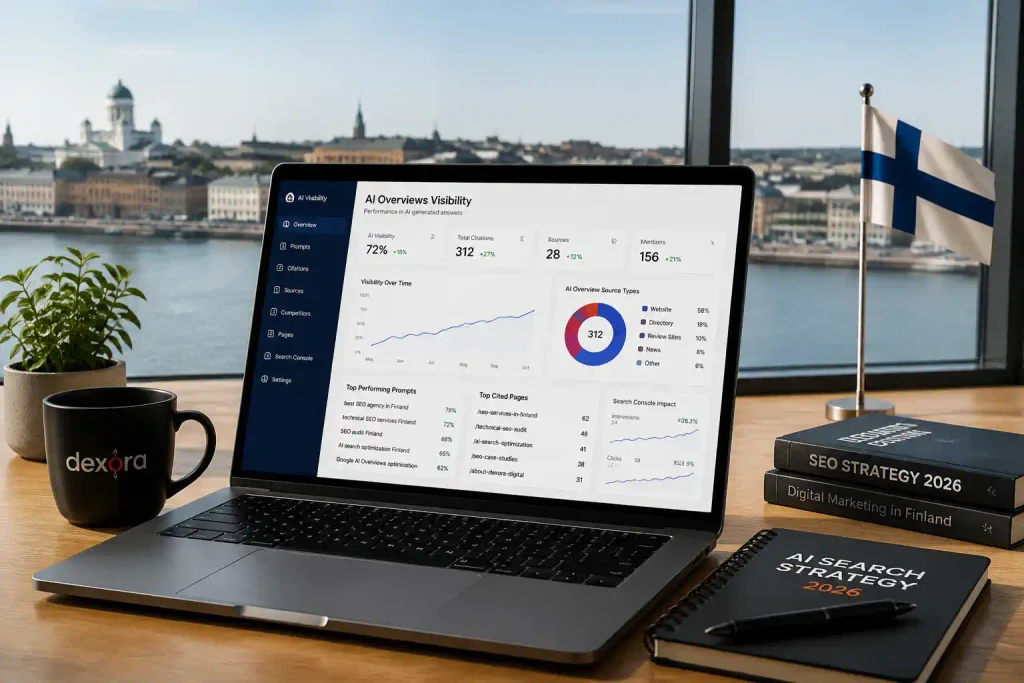
The final audit should tell the company why it is visible or invisible, not simply produce a score.
For one Finnish company, the primary problem may be technical: important content cannot be crawled properly.
For another, the website may be accessible but the company is poorly defined as an entity.
A third business may have excellent website content but competitors dominate independent third-party sources.
A fourth may already receive strong AI citations but has never measured the traffic or conversions they generate.
This is why AI visibility should be audited as a system.
Prompts reveal the opportunity. Citations reveal source selection. Entity checks reveal brand understanding. Technical checks reveal accessibility. Measurement reveals whether any of it matters commercially.
Frequently Asked Questions About AI Visibility Audits
What is an AI visibility audit?
An AI visibility audit examines how a business appears across AI-assisted search, including prompt coverage, brand mentions, citations, competitor visibility, entity clarity, crawler accessibility and measurable traffic or conversions.
What is a GEO audit?
A GEO audit evaluates whether generative search systems can discover, understand and potentially reference a company or its content. It normally combines AI-search testing with established SEO and technical checks.
How do you measure AI visibility?
Use a fixed set of relevant prompts and record brand mentions, citations, cited URLs, competitor appearances and referral traffic. Repeat the same process over time rather than relying on one test.
Is AI visibility the same as Google ranking?
No. Traditional rankings describe search-result positions. AI responses can synthesize several sources and vary between prompts or runs, so AI visibility needs separate citation and recommendation measurement.
Should Finnish businesses test prompts in Finnish?
Yes when Finnish-speaking customers are part of the target market. Finnish and English prompt sets should be tested independently because language can change which brands, sources and information appear.
Can Google Search Console measure AI visibility?
Google introduced dedicated Generative AI performance reports in 2026 for participating Search Console properties, providing data including impressions, pages, countries, devices and performance over time.
Can I track visits from ChatGPT?
Yes. OpenAI says ChatGPT Search referral URLs automatically use utm_source=chatgpt.com, making those inbound visits identifiable within analytics platforms when the user clicks through.
Does ChatGPT need GPTBot access to recommend my website?
Not for ChatGPT Search. OpenAI separates GPTBot from OAI-SearchBot. OAI-SearchBot controls search discovery, while GPTBot relates to potential foundation-model training.
Does an AI visibility audit guarantee more citations?
No. An audit identifies technical, content, entity and competitive opportunities. Search and AI systems independently determine which information appears, so no responsible audit should promise guaranteed citations.
How many prompts should an AI audit test?
There is no universal number. The set should be large enough to represent meaningful informational, commercial, comparison and brand-discovery journeys without padding the audit with irrelevant questions.
How often should AI visibility be audited?
A comprehensive baseline can be updated after major SEO or content changes, while a smaller fixed prompt set can be monitored more regularly to detect meaningful changes in citations and recommendations.
What should an AI visibility audit deliver?
A useful audit should provide a baseline, competitor comparison, prompt and citation findings, technical accessibility issues, entity gaps, measurement data and a prioritized action plan tied to business impact.
Find Out What AI Search Actually Sees About Your Business
Your company may already be appearing in Google AI Search, ChatGPT or other answer systems.
Or your competitors may be receiving the citations and recommendations while your website remains technically accessible but commercially invisible.
The only reliable starting point is to measure it.
Request your free SEO and AI visibility audit from Dexora Digital to check your prompts, citations, competitors, entity signals and technical AI-search readiness.
For a deeper Finland-focused AI visibility strategy, contact Dexora Digital and turn the audit findings into a prioritized search-growth plan.