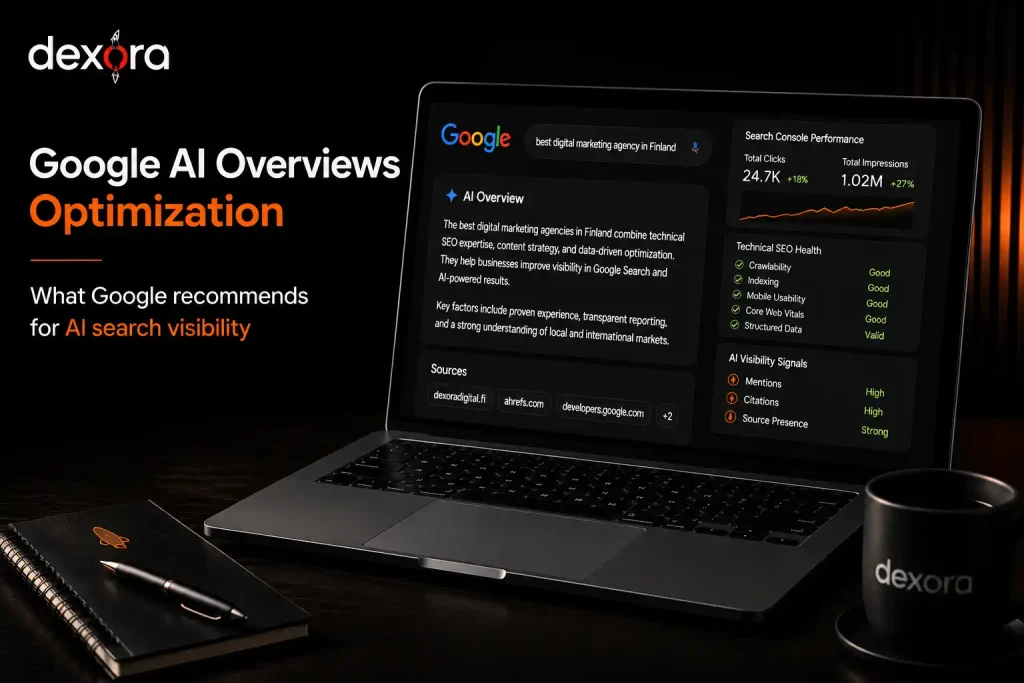
Google AI Overviews optimization is not a separate secret form of SEO.
According to Google’s current guidance, websites do not need a special AI ranking strategy, dedicated AI markup or an entirely different type of content to become eligible for AI Overviews.
Google says its generative search features are built on the same core Search ranking and quality systems that support normal Google Search.
That distinction matters in 2026 because a growing number of businesses are being told they need entirely new “GEO hacks” to appear in Google’s AI-generated answers.
Google’s own documentation says otherwise.
For businesses already investing in SEO services in Finland, the better approach is to strengthen the fundamentals Google already recommends while adapting content to increasingly complex search behaviour.
AI Overviews are currently available in Finland, making this a real visibility consideration for Finnish businesses rather than a future prediction.
What Are Google AI Overviews?
AI Overviews are AI-generated summaries that Google may display when its systems determine that an AI-assisted response can add value beyond conventional search results.
They are designed to help users understand complex topics more quickly while still providing links to supporting websites.
An important point is that an AI Overview does not appear for every query.
Google says these responses are shown when its systems determine that they provide additional value. The exact response and supporting links can also vary because Google may use different models and techniques across its AI search experiences.
For Finnish businesses, this means optimizing for AI Overviews should not become a separate campaign disconnected from ordinary organic visibility.
A company still needs pages Google can crawl, index, understand and consider useful. That is why AI-search preparation should remain connected to broader search engine optimization.
What Google Officially Recommends for AI Overviews
Google published expanded official guidance for generative search optimization in May 2026. The guidance removes much of the speculation that has surrounded GEO and AEO.
Here is the practical summary.
| Google’s Recommendation | What It Means for Your Website |
| Continue using SEO best practices | AI Overviews rely on Google’s existing Search systems |
| Publish valuable, non-commodity content | Add expertise or information competitors cannot easily reproduce |
| Keep pages crawlable and indexable | A page needs normal Search eligibility before supporting AI features |
| Use clear internal linking | Important content should be easy for Google and users to discover |
| Maintain strong page experience | Mobile usability, speed and clarity continue to matter |
| Keep important information in textual form | Do not place essential information only inside inaccessible media |
| Use useful images and videos | Multimedia can provide additional discovery opportunities |
| Keep structured data accurate | Schema should represent visible page content |
| Maintain accurate local/business data | Business Profile and Merchant Center can support relevant AI experiences |
| Measure AI visibility using Search Console | Evaluate actual performance instead of relying on speculative ranking tools |
Google also explicitly says that AEO and GEO may be useful industry terms, but from Google’s perspective, optimizing for generative Search is still SEO.
That does not mean search behaviour has stayed the same. It means the foundation has not been replaced.
Why Traditional SEO Still Drives Google AI Visibility
Google explains that generative Search can use retrieval-augmented generation, commonly called RAG.
In simple terms, Google’s systems can retrieve relevant and current web pages from its Search index and use that information to support an AI-generated response. Google also uses a technique called query fan-out.
Instead of processing only the original search phrase, an AI system may issue several related searches across different subtopics to gather enough information for a more complete response.
Imagine someone searches:
“What is the best SEO approach for a Finnish SaaS company expanding to Sweden?”
Google may need information about SaaS SEO, Finnish companies, international SEO, Swedish expansion, multilingual websites and B2B search behaviour.
This creates opportunities for sites that demonstrate genuine topical depth.
However, it does not mean businesses should generate a separate article for every imaginable variation. Google specifically warns against producing large numbers of pages primarily to manipulate rankings or AI responses.
The better strategy is to create strong topic relationships.

For example, a company’s AI-search content can connect naturally with its AI Search Optimisation Finland service, technical SEO expertise and supporting educational resources.
What Type of Content Does Google Want for AI Search?
One of the strongest points in Google’s 2026 guidance is its emphasis on non-commodity content.
Commodity content repeats information that could come from almost any website.
An article titled:
“10 Benefits of SEO”
may provide little information that distinguishes one expert from another.
A stronger article could instead explain:
“What We Found After Auditing 50 Finnish B2B Websites for AI Search Visibility.”
The second example has the potential to contain original observations, evidence and first-hand expertise.
Google specifically recommends creating content with a unique point of view and adding information based on genuine experience rather than simply recycling what is already available online.
Expertise should be visible, not implied
Businesses frequently describe themselves as “leading,” “experienced” or “trusted.”
Those statements become much stronger when supporting evidence exists.
A page can demonstrate experience through actual methodology, original screenshots, case studies, tested examples, author expertise, measurable outcomes or documented observations.
This is one reason a genuine portfolio of completed work can strengthen the wider content ecosystem.
Likewise, an informative About Us page should clearly communicate who is responsible for the business and its expertise.
Write naturally for people
Google does not recommend creating robotic content solely because an AI system may process it. Headings, paragraphs and logical sections are useful because they improve human readability.
But Google specifically states there is no required AI page length and no requirement to split every idea into artificially small “chunks.”
This is an important correction to some current GEO advice. Clear structure is good. Artificial formatting designed solely for an imagined AI ranking factor is unnecessary.
What Technical SEO Does AI Overviews Require?
Google’s technical requirement is simpler than many businesses expect.
To become eligible as a supporting link in AI Overviews or AI Mode, a page must be indexed and eligible to appear in normal Google Search with a snippet. Google says there are no additional technical requirements specifically for these AI features.
That makes conventional technical SEO highly relevant.
If important content is blocked, incorrectly canonicalized, unintentionally noindexed or difficult to discover internally, the business should fix those problems before searching for advanced GEO tactics.
Google additionally recommends ensuring that crawling is not blocked through robots.txt, CDN configuration or hosting infrastructure.
A Technical SEO Checker can provide an initial review of many foundational problems.
Important information should remain accessible as text
Visual content is useful, but essential facts should not exist only inside an image, animation or difficult-to-render interface.
Google recommends keeping important content available in textual form while supporting that content with useful high-quality images and videos where appropriate.
This gives Google more ways to understand and potentially surface the page while also improving accessibility for users.
Local businesses should maintain accurate business information
Google’s newest generative-search guidance also specifically mentions Google Business Profile.
For local companies, accurate business information can help products and services appear across both conventional and generative Search experiences.
For Finnish companies serving Helsinki, Espoo, Tampere, Turku, Oulu or other regional markets, AI visibility therefore does not eliminate the need for accurate local signals.
Five Popular AI Overview “Hacks” Google Says You Do Not Need
The most useful part of Google’s latest documentation may be what businesses can stop worrying about.
Rather than another checklist, consider these common claims against Google’s current position.
“You need llms.txt to appear in Google AI Overviews”
Google says no.
Its documentation states that Google Search does not use llms.txt as a special generative-search signal. Maintaining one for another service is acceptable, but Google says it will neither improve nor damage Google Search visibility.
“Every paragraph must be chunked for AI”
Google says there is no such requirement.
Its systems can understand multiple topics and identify relevant information without forcing every section into tiny blocks.
“You need special AI schema”
There is no special schema required for Google generative Search.
Existing structured data can still be valuable for supported Search features, but it should accurately represent the visible content.
“Rewrite all your pages specifically for AI bots”
Google advises against this mindset.
Its systems can understand synonyms and broader meaning, so a business does not need to create unnatural wording around every possible long-tail variation.
“Buy as many online brand mentions as possible”
Google specifically warns against pursuing inauthentic mentions as an AI-search tactic.
Its generative features still depend on ranking and anti-spam systems designed to identify useful, trustworthy information.
The lesson is straightforward:
Do not build a weaker website while chasing a stronger AI signal that Google has never confirmed.
How Should AI Overviews Performance Be Measured?
Optimization becomes meaningful only when visibility can be measured. This has improved substantially in 2026.
Google now directs website owners to the Generative AI performance report in Search Console to understand how users discover content through generative AI features on Google Search.
That makes first-party Google data more valuable than screenshots of isolated searches. Businesses should evaluate AI-search performance alongside normal organic outcomes such as qualified visits, enquiries and conversions.
A page appearing as a supporting source is useful, but the commercial question remains:
Did that visibility help the right audience discover the business?
Google also warns businesses to be skeptical of third-party products claiming access to Google’s internal AI or ranking metrics. No external SEO platform has access to Google’s internal ranking systems.
Third-party tools can still be useful for tracking observations, but their measurements should not be presented as Google’s internal “AI score.”
For a broader diagnosis, a free SEO and AI visibility audit can combine Google visibility with technical, content and competitive analysis.
A Practical AI Overviews Strategy for Finnish Businesses
The most defensible strategy in Finland is less complicated than many GEO frameworks suggest.
First, establish whether your commercially important pages already have a sound SEO foundation.
Then determine whether the content contributes anything genuinely useful beyond competing results.
For a Finnish professional-services company, that may mean replacing generic service descriptions with clear processes, real examples, local expertise and answers to the questions customers actually ask.
A B2B company may benefit more from original research, implementation examples and detailed comparison content.
An ecommerce business may need stronger product information, Merchant Center data and supporting content.
A local service provider may need a better Google Business Profile, clearer geographic relevance and stronger service pages.
The implementation changes depending on the business, but the underlying logic remains consistent with Google’s official guidance:
be accessible, be useful, be clear and provide something worth retrieving.
This is where AI Search Optimisation in Finland should complement SEO rather than replace it.
Frequently Asked Questions About Google AI Overviews Optimization
What is Google AI Overviews optimization?
Google AI Overviews optimization means improving website eligibility, content quality and search visibility so pages have a stronger opportunity to appear as supporting sources within Google’s generative search experiences.
Is AI Overviews SEO different from normal SEO?
Not fundamentally. Google states that its generative Search features rely on existing core Search ranking and quality systems, meaning established SEO practices remain the main foundation.
Does Google have a separate AI Overview ranking system?
Google has not described a separate GEO ranking system. AI Overviews use Google’s Search index, ranking systems and generative techniques such as retrieval-augmented generation and query fan-out.
Are Google AI Overviews available in Finland?
Yes. Google’s current availability documentation includes Finland among the locations where AI Overviews are available, making AI-assisted Google visibility directly relevant to Finnish businesses.
Do I need llms.txt for Google AI Overviews?
No. Google’s official 2026 guidance states that Google Search does not use llms.txt as a special signal and that it neither helps nor harms Google Search visibility.
Does schema markup help AI Overviews?
Structured data can remain useful within normal Google Search when appropriate, but Google says no special structured data is required specifically for its generative AI search features.
Does my page need to rank number one to appear in an AI Overview?
Google does not state that a page must rank number one. Its AI features can retrieve supporting pages through multiple related searches and may expose a broader variety of sources.
What type of content is best for AI Overviews?
Google emphasizes unique, helpful and non-commodity content that demonstrates genuine knowledge or experience rather than pages that simply summarize information already widely available elsewhere.
Should I create hundreds of long-tail pages for AI search?
No. Google warns against generating pages for many query variations primarily to manipulate Search or generative responses, as this can conflict with its scaled-content abuse policy.
Is technical SEO important for Google AI search?
Yes. A page must be indexed and eligible for normal Google Search with a snippet before it can become an eligible supporting link within Google’s AI features.
How can I measure AI Overview visibility?
Google now recommends using Search Console’s Generative AI performance report to understand how content is being discovered through generative AI experiences within Google Search.
Can an SEO agency guarantee placement in Google AI Overviews?
No credible provider should guarantee placement. Google states that meeting requirements and best practices does not guarantee crawling, indexing or serving within Search or generative AI experiences.
Stop Guessing Whether Your Website Is Ready for Google AI Search
AI Overviews optimization does not require chasing every new GEO theory.
It requires knowing whether your website has the technical accessibility, useful content, authority and search signals Google actually recommends.
Request a free SEO and AI search audit from Dexora Digital to identify where your website currently stands across Google Search and AI-assisted discovery.
For a tailored Finland-focused strategy, contact Dexora Digital and find out which improvements deserve attention first.