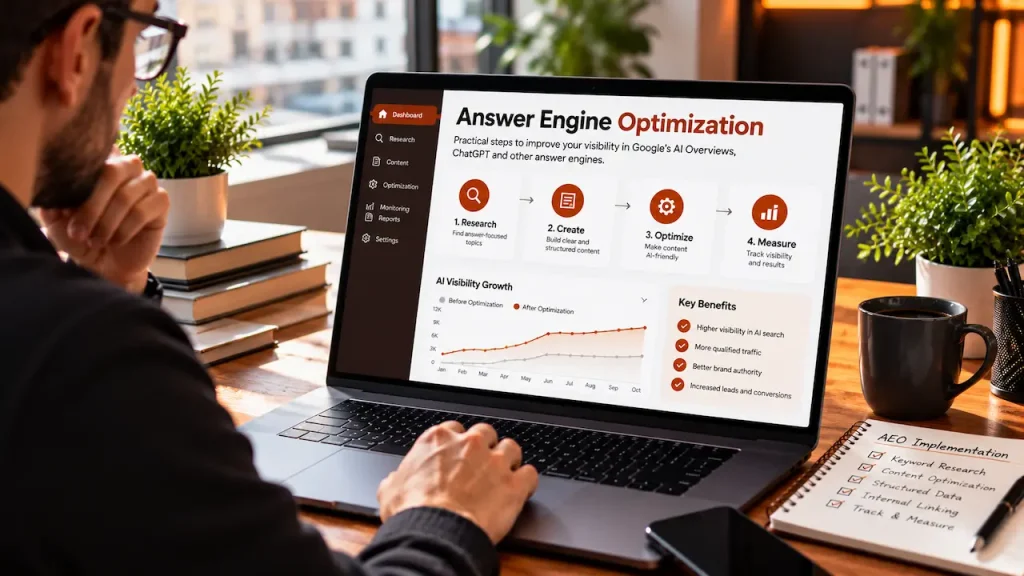
Your potential customers may be researching your business long before they visit your website. They might ask Google for the best service provider in Helsinki, compare options through ChatGPT, or use an AI-powered search experience to understand which company fits their needs.
If your business has invested in SEO but rarely appears in these research experiences, traditional rankings may not tell the full story.
At Dexora Digital, we help businesses across Finland understand how search visibility is changing and what they can do to remain discoverable. One increasingly important part of that work is AI SEO.
But what exactly does AI SEO mean, how does it differ from traditional search engine optimization, and where should Finnish businesses begin?
What Is AI SEO?
AI SEO is the process of improving a website’s discoverability, relevance, and usefulness across traditional search engines and AI-powered search experiences.
It builds on established SEO practices, including technical accessibility, search intent, high-quality content, and website authority. It also considers whether information about a business is sufficiently clear, reliable, and accessible for AI systems to use when answering questions.
For example, imagine a customer asks an AI assistant:
“Which digital marketing agency in Finland can help my company improve visibility in AI search?”
The assistant might respond with an explanation of suitable services and examples of relevant companies. Whether a particular business is mentioned or linked depends on the system, its information sources, the question, and other factors.
AI SEO helps businesses address the underlying discoverability issues. It does not guarantee mentions, recommendations, or citations.
Our AI SEO services in Finland focus on strengthening the technical and informational foundations needed for visibility across changing search environments.
How Is AI SEO Different from Traditional SEO?
Traditional SEO aims to make websites discoverable and useful through search engines. Businesses optimize pages around customer searches, improve technical accessibility, earn relevant references, and measure organic search performance.
AI SEO works with those same foundations but gives additional attention to how information may be interpreted and summarized.
Traditional search visibility
A traditional search results page commonly presents a selection of links, rich results, business information, and other search features. Users compare the available options and decide which websites to visit. A business might measure its performance through rankings, impressions, organic clicks, enquiries, and conversions.
AI-powered discovery
An AI search experience may synthesize information from several sources into a direct response. Someone comparing service providers could receive a summary covering capabilities, locations, pricing considerations, and recommended next steps before clicking through to an individual website.
That creates an additional challenge for businesses: their information must be easy to find, sufficiently detailed, and consistent enough to support an accurate understanding of what they offer.
Why both approaches matter
AI SEO should not replace traditional SEO. Search engines still need to discover and understand pages. Visitors still need functional websites, accessible information, convincing evidence, and clear ways to contact a business.
The strongest approach combines both disciplines rather than treating them as competitors. For a closer comparison, read our guide to SEO, AEO, and GEO.
Why AI SEO Matters for Businesses in Finland
Finland has a diverse commercial environment that includes technology companies, professional service firms, local businesses, industrial suppliers, retailers, and international organizations. Their customers do not all search in the same language or follow the same purchasing journey.
A homeowner in Tampere might search Google for a nearby provider, while an international company entering Helsinki might use AI tools to research potential partners. Businesses need content that serves these different audiences without creating inconsistent messages.
Customers are researching through more channels
Search discovery is no longer limited to entering a short keyword and reviewing ten links. People may ask detailed questions, compare alternatives, request explanations, and refine their requirements through conversational interfaces.
An engineering buyer, for example, might investigate the experience and specialist capabilities of several potential suppliers before making contact.
A website containing only broad promotional claims provides less useful information than one explaining actual services, technical expertise, industries served, and project outcomes.
Clear business information becomes more valuable
AI systems may encounter information from websites, directories, publications, and other accessible sources.
If those sources describe a company differently, the resulting understanding may be incomplete or inconsistent. A Finnish business should communicate its company name, locations, services, industries, and capabilities clearly throughout its website and appropriate external profiles. Accuracy matters more than repeating keywords.
Language and market context create additional complexity
Finnish businesses may serve audiences in Finnish, Swedish, and English. Simply translating a page word for word does not necessarily address differences in search intent, terminology, or buyer expectations.
A company targeting Finnish-speaking customers should research how those customers describe its services rather than assuming English keywords have direct equivalents.
Our article about multilingual SEO in Finland explains how language selection and website architecture work together.
How AI Search Systems Discover Business Information
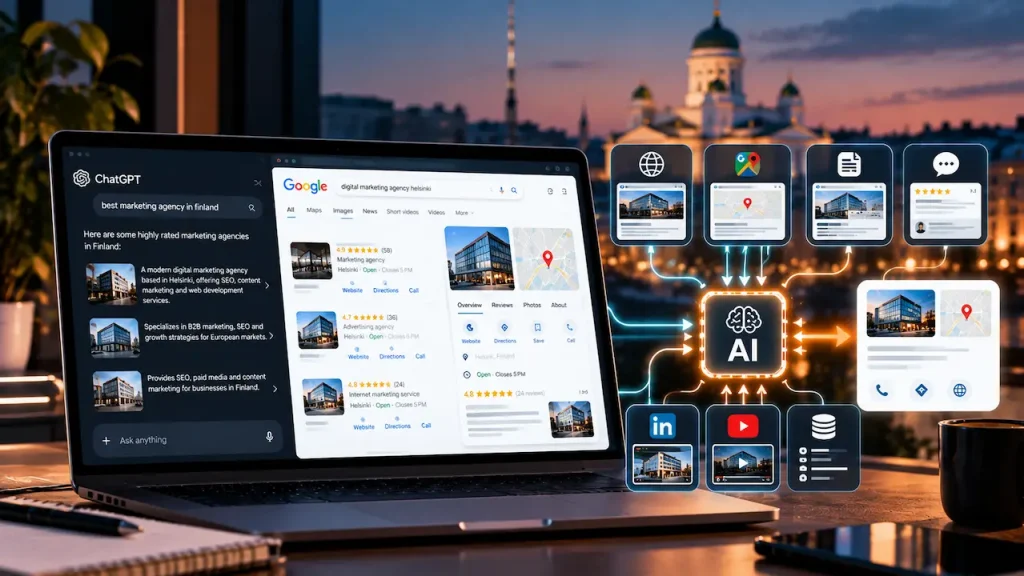
Different AI platforms operate differently. Some retrieve information from live search results, others rely on available indexed material, and some combine several mechanisms. There is no universal method for forcing a particular AI system to recommend a business.
However, several fundamentals help make online information easier to discover and interpret.
Accessible website content
Important service information should appear in accessible page content. If critical details are hidden in images, unavailable to crawlers, or dependent on scripts that a system cannot process reliably, discovery may be more difficult. Clear HTML headings, descriptive page titles, useful internal links, and crawlable content support conventional SEO and many AI-assisted discovery workflows.
Google states that standard SEO best practices continue to apply to AI features in Search.
Useful and specific information
Businesses should explain what they do, who they help, where they operate, and what makes their approach relevant. A page describing “innovative solutions for modern companies” tells a reader very little. A page explaining that a firm designs electrical distribution systems for industrial facilities gives much clearer information.
Specificity helps readers evaluate suitability and can make content more useful to systems answering detailed questions.
Trustworthy supporting evidence
Relevant project examples, author expertise, business credentials, and accurate third-party references can make claims easier to verify. These signals should reflect actual business experience.
An invented testimonial or unsupported performance figure creates reputational risk regardless of how well the surrounding content is optimized.
Seven Practical AI SEO Improvements for Finnish Businesses
1. Review how your business is described
Start with the homepage, service pages, About page, and public business profiles. Ask whether a new visitor can quickly identify your main services, target customers, location, and differentiating capabilities. Remove vague language that does not explain the actual offering.
2. Strengthen individual service pages
Each important service deserves a sufficiently detailed explanation. Describe the customer problem, work involved, likely deliverables, relevant considerations, and next step.
For location-dependent services, explain actual coverage rather than adding numerous city names without useful local context.
3. Build topic-focused educational content
Customers rarely make decisions after reading one page. A potential SEO client may need information about pricing, technical audits, timelines, AI visibility, and expected results.
Supporting articles help answer those questions while connecting readers to the appropriate service. A structured content strategy can organize these resources around genuine audience needs.
4. Fix technical discovery problems
Check that important pages are indexable, navigation works, canonical URLs are appropriate, and unnecessary redirects or server errors are resolved. Structured data should represent visible, accurate information. Our technical SEO checklist provides a useful starting point.
5. Strengthen relevant business references
Review business listings, industry directories, professional profiles, partner pages, and relevant publications. Business information should remain consistent where it matters. A genuine mention in an appropriate industry publication can provide valuable context, but no third-party mention guarantees appearance in an AI-generated answer.
6. Review AI search responses carefully
Test a defined set of buyer questions across relevant AI search experiences. Record whether your company appears, what information is stated, and which sources are linked where available. Use comparable questions and consistent testing conditions. Because outputs can vary, a single response should never be treated as a reliable visibility score.
7. Connect visibility with business outcomes
Track what happens after people discover the business. Qualified leads, enquiries, booked consultations, and attributed conversions remain important. AI mention monitoring can add context, but it should not replace established performance measurement.
Common AI SEO Mistakes to Avoid
One mistake is treating AI SEO as a collection of technical shortcuts. Adding a special file, repeating the company name, or filling pages with artificial questions does not guarantee inclusion in AI answers.
Another mistake is publishing large volumes of nearly identical material. When every article repeats the same generic explanations, the content provides little additional value. Businesses also risk overlooking their existing SEO foundations while pursuing AI-specific trends.
If important pages are inaccessible, poorly structured, or unclear, those problems should be addressed first.
Finally, avoid claiming that every AI recommendation can be tracked precisely. Different platforms expose different levels of data, and visibility may fluctuate between queries and sessions.
How Can a Finnish Business Measure AI SEO Success?
AI SEO measurement should combine several perspectives. Start with conventional search performance through Google Search Console and website analytics. Review organic visibility, relevant landing pages, enquiries, and conversion quality. Then introduce a small, repeatable set of AI search questions.
These might include comparisons of local providers, questions about specialist services, and searches involving the industries your company serves. Document mentions, citations where visible, factual accuracy, and changes over time. Look for patterns rather than interpreting every isolated result.
At Dexora Digital, our AI visibility optimization approach considers both discoverability and practical business relevance.

When Should You Invest in AI SEO?
Not every business needs an extensive AI search project immediately. A newer company with an incomplete website may benefit most from improving its essential service pages and local search presence.
An established business with strong SEO fundamentals may be ready to examine whether its expertise is clearly represented in AI-assisted research.
A company operating in several markets may need a broader strategy involving languages, services, customer segments, and consistent external information.
The right starting point depends on current website quality, business goals, and the ways customers research your services.
Frequently Asked Questions
Is AI SEO replacing traditional SEO?
No. Traditional SEO remains foundational. AI SEO extends the strategy to consider additional search and discovery experiences while maintaining technical accessibility, content quality, and useful business information.
Can a small Finnish business benefit from AI SEO?
Yes. Small businesses can benefit from clearly communicating their services, improving local relevance, answering customer questions, and keeping business details accurate. The appropriate investment depends on their market and priorities.
Does AI SEO guarantee that ChatGPT will recommend my company?
No. No agency can guarantee recommendations or citations from independent AI systems. Improvements should be assessed through consistent monitoring and business outcomes.
Should Finnish businesses publish content in English?
English may be valuable for international customers, but Finnish or Swedish content can be necessary for other audiences. Language choices should reflect actual customers and validated search behaviour.
How long does AI SEO take to work?
There is no universal timeline. Some website improvements can be implemented quickly, but discoverability, search visibility, and business outcomes develop at different rates and depend on competition, content quality, and platform behaviour.
Building a Stronger Search Presence in Finland
AI SEO is best understood as an extension of good search optimization, not a replacement for it. Businesses that clearly explain their expertise, maintain accessible websites, publish useful information, and build credible online identities are better prepared for changes in how people discover companies.
At Dexora Digital, we help Finnish businesses identify weaknesses in traditional and AI-powered search visibility and turn those findings into a practical improvement plan.
If you want to understand where your website currently stands, request a free AI and SEO audit. We’ll help you identify the improvements that deserve attention first.