
Google is becoming better at understanding not only what content says but also who created it, why it should be trusted, and whether it provides genuine value.
E-E-A-T SEO helps websites demonstrate Experience, Expertise, Authoritativeness, and Trustworthiness to build stronger credibility with users and search engines.
This guide explains how E-E-A-T works, why it matters for modern SEO, and how businesses can create trust signals that improve visibility in Google Search and AI-powered experiences.

What Is E-E-A-T SEO?
E-E-A-T SEO refers to the process of improving a website’s credibility by demonstrating four important qualities:
Experience, Expertise, Authoritativeness, and Trustworthiness.
Google introduced E-E-A-T through its Search Quality Rater Guidelines to help evaluate the quality and reliability of web content. The additional “Experience” element was introduced in December 2022 to highlight the importance of first-hand knowledge.
The concept focuses on a simple question:
Why should users trust this website and its information?
Search engines now evaluate more than keyword relevance. They also look for signals showing whether content comes from a knowledgeable source with real-world understanding.
For example, two websites may publish content about SEO.
The first website provides general advice without an author, examples, or proof.
The second website includes:
- Expert-written content
- Real project examples
- Practical experience
- Original insights
The second website provides stronger credibility signals because it demonstrates why users should trust the information. E-E-A-T is not a direct ranking factor where Google gives websites a specific score. Instead, it represents the qualities commonly found in helpful and reliable content.
Businesses can identify weaknesses in their current website through a detailed SEO audit Finland that evaluates content quality, technical performance, and trust signals.
Why E-E-A-T Matters for SEO
The internet contains millions of pages competing for the same search queries. Google needs to determine which sources provide the most accurate and useful information.
E-E-A-T helps search engines understand:
- Who created the content
- Whether the creator understands the topic
- Whether the website has industry recognition
- Whether users can trust the information
This becomes especially important for YMYL (Your Money or Your Life) topics, where incorrect information can impact someone’s health, finances, safety, or legal decisions.
Examples include:
- Medical websites
- Financial services
- Legal resources
- Professional advice platforms
However, E-E-A-T is not only important for YMYL industries.
It also matters for:
- SaaS companies
- Ecommerce websites
- Local businesses
- Marketing agencies
- Professional service providers
A customer deciding between two businesses will usually choose the one that provides stronger credibility through:
- Real experience
- Customer feedback
- Transparent information
- Demonstrated expertise
A complete SEO services strategy should combine technical optimization, quality content, authority building, and trust development.
The Four Pillars of E-E-A-T SEO
Experience: Showing Real-World Knowledge
Experience is the newest element added to E-E-A-T. It focuses on whether the content creator has direct involvement with the topic they are discussing. Google values first-hand experience because it provides insights that cannot always be created through research alone.
For example, a product review becomes more valuable when the writer has personally used the product and can explain:
- What worked well
- What problems they discovered
- How it performed in real situations
Similarly, a service business can demonstrate experience by showing:
- Completed projects
- Client results
- Original images
- Real processes
- Case studies
A website claiming expertise without showing evidence creates weaker trust signals.
For example:
“We provide professional SEO services.”
is less convincing than:
“We improved technical SEO performance by resolving indexing problems, improving site structure, and optimizing content strategies.”
The second example demonstrates actual experience.
Expertise: Demonstrating Real Knowledge
Expertise explains whether the person creating content has the knowledge and skills required to discuss a topic accurately.

Many websites publish content without showing who created it or why that person should be considered knowledgeable.
Strong expertise signals come from:
- Professional experience
- Industry knowledge
- Research
- Practical results
- Author credentials
However, expertise does not always require formal qualifications. In many industries, practical experience is equally valuable.
For example:
A developer may demonstrate expertise through years of building websites.
An SEO consultant may demonstrate expertise through successful optimization projects.
A business owner may demonstrate expertise through solving real customer problems.
To strengthen expertise, websites should create detailed author information, explain their methodology, and provide original insights instead of repeating generic information.
For technical topics, implementing schema markup SEO can also help search engines better understand authors, organizations, and content relationships.
Authoritativeness: Building Recognition in Your Industry
Authoritativeness focuses on how your website, brand, and content are recognized by others. Expertise explains whether you know your subject, while authority explains whether other people and organizations recognize that knowledge.
A website becomes authoritative when it earns recognition through consistent value, accurate information, and industry connections.
For example, an SEO website becomes more authoritative when it is:
- Referenced by other trusted websites
- Mentioned by industry professionals
- Linked from relevant resources
- Recognized for original research or insights
However, authority is not built by collecting random backlinks. Modern SEO focuses on relevant authority. A backlink from a respected website in your industry can provide more value than many unrelated links.
For example, an SEO agency gaining a mention from a marketing publication is more meaningful than receiving links from unrelated websites.
Authority also comes from building strong topical coverage. A website that publishes connected resources around a subject shows deeper understanding than a website with isolated articles.
For example, a company focusing on SEO can strengthen authority by covering related topics such as:
- Technical SEO
- Local SEO
- AI search optimization
- Content strategy
- Website performance
This connected approach helps search engines understand the website’s expertise and improves topical relevance. A strong internal linking strategy supports this process by connecting related content and creating a clearer topic structure.
Trustworthiness: The Foundation of E-E-A-T
Trust is the most important element of E-E-A-T because users need confidence before accepting information or taking action.
A website can have expert content and industry experience, but if users cannot verify who operates the business or whether information is reliable, trust becomes weaker. Trustworthiness is created through transparency, accuracy, and consistency across the entire website.
A trustworthy website usually provides clear information about:
- Business identity
- Contact details
- Authors and contributors
- Policies
- Customer experiences
- Security practices
For example, a professional service website should clearly explain who provides the service, how the process works, and what results customers can expect.
Trust also comes from maintaining accurate information. Outdated statistics, incorrect claims, broken pages, or unclear business details can reduce user confidence. Technical foundations also contribute to trust. A secure website, good performance, and proper website structure create a better user experience.
Businesses improving their technical foundation should also review their technical SEO checklist to identify issues affecting search visibility and user experience.
E-E-A-T SEO and AI Search: Why Trust Signals Matter More Than Ever
Search is moving beyond traditional results. Google AI Overviews and other AI-powered search systems need to understand information quickly and determine which sources provide reliable answers. This makes E-E-A-T increasingly important.

AI systems do not only evaluate whether a page contains information. They need to understand:
- Who created the content
- Whether the source has expertise
- Whether claims are supported
- Whether the information is trustworthy
This is why generic AI-generated content often struggles to compete. Content that simply summarizes existing information usually lacks the experience and originality users expect. A stronger approach combines AI assistance with human expertise.
For example, AI can help with:
- Research organization
- Content structure
- Topic discovery
But experts should add:
- Real examples
- Personal experience
- Original insights
- Professional opinions
Websites preparing for AI-driven search should focus on becoming reliable sources rather than only optimizing for keywords.
A complete AI search optimisation Finland strategy combines helpful content, entity clarity, technical SEO, and trust signals.
How to Improve E-E-A-T SEO on Your Website
Improving E-E-A-T requires a website-wide approach. It is not achieved by changing one page or adding a single element.
The strongest improvements usually come from showing more evidence behind your expertise.
Create Strong Author Profiles
Anonymous content creates uncertainty.
Author pages should explain:
- Professional background
- Industry experience
- Areas of expertise
- Relevant achievements
For example, an SEO article becomes more credible when readers can see that the writer has practical SEO experience.
Add Original Experience to Content
Many websites publish information that looks similar because it is based on the same sources.
To stand out, include:
- Real examples
- Case studies
- Original screenshots
- Customer experiences
- Practical lessons
Original information creates stronger differentiation.
Build Helpful Service Pages
Many businesses focus heavily on blogs but neglect service pages.
A strong service page should explain:
- What you provide
- Who you help
- Your process
- Your experience
- Expected outcomes
A service page should demonstrate why customers should choose your business.
Strengthen Brand and Entity Signals
Search engines need to understand who your business is.
Important signals include:
- Consistent company information
- About page
- Team information
- Business profiles
- Brand mentions
- Structured data
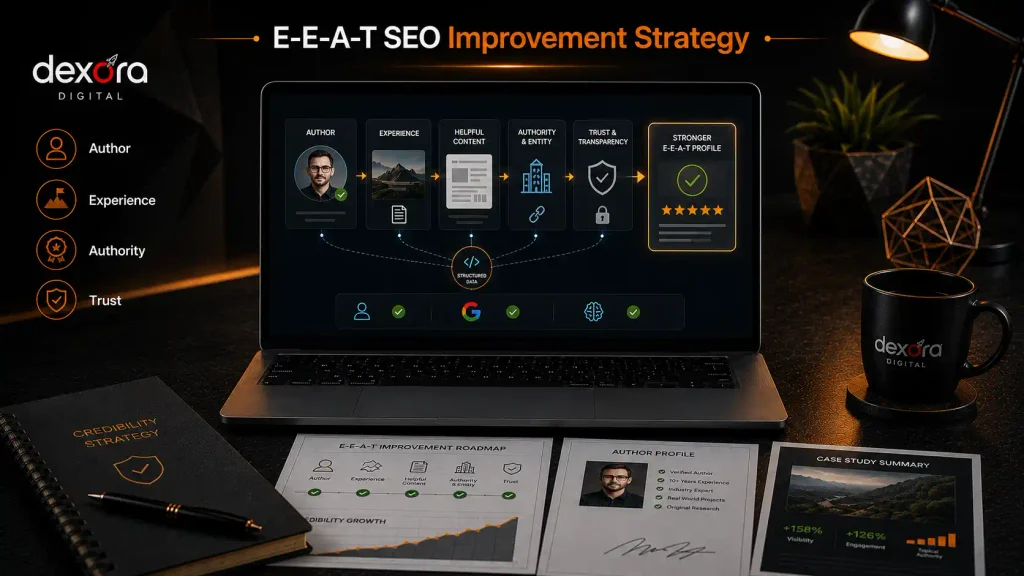
For businesses improving visibility in AI-powered search, combining E-E-A-T with Google AI Overviews optimization can help create clearer signals about expertise and relevance.
E-E-A-T Mistakes That Can Limit SEO Growth
Many websites struggle because they focus only on publishing content without building credibility.
Common mistakes include:
Publishing Anonymous Content
Content without clear authorship makes it difficult for users and search engines to understand expertise.
Creating Generic AI Content
AI-assisted content without human experience often lacks originality and practical value.
Making Unsupported Claims
Statements about results, expertise, or performance should be supported with evidence.
Ignoring Website Trust Elements
Missing contact information, unclear business details, or outdated pages can reduce credibility.
Focusing Only on Rankings
The goal of E-E-A-T is not simply ranking higher. It is creating a website that users genuinely trust.
E-E-A-T SEO Checklist
Before publishing important content, review:
- Does the content show real experience?
- Is the author clearly identified?
- Are claims accurate and supported?
- Does the website demonstrate expertise?
- Are business details transparent?
- Are customer trust signals visible?
- Does the content provide original value?
- Are related topics connected through internal links?
A website that consistently improves these areas builds stronger long-term search foundations.
How E-E-A-T Supports Long-Term SEO Success
E-E-A-T is not a shortcut for rankings. It is a framework for building a website that deserves visibility.
The strongest websites combine:
- Technical SEO
- Helpful content
- Real expertise
- Strong authority
- User trust
As search engines become more focused on understanding entities, context, and credibility, websites that demonstrate genuine value will have a stronger advantage.
E-E-A-T should not be viewed as an SEO tactic. It should be part of how a business communicates expertise online.
Frequently Asked Questions (FAQs)
1. What does E-E-A-T mean in SEO?
E-E-A-T stands for Experience, Expertise, Authoritativeness, and Trustworthiness. It describes the qualities Google evaluates when determining whether content is reliable, useful, and created by a credible source.
2. Is E-E-A-T a direct Google ranking factor?
No, E-E-A-T is not a direct ranking factor. Instead, it represents quality characteristics that align with the signals Google systems use to identify helpful and trustworthy content.
3. How does experience improve SEO?
Experience improves SEO by adding first-hand knowledge, original examples, and practical insights. Content created from real involvement often provides more value than generic information collected from other sources.
4. How can businesses improve E-E-A-T?
Businesses can improve E-E-A-T by showing expertise, adding author information, publishing original content, collecting reviews, improving transparency, and demonstrating real customer results.
5. Does AI-generated content hurt E-E-A-T?
AI-generated content does not automatically harm E-E-A-T. Problems occur when content lacks originality, accuracy, human review, or real expertise behind the information.
6. How does E-E-A-T affect AI search?
E-E-A-T helps AI systems understand whether content comes from reliable sources. Clear expertise, accurate information, and strong entity signals can improve content credibility.
7. What is the difference between E-A-T and E-E-A-T?
E-A-T included Expertise, Authoritativeness, and Trustworthiness. E-E-A-T added Experience to emphasize the importance of first-hand knowledge and real-world involvement.
8. Does E-E-A-T matter for local businesses?
Yes, local businesses benefit from E-E-A-T through reviews, customer experiences, transparent information, and proof of real-world service delivery.
9. How do you show expertise on a website?
You can show expertise through detailed author pages, case studies, original research, professional experience, testimonials, and content that demonstrates practical knowledge.
10. Can backlinks improve E-E-A-T?
Relevant backlinks can support authority because they show recognition from other websites. However, quality and relevance matter more than simply increasing backlink numbers.
11. How long does E-E-A-T improvement take?
E-E-A-T improvements are ongoing. Building authority, trust, and recognition usually requires consistent content quality, reputation building, and website improvements over time.
12. How can I audit my website’s E-E-A-T?
An E-E-A-T audit reviews author information, content quality, trust signals, brand credibility, technical SEO, and evidence of expertise across your website.
Build a More Trustworthy SEO Foundation
E-E-A-T SEO is becoming essential for businesses that want sustainable visibility in Google Search and AI-powered experiences.
By demonstrating real experience, sharing expertise, building authority, and improving trust signals, websites can create stronger connections with both users and search engines.
If you want to improve your website’s technical foundation, content credibility, and organic visibility, explore our SEO services in Finland and build a strategy focused on long-term search growth.