
Businesses entering the Finnish market often make one common mistake: they translate their existing keywords and expect the same SEO results.
However, Finnish search behaviour is influenced by language, culture, customer preferences, and local terminology. A keyword that performs well in another country may have little value in Finland.
Keyword Research Finland helps businesses discover the exact search terms Finnish customers use, understand search intent, analyze competitors, and build an SEO strategy based on real market data.
In this guide, we will explain how Finnish keyword research works, why localization matters, and how businesses can find profitable opportunities in the Finnish search market.
What Is Keyword Research Finland?
Keyword research is the process of identifying and analyzing the words and phrases people enter into search engines when looking for information, products, or services.
For the Finnish market, keyword research requires more than finding popular terms. Businesses need to understand how Finnish users search, what language variations they use, and which keywords represent genuine customer intent.
A successful keyword strategy answers important questions:
- What are Finnish customers searching for?
- Which keywords have business value?
- Which pages should target specific searches?
- What topics are competitors ranking for?
Unlike generic keyword research, Finnish keyword research focuses on market-specific data. It considers Finnish language patterns, local competition, and customer behaviour.
For businesses targeting Finland, keyword research should be the foundation of their SEO strategy. A strong SEO services in Finland approach begins by understanding the search terms that connect businesses with their ideal customers.
Why Keyword Research Is Different in the Finnish Market
Every country has different search patterns, and Finland has several unique characteristics that make keyword research challenging.

Finnish users often search using their native language, especially when looking for local businesses, services, and products. This means international keyword strategies cannot simply be copied into the Finnish market.
Finnish keyword research considers:
- Local language preferences
- Search habits
- Consumer behaviour
- Industry terminology
- Regional searches
- Competitor positioning
For example, a company targeting Finland may discover that the keyword they translated from English is not the phrase Finnish users actually use.
The search engine does not only analyze individual words. It tries to understand the meaning, intent, and relevance behind every query.
This is why businesses need a localized approach rather than a simple translation process.
A complete local SEO Finland guide can help businesses understand how location-based searches and Finnish customer behaviour influence visibility.
Finnish Language Creates Unique SEO Challenges
The Finnish language creates specific challenges for SEO because users can search for the same topic using different word forms and variations.
Finnish includes:
- Multiple grammatical forms
- Compound words
- Different endings
- Alternative expressions
A direct translation may be grammatically correct but still fail to match real search behaviour.
For example:
English keyword:
SEO agency Finland
Possible Finnish variations:
- SEO-toimisto
- hakukoneoptimointi
- SEO palvelut
- hakukoneoptimointi yritykselle
All of these terms relate to SEO services, but they may represent different search behaviours.
Professional keyword research identifies which terms:
- Have actual search demand
- Match customer intent
- Have ranking opportunities
- Support business goals
The goal is not to translate words.
The goal is to understand how Finnish customers think and search online.
Why Direct Keyword Translation Does Not Work in Finland
Many businesses entering Finland start with keywords from another country and translate them directly.
This approach often fails because search behaviour is not identical between markets.
A keyword successful in Germany, the United States, or another European country may not have the same meaning or demand in Finland.
Effective Finnish keyword localization includes:
- Translating initial keyword ideas
- Checking Finnish search volume
- Reviewing search results
- Studying competitors
- Understanding user intent
For example, an ecommerce company may translate product categories from German into Finnish. However, customers may use completely different terms when searching for those products.
Keyword research helps identify the language customers already use instead of forcing unfamiliar terminology.
Before creating a keyword strategy, businesses should also analyze their current website performance through an SEO audit Finland to identify technical issues and existing opportunities.
How to Perform Keyword Research Finland Step-by-Step
A successful Finnish keyword strategy requires a structured process. The objective is not to collect thousands of keywords but to identify the terms that connect your business with people who are most likely to become customers.
Because Finnish has unique language characteristics, keyword research should include linguistic analysis, search intent evaluation, competitor research, and market understanding. Finnish keywords often require more manual review because word forms, compound words, and local expressions can affect how users search.
A professional keyword research process follows these steps:
1. Understand Your Finnish Audience and Market
Before opening any SEO tool, understand the people you want to reach.
Keyword research starts with customer research.
Ask:
- Who are your Finnish customers?
- What problems are they trying to solve?
- Are they searching for information, comparing options, or ready to purchase?
- What language do they use when describing their needs?
For example, a company selling accounting software in Finland should not only research “accounting software Finland.” It should understand how Finnish businesses describe their problems.
Customers may search for:
- Accounting solutions for companies
- Business finance software
- Automated bookkeeping tools
The best keywords usually come from understanding customer behaviour, not only from SEO tools.
2. Create a Seed Keyword List
Seed keywords are the foundation of keyword research.
These are broad terms related to your products, services, or industry.
Sources for seed keywords include:
- Your existing website pages
- Customer questions
- Sales conversations
- Competitor websites
- Industry terminology
- Google autocomplete suggestions
For a Finnish SEO agency, seed keywords may include:
- SEO Finland
- SEO agency Finland
- hakukoneoptimointi
- SEO services
- Google ranking Finland
At this stage, the goal is exploration. Do not remove keywords too early because valuable opportunities often appear during deeper analysis.
3. Localize Keywords for the Finnish Market
Localization is one of the most important steps in Finnish keyword research.
Many businesses make the mistake of translating their existing keywords directly into Finnish.
However, translation does not always represent real search behaviour.
A Finnish customer may use a completely different phrase than the translated version of an English keyword.
For example:
English keyword:
“best running shoes”
A direct translation might not match actual Finnish searches.
Finnish users may search with terms related to:
- Reviews
- Recommendations
- Testing results
- Experiences
Finnish keyword research requires checking how people actually search, not assuming what they search.
During localization, analyze:
- Finnish wording
- Common expressions
- Compound words
- Search variations
- Customer language
4. Analyze Finnish Keyword Data
After creating a keyword list, evaluate each keyword based on SEO and business value.

Important metrics include:
Search Volume
Shows how often users search for a keyword.
However, lower search volume does not always mean a keyword is less valuable.
Finland is a smaller market compared with English-speaking countries, so many valuable keywords naturally have fewer searches.
Keyword Difficulty
Keyword difficulty shows how competitive a keyword is.
A keyword with extremely strong competitors may require significant resources.
Sometimes targeting more specific long-tail keywords provides faster opportunities.
Search Intent
Search intent explains why someone searches for a keyword.
A keyword may be:
- Informational
- Commercial
- Transactional
- Navigational
The best keywords are those that match both customer needs and business goals.
Keyword research should prioritize relevance and intent instead of only focusing on search volume.
5. Analyze Competitor Keywords in Finland
Competitor research helps identify opportunities that your website may be missing.
Your competitors already provide Google with signals about:
- Important topics
- Ranking pages
- Keyword relationships
- Content expectations
Analyze:
- Which keywords competitors rank for
- Which pages receive traffic
- Their content structure
- Missing topics you can cover better
For example, if competitors rank for “SEO Finland” but only explain basic SEO concepts, you can create a stronger resource covering:
- Finnish search behaviour
- Keyword localization
- AI search optimization
- Local SEO
- Content strategy
The goal is not copying competitors.
The goal is finding gaps where your website can provide more value.
6. Group Keywords Into Topic Clusters
Modern SEO does not rely on creating separate pages for every keyword.
Search engines understand relationships between topics.
Keyword clustering groups related searches together and helps create stronger content structures.
Example:
Main topic:
Keyword Research Finland
Related keywords:
- Finnish keyword research
- SEO keywords Finland
- Finnish SEO strategy
- local keyword research Finland
- ecommerce keyword research Finland
These keywords can support one comprehensive resource instead of creating multiple thin pages.
A well-organized keyword cluster also improves internal linking and helps search engines understand your website authority around a topic.
A strong internal linking strategy connects related pages and distributes relevance across your website.
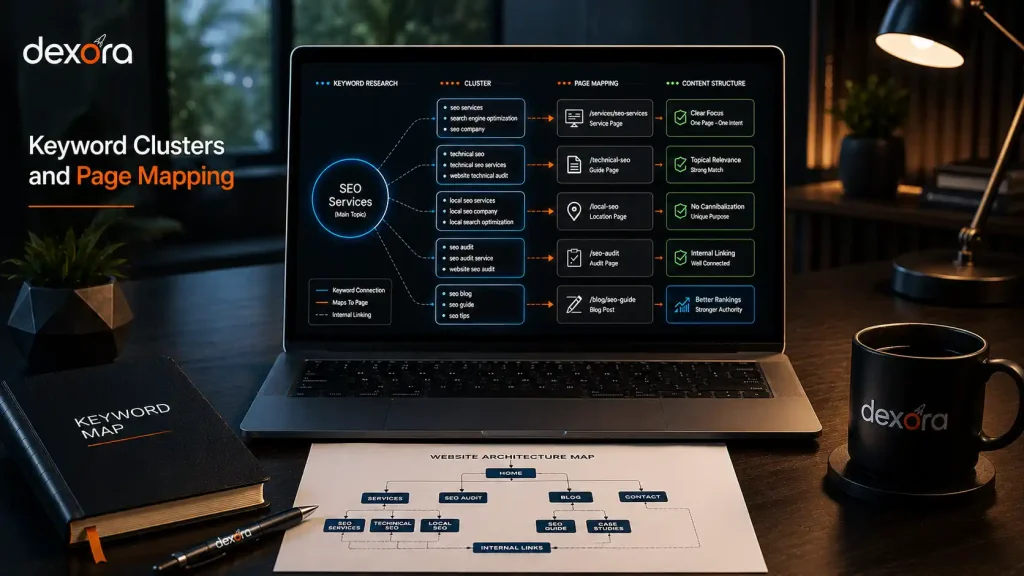
7. Map Keywords to the Right Pages
Keyword research becomes valuable when every keyword has a clear destination.
Keyword mapping connects search terms with website pages.
Example:
| Keyword | Intent | Page |
| SEO Finland | Commercial | SEO service page |
| Keyword research Finland | Informational/commercial | Blog guide |
| SEO Helsinki | Local | Location page |
| SEO audit Finland | Commercial | Audit service page |
This prevents keyword cannibalization and ensures every page has a clear purpose.
A website should answer:
“What search should this page rank for?”
If the answer is unclear, the page probably needs better keyword targeting.
8. Identify Long-Tail Keywords in Finland
Long-tail keywords are specific search phrases that usually have stronger intent.
Examples:
Broad keyword:
SEO agency Finland
Long-tail keyword:
SEO agency for small businesses in Finland
The second keyword may have fewer searches but often attracts users closer to making a decision.
Long-tail keywords are especially valuable in Finland because businesses can target specific customer needs instead of competing only for broad terms.
Examples:
- Service + city keywords
- Industry-specific searches
- Question-based searches
- Problem-solving queries
These keywords often produce highly qualified traffic.
9. Use Keyword Research for Content Planning
Keyword research should guide your entire content strategy.
Instead of randomly publishing articles, businesses can create content based on real search demand.
Keyword research helps identify:
- Blog topics
- Service pages
- FAQ sections
- Landing pages
- Supporting content
For example:
Keyword:
“technical SEO Finland”
Content opportunity:
A complete technical SEO guide for Finnish businesses.
Keyword:
“SEO audit Finland”
Content opportunity:
A service page explaining SEO audit benefits.
This approach creates content that supports both users and search engines.
10. Optimize Keywords for AI Search and Google AI Overviews
Modern keyword research is expanding beyond traditional Google rankings.
Users now search through:
- Google AI Overviews
- ChatGPT
- Voice assistants
- Conversational search
This means businesses should research not only short keywords but also natural questions.
Traditional keyword:
“SEO Finland”
AI-style query:
“Which SEO company in Finland helps small businesses improve Google rankings?”
AI systems need context.
Content should clearly explain:
- Who the business helps
- What expertise it provides
- How solutions work
- Why users should trust the information
Businesses improving AI visibility can also explore Google AI Overviews optimization to build stronger search presence.
Common Keyword Research Mistakes Businesses Make in Finland
Even businesses that understand the importance of SEO often make mistakes during keyword research. These mistakes can result in targeting the wrong audience, creating ineffective content, and losing valuable ranking opportunities.
The Finnish market requires a more careful approach because language, culture, and search behaviour strongly influence keyword performance.
Understanding these mistakes helps businesses create a stronger SEO foundation.
Mistake 1: Translating Keywords Without Localizing Them
One of the biggest mistakes international businesses make is assuming direct translation will produce the same SEO results.
A translated keyword may be grammatically correct but still not match how Finnish users search.
For example, a company may translate an English service term into Finnish and create content around it. However, Finnish customers may use another phrase that has:
- Higher search demand
- Better commercial intent
- Stronger relevance
Keyword localization requires analyzing actual Finnish searches instead of relying only on language translation.
Mistake 2: Choosing Keywords Only Based on Search Volume
Search volume is important, but it should not be the only decision factor.
A keyword with thousands of monthly searches may not generate business results if it attracts the wrong audience.
A more effective strategy considers:
- Search intent
- Competition
- Conversion potential
- Customer journey stage
For Finnish businesses, highly targeted keywords often provide better opportunities because the market is smaller and more specialized.
For example:
A broad keyword:
“SEO”
may attract general information seekers.
A targeted keyword:
“SEO agency for small businesses Finland”
has clearer business intent.
Mistake 3: Ignoring Finnish Search Intent
The same keyword can represent different goals depending on the user.
A person searching:
“SEO tools”
may want software recommendations.
A person searching:
“SEO company Finland”
is likely looking for professional services.
Creating content without understanding intent often results in pages that rank poorly because they do not satisfy what users expect.
Every keyword should answer:
- What does the user want?
- What stage of the buying journey are they in?
- What type of content should rank?
Mistake 4: Researching Keywords Without Competitor Analysis
Keyword research should not happen in isolation.
Competitors already provide valuable information about:
- Topics Google considers important
- Pages that perform well
- Keyword opportunities
- Content gaps
A proper competitor analysis identifies:
- Missing information
- Weak content areas
- Better ways to answer user questions
The objective is not to copy competitors.
The objective is to understand the market and create something more useful.
Mistake 5: Creating Content Without Keyword Mapping
Many businesses collect keywords but never connect them with specific pages.
This creates problems such as:
- Multiple pages competing for the same keyword
- Important keywords not being targeted
- Unclear website structure
Keyword mapping creates a clear relationship between:
Keyword → Page → Search Intent → Business Goal
This makes content planning more effective and improves overall website organization.
How Dexora Digital Approaches Keyword Research Finland
Effective keyword research requires understanding both data and people.
At Dexora Digital, our approach combines Finnish market research, SEO analysis, and search intent evaluation to identify opportunities that support real business growth.
Our keyword research process includes:
Market and Audience Analysis
We first understand:
- Target customers
- Industry terminology
- Business goals
- Customer search behaviour
This ensures keyword selection is connected to actual users.
Competitor Keyword Analysis
We analyze competitors to discover:
- Ranking opportunities
- Content gaps
- Keyword patterns
- Search intent signals
This helps identify areas where businesses can compete more effectively.
Finnish Keyword Localization
Instead of translating keywords, we evaluate:
- Finnish search terms
- Local expressions
- Search demand
- User behaviour
This creates keyword strategies that match the Finnish market.
Keyword Clustering and Content Planning
We organize keywords into topic groups to create:
- Service pages
- Blog content
- Landing pages
- Supporting resources
This improves topical authority and creates a stronger SEO structure.
AI Search Optimization
Search behaviour is changing.
Modern keyword research also considers:
- Conversational searches
- Question-based queries
- AI-generated answers
- Entity relationships
Businesses that understand these changes can prepare their websites for future search experiences.
A complete AI-focused SEO approach can be supported through AI SEO Finland GEO guide to improve visibility across emerging search platforms.
How to Choose the Right Keywords for Your Finnish Business
The best keywords are not always the ones with the highest search volume.
The right keywords should:
- Match your target audience
- Reflect real customer searches
- Have clear business value
- Match the purpose of your page
- Support your overall SEO strategy
A successful keyword strategy balances:
Search demand + Competition + User intent + Business goals
When these elements work together, keywords become a growth tool instead of just a ranking target.
Frequently Asked Questions About Keyword Research Finland
1. What is keyword research Finland?
Keyword research Finland is the process of finding and analyzing search terms used by Finnish audiences to improve website visibility, content strategy, and SEO performance in the Finnish market.
2. Why is Finnish keyword research different from other countries?
Finnish keyword research differs because language structure, customer behaviour, local terminology, and search habits influence how users search compared with other markets.
3. Can I use translated keywords for Finland?
Translated keywords are a starting point, but they should be localized and validated with Finnish search data to ensure they match real customer searches.
4. How do you find Finnish keywords?
Finnish keywords are discovered through SEO tools, competitor analysis, Google data, customer research, and understanding local language patterns.
5. Which tools are best for Finnish keyword research?
Popular tools include Google Keyword Planner, Google Search Console, Ahrefs, Semrush, and Google Trends for analyzing Finnish search opportunities.
6. Is keyword research important for ecommerce websites in Finland?
Yes, keyword research helps ecommerce businesses create better product categories, optimize product pages, and target searches used by Finnish shoppers.
7. How often should keyword research be updated?
Keyword research should be reviewed regularly because search trends, competition, customer behaviour, and market conditions continue changing.
8. Does keyword research improve Google rankings?
Keyword research improves rankings by helping businesses create relevant pages that match user searches, search intent, and Google’s understanding of topics.
9. Can keyword research help with AI search visibility?
Yes, keyword research helps identify conversational queries and topics that allow content to better answer questions in AI-powered search experiences.
10. What is the difference between keyword research and keyword mapping?
Keyword research identifies valuable search terms, while keyword mapping assigns those terms to specific pages based on intent and SEO goals.
Build a Finnish SEO Strategy Based on Real Search Behaviour
Keyword Research Finland is the foundation of successful SEO in the Finnish market.
Businesses that understand local search behaviour can create better content, improve visibility, and connect with customers using the language they naturally search.
The future of SEO is not about targeting more keywords. It is about understanding users, answering their questions, and building content that search engines can confidently recommend.
If you want to discover the keywords your Finnish customers are searching for and build a data-driven growth strategy, explore our SEO services in Finland and start improving your organic visibility.