
Local SEO in Finland helps businesses become more visible when people search for nearby products, professional services or companies within a specific Finnish city or region.
It combines Google Business Profile optimization, Google Maps visibility, localized website content, technical SEO, reviews, business information and authority signals.
For a dentist in Helsinki, an electrician in Tampere, a restaurant in Turku or a professional service provider in Oulu, national rankings alone are often not enough. The business needs to be visible where customers are actually searching.
Google explains that local results are primarily determined by relevance, distance and prominence. That makes local SEO different from simply placing city names into website content.
A strong strategy connects your Google presence with your website, location information, reputation and broader SEO services in Finland.
What Is Local SEO in Finland?
Local SEO is the process of improving a business’s visibility for searches connected to a physical location or service area.
A normal organic search might be:
“accounting software for small companies”
A local search could instead be:
“accountant Helsinki”
or:
“electrician near me”
The second type carries a geographical requirement. Google therefore has to determine not only which business is relevant but also where it operates and how suitable it is for the searcher.
This is why local SEO typically connects two major assets: the business website and the Google Business Profile.
A well-optimized website explains services, expertise and locations in depth. The Business Profile helps Google and potential customers understand operational information such as the business category, location, opening hours, contact information, reviews and other details.
Finland-focused competitors also emphasize this combination. Waahtera, for example, connects regional landing pages with Google Maps visibility, while VisibleLocal combines Business Profile work with website SEO, reviews and local directory information.
Businesses that need a broader organic foundation should therefore treat local SEO as part of their overall search engine optimization strategy, not as an isolated marketing activity.
How Does Google Rank Local Businesses?
Google’s official local-ranking guidance gives businesses a useful framework because it identifies three main considerations: relevance, distance and prominence.
| Local Ranking Factor | What It Means | What a Business Can Improve |
| Relevance | How closely the business matches what the user is searching for | Accurate categories, services, website content and complete business information |
| Distance | How far the business is from the location connected with the search | Accurate address or service-area information; distance itself cannot simply be optimized away |
| Prominence | How well-known and established the business appears | Reviews, links, mentions, authority and overall reputation |
Relevance
Relevance is about matching the searcher’s need.
If someone searches for an emergency plumber in Tampere, Google needs sufficient information to understand whether a business actually provides emergency plumbing services and operates in the relevant area.
This makes accurate categories, service information and locally relevant website content important. Google also recommends keeping Business Profile information complete and accurate because complete information makes it easier to match businesses with relevant searches.
Distance
Distance is more difficult because it depends partly on the searcher’s location or the place mentioned in the query.
A business cannot legitimately manipulate its physical distance from a potential customer.
This is why creating fake locations, virtual offices or misleading addresses is not a sustainable local SEO strategy. Google requires businesses to represent their real-world location and operations accurately.
Prominence
Prominence reflects how established or well-known a business appears.
Google states that information available across the web can contribute to prominence and that review count and review score can influence local search ranking.
For businesses in competitive Finnish cities, prominence can become particularly important when several companies offer similar services within the same area.
Google Business Profile Checklist for Finnish Businesses
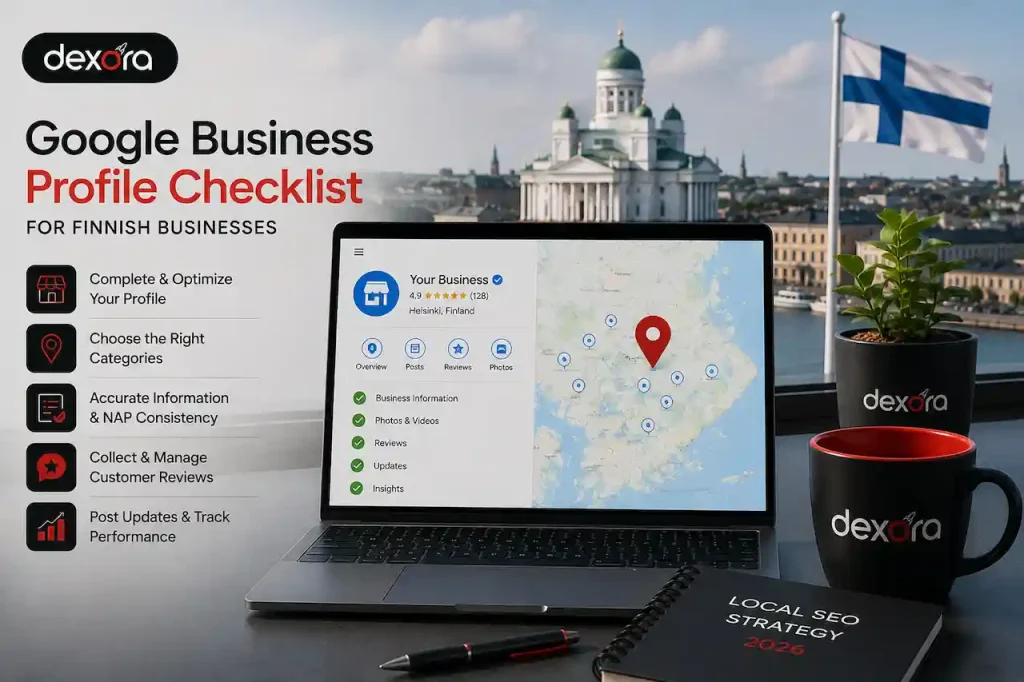
A Google Business Profile is one of the most important assets in local search, but optimization should begin with accuracy rather than keyword stuffing.
Google’s guidelines require profiles to reflect businesses as they exist in the real world.
A practical 2026 checklist looks like this:
| GBP Element | Recommended Approach |
| Business name | Use the genuine real-world business name |
| Primary category | Select the category that most accurately describes the main business |
| Additional categories | Add only categories that genuinely represent additional services |
| Address | Use an accurate eligible physical address |
| Service area | Define genuine locations the business actually serves |
| Opening hours | Keep normal and special hours accurate |
| Phone | Use the authoritative business phone number |
| Website | Link to the most appropriate business website or relevant location page |
| Services | Describe genuine services clearly |
| Photos | Add current, representative business images |
| Reviews | Encourage genuine customer feedback and respond professionally |
| Updates | Keep important business information current |
Google specifically recommends verification, accurate information, review responses and photos or videos as ways businesses can improve their local presence.
The goal is not to insert the phrase “best plumber Helsinki” into every available field. The profile should help Google understand the business and help a potential customer decide whether it meets their needs.
The same principle should apply to the website. If your GBP says one thing while your website says something different, the overall business information becomes less clear.
How to Optimize Your Website for Local Search in Finland
A Google Business Profile alone is not a complete local SEO strategy. Your website provides much of the detailed information that supports service relevance, geographic context and conversions.
Create genuinely useful location pages
If a company operates in several Finnish markets, dedicated location pages can make sense when each page serves a real audience.
For example, a business serving Helsinki, Espoo and Vantaa may need separate pages when services, customer needs, examples, contact information or operating details meaningfully differ.
What should be avoided is producing dozens of pages where only the city name changes.
A useful local page should explain the service in that area, demonstrate actual experience and make the next step clear.
This approach also matches what Finland-focused competitors are already doing. Waahtera uses regional location architecture for areas such as Tampere, Helsinki, Vantaa and Nokia while connecting it with broader SEO services.
Optimize pages around local search intent
Local keyword research should identify the way customers combine services and locations.
A potential customer may search using a city, municipality, neighbourhood or broader region.
The important point is to match genuine search intent rather than mechanically repeating location keywords.
The page title, H1, introduction, relevant subheadings, body content, internal links and contact information should collectively make the page topic clear.
Your most important local pages should also connect naturally with relevant technical SEO services because crawlability, indexing and site structure still affect whether location content can perform.
Keep technical signals clean
Local SEO depends on the same technical foundation as conventional SEO.
Search engines must be able to crawl important pages, understand canonical URLs and move logically between services and locations.
For sites with technical uncertainty, a Technical SEO Checker can help identify basic crawl, indexation and implementation issues before more local content is added.
If the underlying site needs structural improvements rather than only SEO changes, the website development service may also be relevant.
How Reviews, Citations and Authority Support Local SEO
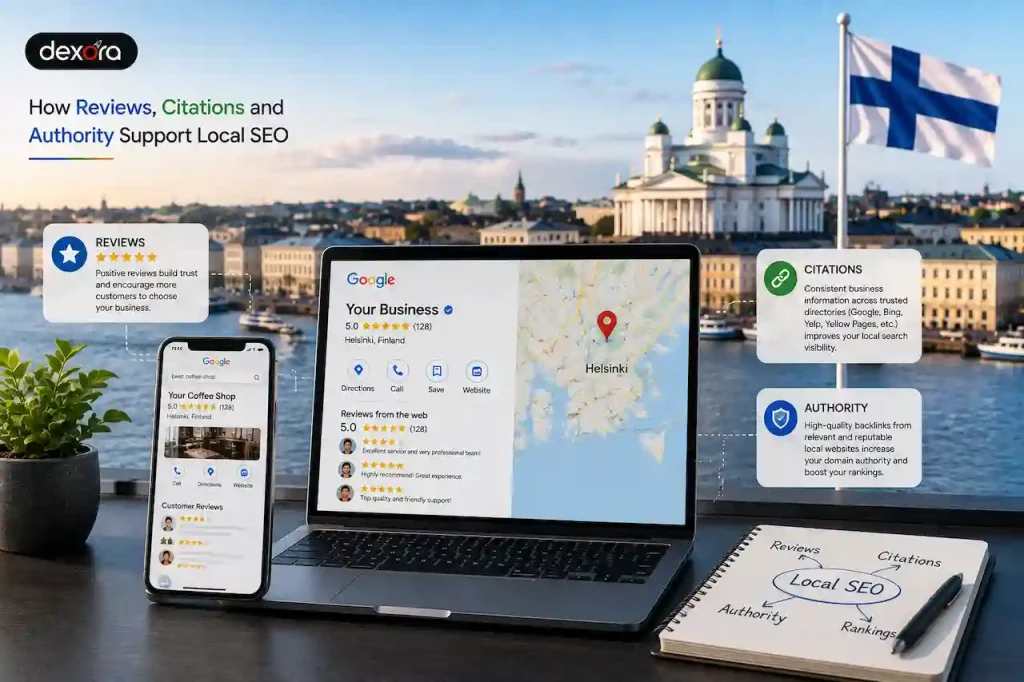
Reviews matter for two reasons: they influence how customers evaluate a business, and Google confirms that review count and review score can contribute to local ranking.
Businesses should therefore build a normal process for requesting genuine feedback after real customer interactions.
Responses matter too. A professional response demonstrates that the business actively manages customer relationships. Google explicitly recommends responding to reviews as part of improving local presence.
Negative reviews should not automatically be reported simply because they are unfavorable. Google states that reviews are generally eligible for removal only when they violate its policies.
Keep business information consistent
Local citations are references to business details on directories and other websites.
For Finnish businesses, these may include relevant national directories, industry-specific websites, local organizations and trusted platforms.
VisibleLocal, one of the Finland-focused providers surfaced in our competitor research, specifically emphasizes consistent name, address and phone information across services such as Google, Fonecta, Finder and other directories.
The objective should be accuracy and authority, not submitting the company to hundreds of low-quality directories.
A strong About Us page can further reinforce clear company information, expertise and organizational identity.
Local SEO for Service-Area and Multi-Location Businesses
Not every local business has a shop or office customers visit.
A cleaning company, electrician, repair provider or other mobile business may travel to customers instead.
Google allows eligible service-area businesses to hide an address when customers are not served there and specify the area where services are provided.
The important principle is accuracy.
A company should not create fake offices simply to appear in additional Finnish cities. Google requires Business Profiles to represent genuine business operations and makes some online-only and lead-generation business models ineligible for Business Profiles.
Multi-location companies
A genuine multi-location company should develop each location around its actual operations.
Each valid location may have different opening hours, contact details, services, customer examples or geographic priorities.
The website architecture should make these relationships understandable. A main service page can establish the overall offering, while location pages provide specific regional context.
For companies operating throughout Finland, this structure can also connect to broader SEO services in Finland rather than trying to make every city page function independently.
How to Measure Local SEO Results
Local SEO should be measured against business outcomes, not only rankings.
A company can rank differently depending on where a search is performed because distance is part of Google’s local ranking system.
This means checking the same keyword manually from one computer provides an incomplete view.
Google Business Profile performance data can provide information about views, clicks and customer interactions from Search and Maps.
A useful reporting model connects those signals with website analytics, Search Console and actual enquiries.
For example, a local SEO campaign should determine whether improved visibility is producing more relevant visits, calls, bookings, forms or sales—not simply whether a map listing moved from one arbitrary position to another.
The core performance indicators will vary by business, but four are especially useful:
- Local organic and Maps visibility
- Qualified website visits from target areas
- Calls, enquiries, bookings or direction requests
- Conversions and revenue generated from organic discovery
Dexora Digital’s portfolio can also be used to evaluate practical digital marketing work rather than judging an SEO provider only by promises.
Common Local SEO Mistakes to Avoid in 2026
One of the most common mistakes is treating local SEO as keyword insertion.
A business adds a city name repeatedly, creates many near-identical pages and expects Maps visibility to follow.
Google’s own model shows why this is incomplete. Relevance is only one part of local ranking; distance and prominence also matter.
Another mistake is allowing outdated profile information to remain live. Wrong hours, old phone numbers or inaccurate addresses can frustrate users and weaken the clarity of the business information Google receives.
Businesses should also avoid fake locations and misleading profile names. Google’s Business Profile guidelines require accurate representation of the real business.
Finally, local SEO should not be treated as a one-time setup.
Competitors change. Reviews accumulate. Services evolve. Websites are updated. Search demand changes.
A sustainable local search process reviews performance, keeps information accurate, improves useful local content and strengthens genuine authority over time.
Frequently Asked Questions About Local SEO Finland
What is local SEO in Finland?
Local SEO in Finland improves a business’s visibility for geographically relevant searches on Google Search and Google Maps, connecting website optimization with location, Business Profile, reviews and local authority.
How does Google rank local businesses?
Google says local rankings are primarily based on relevance, distance and prominence. Businesses can improve relevance and prominence, while physical distance depends largely on the searcher’s location.
Is Google Business Profile important for local SEO?
Yes. For eligible local businesses, Google Business Profile provides essential information used across Google Search and Maps, including location, hours, contact details, photos, services and customer reviews.
How do I rank higher on Google Maps in Finland?
Start with an accurate Business Profile, correct categories, strong service and location relevance, genuine reviews, a well-optimized website and broader authority. There is no guaranteed Maps position.
Do Google reviews affect local rankings?
Yes. Google states that review count and review score can influence local search ranking. Reviews also provide prospective customers with useful evidence about previous customer experiences.
Do I need a physical office for local SEO?
Not always. Eligible service-area businesses can use Google Business Profile without displaying an address when they travel to customers rather than serving customers at their premises.
Should I create a page for every Finnish city?
Only when each page addresses genuine location-specific demand and provides useful regional information. Mass-producing nearly identical pages with swapped city names provides little value to users.
What is NAP consistency?
NAP means name, address and phone number. Keeping these core business details accurate across your website, Google Business Profile and important external listings reduces conflicting information.
What are local citations?
Local citations are online references to a company’s business information. Relevant directories, industry websites and local organizations can help reinforce the existence and prominence of a real business.
How long does local SEO take in Finland?
There is no fixed timeline. Competition, location, current authority, website condition, Business Profile quality and existing visibility all influence how quickly meaningful improvements may appear.
Can local SEO help a business outside Helsinki?
Yes. Local SEO applies throughout Finland wherever customers search geographically, including cities and regions such as Tampere, Turku, Oulu, Espoo, Vantaa and smaller local markets.
How should I measure local SEO performance?
Measure Maps and organic visibility alongside website visits, calls, bookings, enquiries and conversions. Google Business Profile performance also provides data about customer interactions across Search and Maps.
What is the difference between local SEO and normal SEO?
Traditional SEO can target national or topic-based searches. Local SEO adds geographic relevance, Google Maps, Business Profile optimization, local reviews and location signals for customers searching within specific areas.
Turn Local Searches Into Real Customers
Being visible locally is valuable only when that visibility brings the right customers to your business.
Dexora Digital combines local search strategy with technical SEO, website optimization and wider organic search work to identify what is limiting visibility and where the strongest opportunities exist.
Request your free SEO audit to find the local, technical and on-page issues that may be holding your business back in Google Search and Maps.
For a tailored local SEO strategy, contact Dexora Digital and discuss your target locations, services and growth goals.