
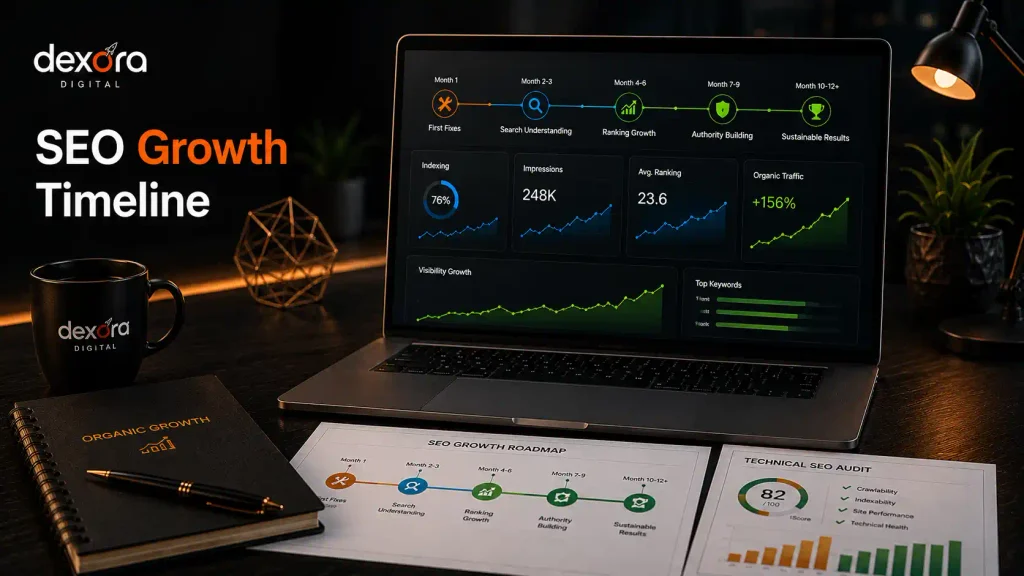
SEO does not work like paid advertising where results appear immediately after spending money. Organic growth requires search engines to understand your website, evaluate your content, and build confidence in your authority.
How long does SEO takes is a common question for businesses investing in organic growth. For most businesses, SEO starts showing measurable improvements within 3–6 months, while stronger traffic growth and competitive rankings often require 6–12 months or longer. The exact timeline depends on your website’s current condition, competition, content quality, technical foundation, and SEO execution.
A realistic SEO strategy is not focused only on ranking positions. It builds a long-term system that increases visibility, attracts qualified visitors, and creates sustainable business growth
SEO Results Do Not Happen at One Moment — They Develop in Stages
One of the biggest misunderstandings about SEO is expecting a single moment when results suddenly appear. SEO growth usually happens gradually.
Before a website receives significant traffic, Google needs to complete several steps:
- Discover and crawl your pages
- Understand your topics and keywords
- Compare your content with competitors
- Evaluate user behaviour
- Build trust through authority signals
A website may be improving long before the traffic numbers show major changes.
For example, during the early stages of SEO, you may notice:
- More pages appearing in Google
- Increased search impressions
- More keywords ranking
- Better engagement signals
These are early indicators that search engines are starting to recognize your website. A complete SEO audit Finland can identify the technical and content factors affecting how quickly your website can gain visibility.
The Real SEO Timeline: What Happens Behind the Scenes
Instead of thinking about SEO only in months, it is more useful to understand the different growth stages.
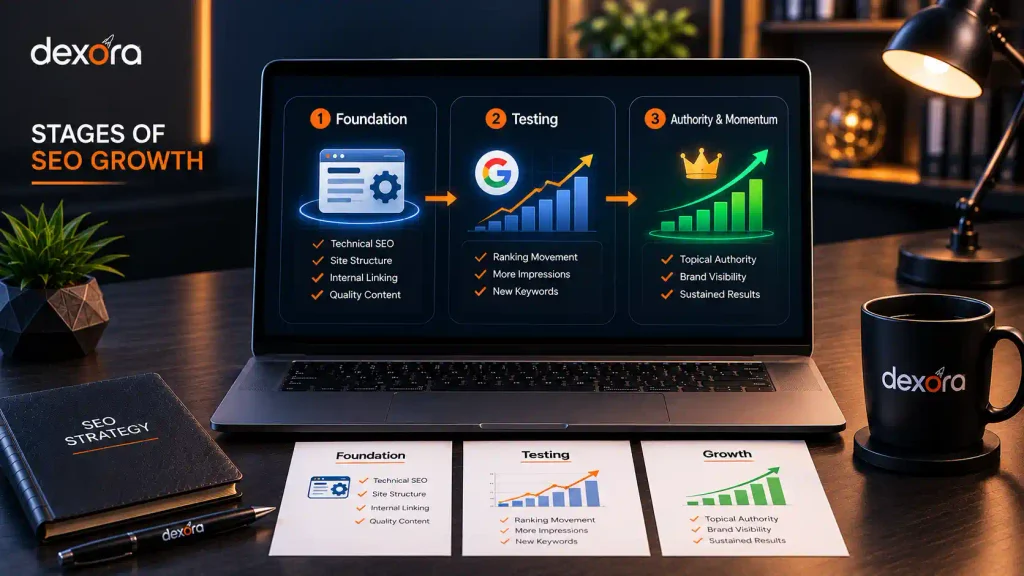
Stage 1: Google Understands Your Website
Approximate timeline: First 1–3 months
The first stage focuses on creating a strong foundation.
Search engines need to understand:
- What your website offers
- Which topics you are relevant for
- Which pages should rank for specific searches
- Whether your website provides a good experience
During this stage, SEO work usually includes:
- Technical SEO improvements
- Keyword research
- Website structure optimization
- Internal linking improvements
- Content optimization
- Indexing checks
A website with technical problems may delay progress because Google cannot properly crawl or evaluate important pages.
For example, improving site structure and fixing technical issues through a proper technical SEO checklist can help search engines better understand your website.
Stage 2: Google Tests Your Content and Rankings
Approximate timeline: Months 3–6
After Google understands your website, it begins testing your pages for different search queries.
During this phase, businesses often see:
- Ranking movements
- More impressions
- Increased keyword visibility
- Long-tail keyword growth
However, rankings may fluctuate.
A page may move:
Position 70 → Position 35 → Position 18 → Position 9
This process happens because Google continuously compares your content against competing pages.
The websites that provide the best combination of:
- Relevance
- Helpful information
- User experience
- Authority
usually continue moving upward.
Stage 3: SEO Builds Authority and Momentum
Approximate timeline: Months 6–12+
This is where SEO starts becoming a stronger growth channel.
Once a website has:
- Quality content
- Strong technical foundations
- Internal linking
- External authority
- Positive user signals
growth can begin compounding.
At this stage, businesses often focus on:
- Expanding topic coverage
- Improving existing pages
- Creating supporting content
- Building industry authority
SEO becomes more effective because every new improvement supports previous work.
A strong content ecosystem around related topics can improve visibility across multiple searches instead of relying on one keyword.
Why Some Websites Get SEO Results Faster Than Others
Not every website follows the same SEO timeline.
Some websites start gaining visibility within a few months, while others require a year or longer before seeing significant growth. The difference is usually not because SEO works differently for each website. It is because every website starts with a different level of authority, competition, and optimization.
The main factors that influence SEO speed include:
- Website history
- Industry competition
- Technical foundation
- Content quality
- Search intent alignment
- Authority signals
- SEO resources and execution
Understanding these factors helps businesses create realistic expectations instead of comparing their progress with unrelated websites.
Website Age and Existing Authority
A website with years of history usually has advantages over a completely new domain.
Older websites may already have:
- Indexed content
- Backlinks
- Brand recognition
- Search history
- Existing rankings
This gives Google more information about the website and its relevance.
A new website, however, needs time to establish trust.
Google must understand:
- What the website is about
- Whether the content is reliable
- How users interact with the website
- Whether other websites recognize it as valuable
This does not mean new websites cannot rank. A new website with excellent content, strong technical SEO, and a focused strategy can outperform older competitors.
Authority is earned through consistent optimization, not simply through domain age.
Competition Determines Your SEO Timeline
The difficulty of your target keywords has a major impact on how long SEO takes.
Ranking for a local or specific search term is usually faster than competing for broad, highly competitive keywords.
For example:
A keyword like:
“SEO agency Helsinki for startups”
has a narrower audience.
A keyword like:
“SEO agency”
has global competition from established companies with strong authority.
Highly competitive keywords require more:
- Content depth
- Backlinks
- Brand recognition
- Industry expertise
- Time
A realistic SEO strategy often starts by targeting valuable keywords where your website has a genuine opportunity to compete, then gradually moves toward more competitive terms.
Content Quality Directly Impacts SEO Growth
Publishing more content does not automatically create better rankings.
Search engines evaluate whether content actually helps users.
High-performing SEO content usually provides:
- Complete answers
- Original insights
- Clear explanations
- Practical examples
- Updated information
- Real expertise
For example, an article explaining SEO timelines should not only say “SEO takes 3–6 months.”
A stronger resource explains:
- Why timelines differ
- What happens during each stage
- What businesses should measure
- How to improve results
Google increasingly rewards content that demonstrates experience and provides meaningful value.
Technical SEO Can Speed Up Early Improvements
Technical SEO creates the foundation that allows other SEO activities to work properly.
A website may have excellent content, but technical issues can limit performance.
Common problems include:
- Slow loading speed
- Poor mobile experience
- Incorrect indexing
- Duplicate pages
- Broken links
- Weak site structure
Fixing technical issues can sometimes create faster improvements because Google can better access and evaluate existing pages.
Technical optimization should happen before investing heavily in content promotion because strong foundations support long-term growth.
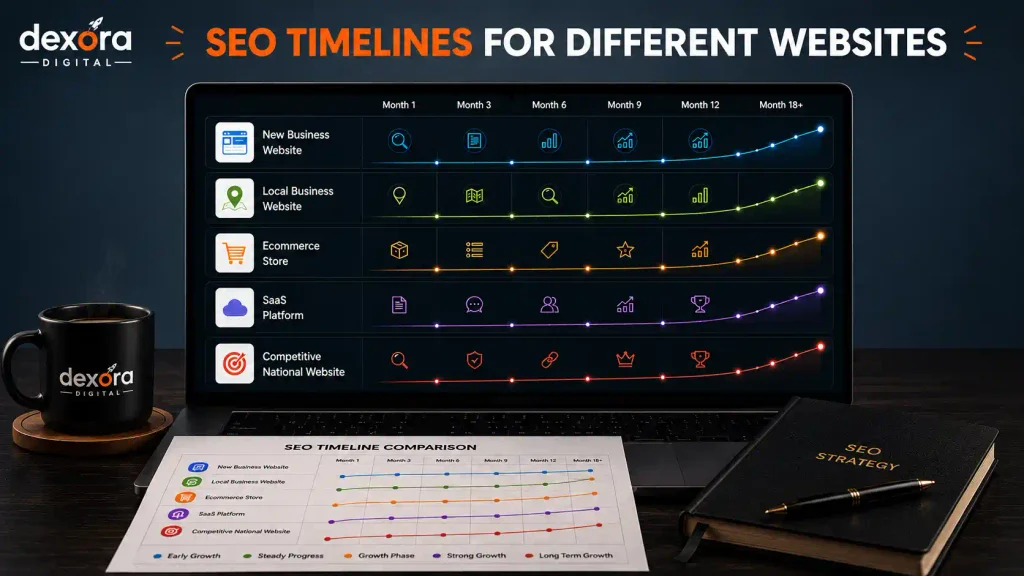
How Long Does SEO Take For Different Types of Websites?
SEO timelines vary depending on the business model, competition level, and website goals.
| Website Type | Typical SEO Timeline |
| New website | 6–12+ months |
| Local business website | 3–6 months |
| Ecommerce website | 6–12+ months |
| SaaS website | 6–18 months |
| Competitive national website | 12+ months |
These timelines are general expectations, not guarantees. A local business in a small market may see results faster than an ecommerce brand competing nationally.
How Long Does Local SEO Take?
Local SEO can often produce results faster than national SEO because the competition is usually more limited.
Businesses focusing on local searches need to optimize:
- Google Business Profile
- Local landing pages
- Customer reviews
- Local citations
- Location-based content
For example, a business targeting “SEO company Finland” competes nationally.
A business targeting “SEO company Tampere” competes within a smaller geographic area.
A successful local SEO strategy combines website optimization with strong local signals.
Businesses targeting Finnish locations can also improve their visibility through a dedicated Local SEO Finland strategy focused on regional search behaviour.
How Long Does Ecommerce SEO Take?
Ecommerce SEO usually requires more time because online stores often contain hundreds or thousands of pages.
SEO challenges include:
- Product page optimization
- Category structure
- Duplicate content
- Internal linking
- Search intent matching
- Technical crawl management
A new ecommerce store may need months to build visibility because Google needs to understand:
- Product relevance
- Category relationships
- Website authority
- Customer value
Successful ecommerce SEO focuses on both rankings and conversions. A page ranking for the right keyword is valuable only when it attracts customers who are ready to purchase.
How To Speed Up SEO Results Without Risking Rankings
SEO cannot be made instant, but the process can be made more efficient. The fastest improvements usually come from focusing on high-impact opportunities.
Improve Existing Content
Updating pages that already have rankings can produce faster results than creating everything from zero.
Look for pages ranking between positions 5–30 and improve:
- Content depth
- Search intent matching
- Internal links
- Titles and descriptions
Strengthen Internal Linking
Internal links help search engines understand relationships between pages.
A strong internal linking structure can:
- Improve crawling
- Distribute authority
- Support important pages
For example, connecting supporting SEO articles to important service pages helps build topical relevance.
A structured internal linking strategy helps websites create stronger topic relationships.
Target Realistic Keyword Opportunities
Many businesses waste time targeting keywords that are too competitive.
A better approach:
- Build visibility with achievable keywords
- Create topical authority
- Earn trust signals
- Move toward competitive terms
This creates sustainable growth instead of chasing impossible rankings.
How Long Does SEO Take for Google AI Overviews and AI Search?
Search is changing. Users are no longer only clicking traditional blue links. They are increasingly using AI-powered search experiences such as Google AI Overviews and conversational search tools to find information.

This change does not mean traditional SEO is disappearing. Instead, it means businesses need to build stronger signals around:
- Expertise
- Content quality
- Brand authority
- Entity understanding
- Helpful information
AI systems need reliable sources they can understand and reference. Websites that consistently demonstrate expertise and provide valuable answers have a stronger chance of appearing in AI-generated responses.
However, AI search visibility also takes time.
A website usually needs:
- Strong topical coverage
- Clear content structure
- Trusted information
- Consistent publishing
- Authority signals
Building these signals is a long-term process. Businesses focusing on future search visibility should consider combining traditional SEO with AI search optimisation Finland strategies to prepare their content for evolving search experiences.
Signs Your SEO Strategy Is Working Before Traffic Increases
Many businesses make the mistake of judging SEO only by traffic. However, traffic is usually a later result. Before significant traffic growth appears, several positive signals often happen first.
Increased Search Impressions
When Google starts showing your pages for more searches, impressions increase.
This means:
- Google is discovering your content
- Your website is becoming relevant for more queries
- Search engines are testing your pages
More impressions are often the first indication that SEO improvements are working.
More Keywords Entering Search Results
A successful SEO campaign usually increases the number of keywords a website ranks for.
For example:
Before SEO:
- 50 ranking keywords
After optimization:
- 300+ ranking keywords
Not every keyword immediately brings traffic, but increased keyword visibility shows growing search relevance.
Rankings Moving Upward
SEO progress often happens gradually.
A keyword may move through several stages:
- Page 8 → Page 4
- Page 4 → Page 2
- Page 2 → Page 1
Businesses should not only focus on position one. Moving hundreds of keywords closer to the first page creates significant future traffic opportunities.
Better User Engagement
Google evaluates how users interact with websites.
Positive engagement signals include:
- Users spending more time on pages
- Visitors exploring multiple pages
- Lower abandonment rates
- More conversions
A website that satisfies users has a stronger chance of maintaining rankings.
Common Mistakes That Delay SEO Results
Many businesses do not fail because SEO does not work. They fail because their strategy prevents growth.
Expecting Overnight Rankings
SEO requires time because search engines need evidence that your website deserves visibility.
A page published today usually cannot immediately outrank websites that have:
- Years of authority
- Thousands of backlinks
- Established content libraries
Successful SEO requires patience and consistent improvement.
Targeting the Wrong Keywords
A common mistake is choosing keywords only because they have high search volume.
A keyword should match:
- Your audience
- Your services
- Your business goals
- User intent
A lower-volume keyword that attracts potential customers can be more valuable than a high-volume keyword with no conversion potential.
Publishing Content Without Strategy
Creating random blog posts does not automatically improve rankings.
Effective content requires:
- Keyword research
- Topic planning
- Internal linking
- Search intent alignment
- Content updates
Every article should support a larger SEO goal.
Ignoring Existing Ranking Opportunities
Many websites already rank for valuable keywords but fail to improve those pages.
For example:
A page ranking at position 12 may only need:
- Better content
- Improved title
- Stronger internal links
- Additional examples
- Updated information
Improving existing pages is often faster than creating new pages from scratch.
Poor Internal Linking Structure
Internal links help search engines understand which pages are important.
Without proper internal linking:
- Important pages may remain weak
- Search engines may miss relationships between topics
- Authority may not flow effectively
A website should create clear connections between related content and important commercial pages.
Not Measuring the Right SEO Metrics
Rankings and traffic are important, but they are not the only measurements.
A complete SEO evaluation should monitor:
- Organic traffic
- Keyword growth
- Search impressions
- Click-through rate
- Conversion rate
- Leads generated
- Revenue impact
The goal of SEO is not simply higher rankings. The goal is business growth through organic visibility.
Frequently Asked Questions About How Long SEO Takes
1. How long does SEO take to show results?
Most websites begin seeing measurable SEO improvements within 3–6 months. Larger growth usually develops between 6–12 months depending on competition, authority, and optimization quality.
2. Can SEO work in 30 days?
SEO improvements can happen within 30 days, especially from technical fixes or existing page optimization. However, consistent traffic growth usually requires several months.
3. Why does SEO take so long?
SEO takes time because Google needs to crawl, evaluate, and compare your website against competitors before increasing rankings and visibility.
4. How long does Google take to rank a new website?
New websites often require 6–12 months because they need to build authority, trust signals, content depth, and search visibility from the beginning.
5. Does technical SEO improve rankings faster?
Technical SEO can create faster improvements when issues prevent crawling, indexing, or user experience. However, long-term rankings also require quality content and authority.
6. How long does local SEO take?
Local SEO often takes around 3–6 months, depending on competition, reviews, Google Business Profile optimization, and local authority signals.
7. How long does ecommerce SEO take?
Ecommerce SEO commonly takes 6–12 months because stores need optimized product pages, category structures, content, and authority to compete.
8. Can backlinks speed up SEO results?
Quality backlinks can improve authority and rankings, but earning trustworthy links requires time and should be combined with strong content.
9. How often should SEO strategies be updated?
SEO strategies should be reviewed regularly because competitors, algorithms, search trends, and customer behaviour continuously change.
10. Is SEO worth investing in?
SEO is valuable because it can generate consistent organic traffic, leads, and visibility without paying for every individual visitor.
11. Can AI tools replace SEO?
AI tools can support SEO research and content workflows, but human expertise, strategy, experience, and quality control remain essential.
12. What is the fastest way to improve SEO results?
The fastest improvements usually come from fixing technical issues, optimizing existing pages, improving internal links, and targeting realistic keyword opportunities.
Build a Long-Term SEO Strategy That Creates Real Growth
SEO is not a quick shortcut. It is a long-term investment that compounds when the right strategy is consistently executed.
The businesses that achieve sustainable organic growth focus on improving every part of the search experience:
- Technical foundation
- Helpful content
- User experience
- Authority building
- AI search readiness
A realistic SEO timeline helps businesses make better decisions and understand that rankings are built through continuous improvement.
If you want to understand your website’s SEO opportunities and create a strategy based on real search data, explore our SEO services in Finland and build a roadmap for sustainable organic growth.