
A website redesign should do more than make your business look current. For a company serving customers in Finland, it should make your services easier to understand, help visitors complete important tasks, and protect the search visibility you have already earned. This guide explains when to redesign, what to measure, how to control migration risks, and what to ask a web development partner before you approve a rebuild.
Short answer: Redesign when evidence shows the current site is holding back usability, business enquiries, maintainability or growth—not simply because its appearance is older. Keep working pages and URLs wherever practical, preserve search signals, and measure business outcomes before and after launch.
When does a Finnish business actually need a website redesign?
Not every site with an old visual style requires a complete rebuild. A focused update may solve the problem at lower cost and lower risk. Start by reviewing the following warning signs against real analytics, customer feedback and usability tests.
- Customers cannot quickly identify the offer. Visitors have to read multiple pages before they understand who you serve or how to contact you.
- Mobile journeys are awkward. Navigation, buttons, forms or pricing information are difficult to use on a phone.
- The website is technically fragile. Routine content edits break templates, plugins conflict, or the site depends on unsupported features.
- Important pages have poor organic discoverability. Service pages are hard to crawl, isolated in the architecture, or missing useful information that matches buyers’ questions.
- Leads are difficult to attribute. Your business cannot confidently distinguish form enquiries, calls, booked consultations and irrelevant traffic.
- The site’s positioning is outdated. You now offer different services or serve new markets, but the website still describes the old business.
For example, a B2B consultancy in Oulu may have an attractive homepage but little information about individual services. The right improvement could be dedicated service pages and clearer internal navigation rather than a full redesign. Conversely, an online store with an outdated product structure might need a wider architecture and UX project.
Redesign, refresh or rebuild: which approach should you choose?
| Option | Best when | Main work | SEO risk |
|---|---|---|---|
| Content and UX refresh | The platform and templates already work | Improve copy, navigation, CTAs and selected layouts | Usually limited if URLs and intent remain stable |
| Visual redesign | Brand presentation is outdated but site structure is sound | Update design components and mobile layouts | Moderate if changes alter headings or content visibility |
| Platform migration | Current CMS limits security, publishing or integrations | Move to another platform, migrate content and features | Higher: redirects, rendering, canonical and tracking must be checked |
| Full website rebuild | Architecture and technology no longer match business needs | Replan information architecture, content, design and implementation | Highest when URLs, content and templates change together |
The lowest-risk option that solves the actual business problem should normally be considered first. Scope depends on features, integrations, the number of templates, content migration needs and approval rounds—not on page count alone.
Five stages of an SEO-aware website redesign
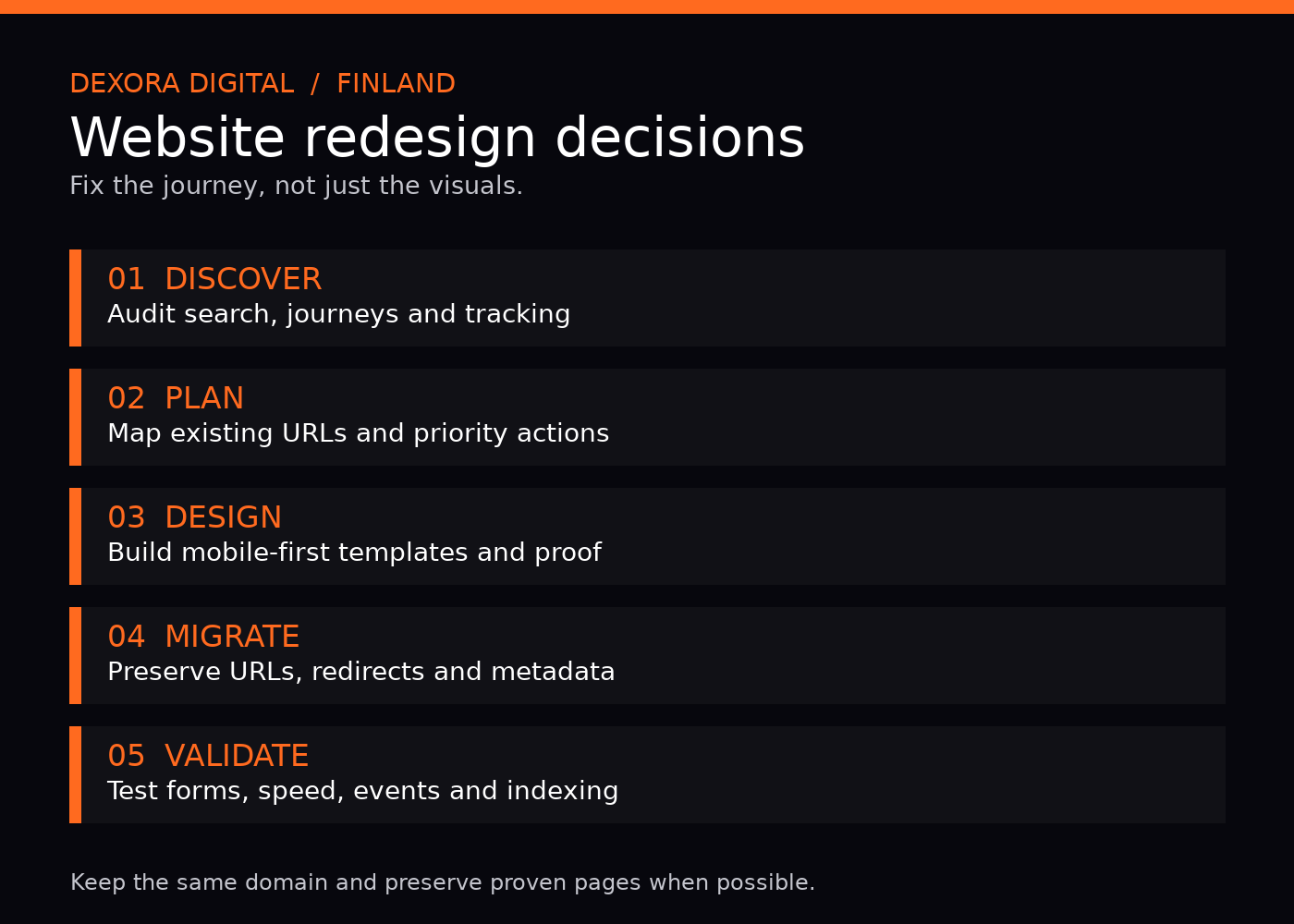
1. Discover: measure the current experience
Record a baseline before replacing any templates. Review top organic landing pages in Google Search Console, engagement and lead events in GA4, phone or booking data, and the most common questions from sales conversations. Run a crawl to identify current URLs, status codes, canonical signals, indexability, internal links, headings and metadata.
Separate the problems into discovery (customers cannot find a relevant page), clarity (customers do not understand the offer), and conversion (customers understand but cannot comfortably act). These categories prevent a visual redesign from becoming a substitute for solving marketing problems.
2. Plan: create a URL and content inventory
For each important existing URL, decide whether to retain, improve, consolidate or redirect it. Keep a spreadsheet with the old URL, intended new URL, primary search intent, current organic performance, migration action and owner. If you serve customers in Helsinki, Espoo, Tampere, Turku or elsewhere in Finland, build location-specific pages only when there is a real service and distinct local usefulness to explain. Avoid producing city pages that differ only by the city name.
Connect related topics: a website redesign guide should naturally link to SEO services, technical SEO, content strategy and the company’s contact or audit page. These links help people move to the next relevant decision.
3. Design: prioritize mobile usability and trust
Begin with the tasks visitors need to complete. Service pages should clarify the audience, problem, approach, proof and next action. Test that the navigation works with keyboard input, headings make sense, forms have labels, and text remains readable on smaller screens. Use authentic project examples and attributed testimonials when available; decorative trust badges and unsupported performance numbers can weaken credibility.
Design decisions should not assume everyone wants the same contact method. A visitor comparing agencies may want to examine work, while a ready-to-buy prospect may want a short enquiry form. Offer clear pathways without overwhelming the page with competing calls to action.
4. Migrate: preserve search and measurement signals
Before launch, map old-to-new URLs and test redirects. Preserve pages that already serve valuable search intent unless evidence justifies consolidation. Check that staging sites cannot be indexed, but ensure a production noindex setting does not accidentally carry over. Keep canonical links consistent, regenerate XML sitemaps only for valid canonical URLs, and inspect internal links for references to outdated paths.
For multilingual or multi-market businesses, do not casually rewrite hreflang, country targeting or cross-domain mappings as part of a design project. Review existing international SEO rules as a separate controlled workstream. A redesign is not a reason to replace working country relationships.
5. Validate: monitor leads, pages and search after launch
Test real user paths rather than stopping at a visual sign-off. Submit enquiry forms, check notification delivery, click phone and email links, verify booking flows, and inspect analytics events in debug mode. Spot-check the homepage, important service pages, blog posts and redirected URLs on desktop and mobile. Monitor Google Search Console for indexing anomalies and Google Analytics for significant changes in conversion journeys.
Google recommends prioritizing helpful, reliable, people-first content and a strong overall page experience. A new template does not automatically make a site more useful. See Google Search Central’s people-first content guidance for the underlying principles.
What should a website redesign cost in Finland?
There is no reliable universal price for a redesign. A small brochure site, a multilingual corporate website and an eCommerce store with product filters require very different amounts of work. A responsible quote should explain the deliverables: discovery, number of unique templates, copywriting, SEO migration, integrations, accessibility, testing, training and post-launch support.
Ask whether the quote includes redirect mapping, content entry, analytics/event testing, mobile QA, licences and documentation. A lower-priced design package that omits these items can lead to additional costs or lost organic traffic later. Compare like-for-like scopes rather than selecting by a headline price alone.
SEO, AEO and AI visibility after a redesign
Search and AI discovery are not separate excuses to create overlapping pages. Begin with a website that search engines can crawl, users can navigate and buyers can trust. Then organize helpful content around actual questions, cite verifiable evidence, and maintain accurate business information. AI systems may reference a page, but no legitimate optimization process can guarantee citations in ChatGPT or Google AI experiences.
If the site needs wider AI search planning, explore AI SEO, answer engine optimization and AI visibility monitoring. These should support clear user value rather than replace foundational technical SEO.
Website redesign launch checklist
| Area | Pre-launch check | Post-launch verification |
|---|---|---|
| Crawl and indexing | Inventory old URLs and index controls | 200/301 responses, canonical and robots checks |
| Content and headings | Preserve important search intent | Visible content, titles, H1 and internal links |
| Analytics and CRO | Document existing events and enquiries | Test form, call and booking conversion events |
| Mobile and accessibility | Check layout, labels and navigation | Test actual device interactions and errors |
| Performance | Establish field-data and lab baselines | Monitor Core Web Vitals and major templates |
| International SEO | Document existing locale/country mappings | Verify they remain intact without unapproved changes |
Frequently asked questions
Will redesigning my website improve Google rankings?
Not by itself. Better structure, clearer information and improved technical performance can help, while missing redirects or lost content can cause declines. Plan and measure the project carefully.
Should I keep my current website URLs?
Usually retain established URLs when they match the same service or topic and work well. Change them only with a documented reason and appropriate redirects.
Can I redesign a WordPress website without changing the CMS?
Yes. WordPress sites can often improve templates, navigation and content without changing platform. The decision depends on maintainability and required functionality.
Should my Finnish business website be in Finnish or English?
Choose language based on the actual customers you serve and the content you can maintain accurately. If an English-language site serves your audience and offers optional translation, maintain truthful language signals; machine translation alone does not create independently maintained localized landing pages.
How can I prevent lead tracking from breaking during launch?
Document existing tags and event names, test forms and calls before switching traffic, verify consent behavior where applicable, and compare actual lead records with analytics.
Does a redesigned website need FAQ schema?
Not automatically. Include FAQs when they genuinely help readers. Structured data should describe visible content accurately and does not guarantee special search features.
Choose the right redesign scope
A strong redesign begins with evidence: what customers need, which pages already work, and where friction prevents enquiries. Dexora Digital supports businesses in Finland with organic search strategy, technical SEO, website improvements and conversion-focused planning. If you are considering changes to your existing site, request a free initial website review or contact the team to discuss priorities.