Getting visitors to your website without receiving useful enquiries is frustrating, but it does not automatically mean SEO is failing. The real problem might be search intent, unclear service positioning, a difficult mobile form, broken measurement or a mismatch between the audience and the offer. This guide gives businesses serving Finland a practical diagnostic process before investing in more traffic.
Start here: compare the quality and intent of traffic with the conversion path. Confirm that forms, calls and bookings actually work, then identify the highest-friction step. Do not assume every visitor should become a lead.
First: define what counts as a qualified lead
A form submission is not always a business opportunity. Define the audience, service fit, geographic coverage and next step. A consultancy might count an enquiry as qualified when the prospect needs a service it offers and provides enough information for a meaningful response. A retailer may measure completed orders instead. Keep form completions, qualified enquiries and closed business separate in reports.
For measurement setup, use our conversion tracking guide for Finland. It explains how analytics events and CRM stages can support one another without pretending every event equals revenue.
Seven reasons visitors are not becoming enquiries
1. The traffic does not match buying intent
Informational blog traffic can be valuable for awareness, but readers researching a definition may not be ready to purchase. Review landing pages and available search queries by intent: informational, comparison, commercial and navigational. Do not judge a beginner guide by the same conversion expectation as a service pricing page.
2. The page does not clearly explain who the service is for
A visitor should quickly understand what you offer, which problems you solve, who you serve and what to do next. Replace generic claims with specific descriptions of the work and process. For Finland-wide services, say where you can genuinely deliver rather than implying local offices you do not have.
3. Calls to action are vague or compete
“Learn more” can be appropriate for educational content, but a service page may need a clearer next step such as requesting an assessment or discussing a project. Avoid placing several equally prominent buttons with unrelated actions in the same section. Make the next step match the visitor’s stage of decision-making.
4. Mobile navigation or forms create friction
Test the full journey on an actual phone: menu, service selection, form fields, validation, confirmation and email delivery. Check keyboard accessibility and whether labels remain visible. A form that looks good in a desktop preview may still be difficult to complete on mobile.
5. The website lacks evidence needed to trust the offer
Visitors may need clear deliverables, process details, real examples, relevant qualifications and honest answers about scope. Use only verifiable client stories and testimonials with appropriate permission. Avoid fabricated ratings, guarantees or invented office addresses.
6. Conversion tracking is incomplete or misleading
Google Analytics may record a click without a completed form. A thank-you page might be visited independently, and spam can inflate form counts. Test events in a controlled session and compare them with CRM or email records. Review consent behavior and avoid assuming analytics captures every user.
7. The offer and page intent do not align
If a searcher wants a website redesign price estimate, a page focused only on branding theory may not answer the question. Provide useful scope factors, examples of deliverables and a realistic path to an individualized quote. Our website design cost guide shows how to clarify project scope without inventing a standard price.
A five-step conversion diagnosis
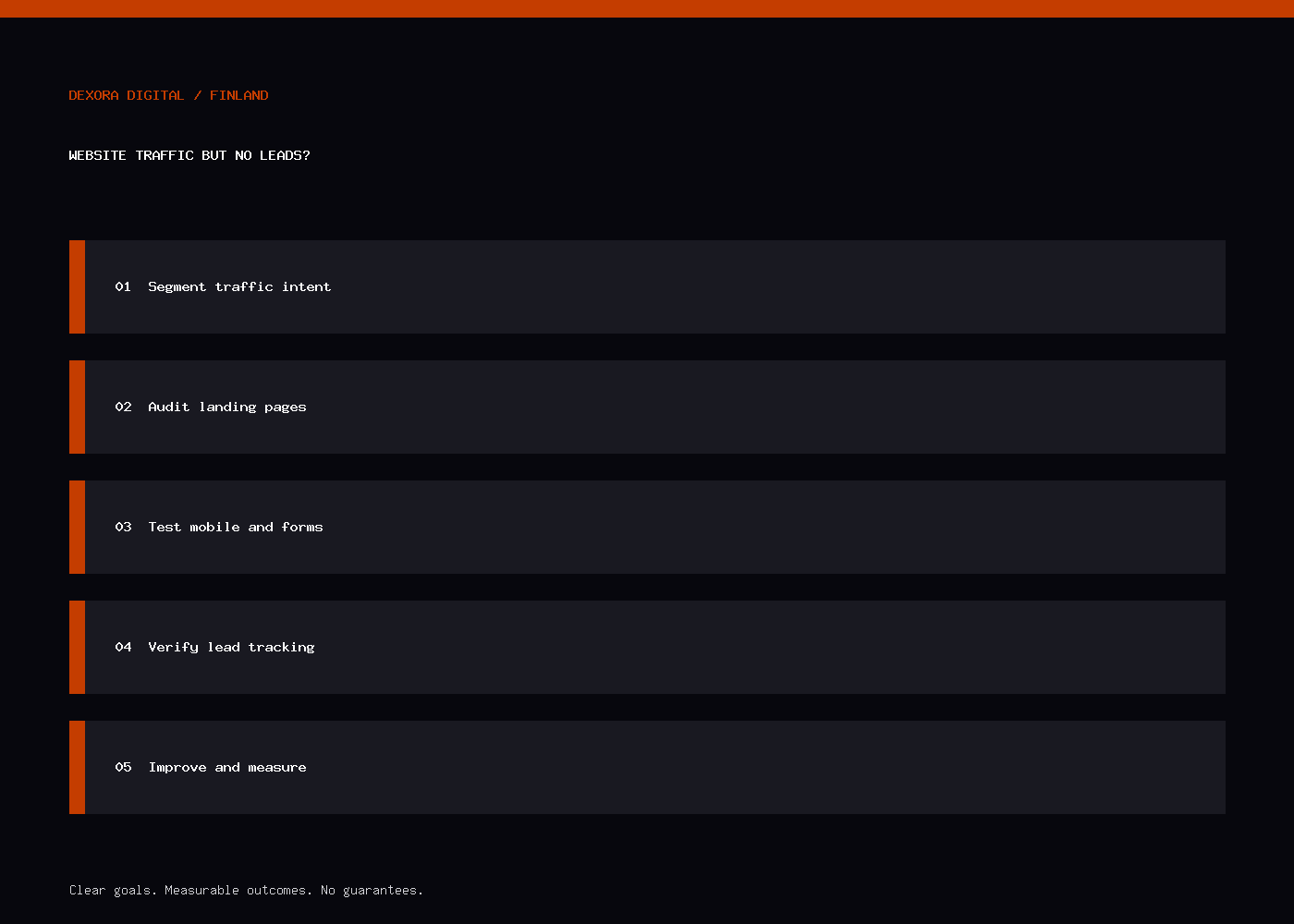
Step 1: segment by landing page and intent
Compare service pages, comparison guides, local pages and general articles. Look at engaged visits and meaningful actions rather than treating all sessions as equal. In Search Console, inspect query and page patterns where data is available, but remember that clicks do not identify individual buyers.
Step 2: audit the first screen and decision path
Ask someone unfamiliar with the business to explain the service after viewing the page briefly. Then ask them to find pricing information, proof, process and contact options. Record where they hesitate. Review content strategy if the site has multiple pages competing for the same intent.
Step 3: test the entire conversion flow
Use a test enquiry and confirm successful delivery to the intended mailbox or CRM. Test required fields, error messages, file uploads if present, and mobile keyboard behavior. Do not collect more personal information than the sales process actually needs.
Step 4: verify tracking and attribution
Check event names, triggers and duplicate firing. Where appropriate, use a lead identifier to reconcile marketing analytics with qualified CRM records without exposing personal information in analytics. Distinguish unknown attribution from a campaign that genuinely generated no leads.
Step 5: prioritize and test improvements
Fix broken forms and misleading copy first. Then test clearer service explanations, shorter forms, improved trust information and relevant CTAs. Measure a meaningful period and consider sample size; a handful of conversions is not enough to claim a reliable uplift.
Which metrics should Finnish businesses monitor?
| Metric | What it helps explain | Important limitation |
|---|---|---|
| Organic landing-page visits | Which pages attract visitors | Does not establish purchase intent |
| Verified form submissions | Whether the enquiry flow works | May include spam or poor-fit prospects |
| Qualified lead rate | Share of leads that fit your offer | Requires consistent CRM qualification |
| Booked consultations | Movement toward a sales conversation | Not the same as closed revenue |
| Revenue or pipeline by source | Commercial value when attribution is reliable | Consent, offline sales and multiple touches complicate attribution |
When should you invest in SEO versus CRO?
If a service page has little relevant search visibility, improving content coverage and SEO may be a priority. If qualified visitors reach the page but abandon the form, focus on conversion usability. When both are weak, fix the measurement and user journey before scaling traffic acquisition. A redesign is sometimes warranted, but a focused improvement can be faster and lower risk; see the website redesign checklist.
Frequently asked questions
Why does my website get traffic but no enquiries?
Common causes include mismatched intent, unclear offers, poor mobile usability, weak trust signals, broken forms or tracking errors. Diagnose each before choosing a solution.
Is a high bounce rate proof that my website is bad?
No. A visitor may find an answer on one page. Interpret engagement alongside page intent and verified business outcomes.
Should I shorten my contact form?
Remove unnecessary fields, but retain information needed to respond and qualify the enquiry. Test form completion and lead quality together.
Can AI SEO fix low conversions?
AI visibility work may help discovery, but it cannot replace a clear offer, usable website and functioning conversion path.
How quickly can conversion improvements be measured?
Technical fixes can be checked immediately. Reliable commercial comparisons depend on traffic, lead volume, seasonality and the length of your sales cycle.
Should you add an AI chatbot when traffic is not converting?
Only after checking the existing offer, navigation, trust signals and enquiry form. An AI chatbot can help visitors ask detailed questions, but it cannot fix unclear positioning or an unreliable booking system. Run a controlled test: compare qualified leads and completed enquiries with and without the assistant, monitor handoffs and track additional operating costs. Keep the original contact route available so visitors are not forced into a conversation.
Before deployment, use the seven-step AI agent readiness checklist to assess knowledge quality, data handling, permissions and failure recovery.
Turn visits into meaningful business opportunities
Start with one high-value landing page and a tested lead journey. Request a website review or contact Dexora Digital to discuss search visibility, usability and lead tracking for your Finland-focused business.