
Client: Full-service digital marketing agency (name withheld) | Location: Queensland, Australia | Services: Local SEO, technical SEO, on-page SEO, content strategy, AEO and GEO | Engagement: 16 months, ongoing at the time of the supplied report.
Executive summary: growing visibility in Google and AI search
A full-service digital agency in Queensland, Australia was delivering work for its own clients but had limited visibility for its own services in search. Its website functioned technically, yet its organic search structure, content and AI-search readiness needed coordinated improvement.
Dexora’s project combined website updates, technical and on-page SEO, content strategy, structured data and optimization for AI-powered discovery. According to the supplied project report, the agency recorded 339,000 Google Search impressions and 1,820 clicks, with approximately 1,300 organic keywords recorded in Semrush. AI visibility reporting showed 30 pages cited in ChatGPT and a reported 45 AI citations across tracked AI search experiences.
Request a free AI and SEO audit to identify search visibility opportunities for your own website.
The challenge: a digital agency that needed to improve its own discoverability
The starting problem was not the absence of a website: the agency already had a technically functional site. The gap was between that online presence and the site’s ability to compete for relevant searches and appear as a useful source in AI-driven discovery.
The project called for a joined-up organic growth program rather than an isolated keyword adjustment. Search visibility, page structure, content relevance and information clarity all had to be considered together.
Business problem
Prospective clients searching for digital marketing services needed clearer paths to relevant, useful pages. The agency also wanted its services and expertise to be easier for AI search systems to discover and reference.
Technical and content opportunity
The source brief identifies website updates, technical SEO, on-page SEO, content strategy, schema markup and AI search optimization as the scope of work. It does not provide a detailed initial crawl or itemized list of fixes, so this case study does not attribute specific unverified defects to the website.
Our approach: connect technical SEO, local intent and AI visibility
Rather than treating search optimization and AI visibility as unrelated services, the engagement addressed the website as one information system: pages must be accessible, relevant to customer queries, clearly organized and useful enough to deserve visibility.
1. Website updates and technical SEO
Website updates and technical SEO formed the foundation of the work. These activities were part of the documented project scope and aimed to improve the website’s organic-search readiness. The underlying technical audit is not supplied, so particular fixes such as individual redirect changes or Core Web Vitals outcomes are not claimed.
2. On-page SEO aligned with service search intent
The on-page work focused on helping important pages communicate their topics and services more clearly. The strategy connected search intent with the site’s service information instead of relying solely on broader visibility metrics.
3. Content strategy to expand relevant topic coverage
Content strategy was used as part of the broader organic program. Relevant service and informational topics supported discoverability across multiple stages of research and evaluation. The report does not quantify articles published, and no publication count is claimed here.
4. Schema markup and structured information
Structured data implementation was included in the project to help describe relevant website information in machine-readable form. Schema does not guarantee Google rankings or AI citations, and the supplied report does not specify each schema type deployed.
5. AI search optimization, including AEO and GEO
The project paired conventional SEO with answer-oriented and generative-search optimization. Its stated goal was stronger representation in AI-generated search experiences, supported by relevant content and clearer site information. AI systems independently determine which sources they reference; inclusion cannot be guaranteed.
Measured outcomes: the search performance evidence
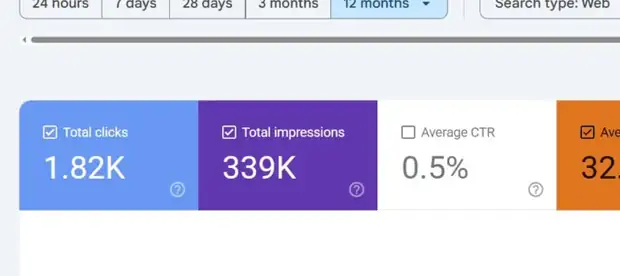
Google Search Console: 339,000 impressions and 1,820 clicks
The Google Search Console screenshot in the supplied report shows 339K total impressions, 1.82K total clicks, 0.5% average CTR and 32.6 average position for the selected 12-month view. These are reported search performance figures, not leads or revenue. Average position is an aggregate measure, not a claim that all target terms reached page one.
Semrush: approximately 1,300 organic keywords, up 25%
The Semrush screenshot reports 1.3K organic keywords (+25%) and 211 estimated organic visits (+26%) at capture time. It also displays an authority score of 9, 31 referring domains and 388 backlinks. These are third-party estimates and inventory metrics; they are not directly interchangeable with Google Search Console clicks.
Organic discovery developed over time
The charts in the PDF show increases in keyword visibility and estimated organic traffic during the displayed reporting window, particularly during 2026. The source narrative describes the overall engagement as 16 months and ongoing; the GSC screenshot itself uses a 12-month filter. We keep those periods separate instead of presenting them as the same reporting interval.
AI search visibility: citations and referenced pages
The Semrush AI Search screenshot reports AI Visibility 14, 8 mentions and 45 cited pages in its aggregate dashboard. Its platform breakdown shows:
- ChatGPT: 2 mentions and 30 cited pages
- Google AI Overviews: 2 mentions and 9 cited pages
- Google AI Mode: 3 mentions and 14 cited pages
- Gemini: 1 mention and 3 cited pages
The accompanying case study narrative refers to 45 total AI citations. Because the screenshot calls this metric “cited pages,” this page distinguishes the source’s narrative claim from the dashboard label. The platform counts should not be summed into a unique-page total because a page may appear in more than one AI platform.
These figures document visibility detected by the measurement platform at the time of reporting. They do not establish an exact volume of AI-generated traffic, enquiries or sales.
What this case illustrates for agencies and B2B service companies
Improve search foundations before pursuing AI citations
Technical SEO, accessible pages and useful content remain necessary foundations. AI discovery work should reinforce those assets rather than replace them.
Measure search and AI discovery independently
Search Console impressions and clicks are different measurements from Semrush keyword estimates, AI mentions and cited-page reports. Each helps explain a different aspect of visibility.
Build long-term search coverage
The source charts show a broad rise in search visibility over the reported period. However, this individual case does not prove that the same trajectory or timeline will occur for every company.
Evidence and reporting methodology
Primary evidence: client-supplied two-page PDF titled Agency LOCAL SEO + AI Search (AEO, GEO): 339K Impressions, 30 Pages in ChatGPT.
- Google Search Console: total clicks, impressions, CTR and average position shown with a 12-month filter.
- Semrush SEO: organic keyword count, percentage change, estimated organic traffic, authority score, referring domains and backlinks.
- Semrush AI Search: AI Visibility, mentions, aggregate cited pages and platform-level cited-page figures.
Measurement limitation: The screenshots are historical snapshots and do not establish current performance on the date this article is published. The source does not provide transaction-level attribution, lead volume or client revenue, so we make no claims about those results.
Frequently asked questions
How did the agency reach 339K search impressions?
The documented engagement combined website improvements, technical SEO, on-page optimization, content strategy, structured data and AI search optimization. The source does not isolate how much each activity contributed.
What does 30 pages cited in ChatGPT mean?
It is the count reported for ChatGPT cited pages in the supplied Semrush AI Search screenshot. It does not mean that ChatGPT recommends all these pages for every query.
Are Google impressions the same as visits?
No. Impressions measure appearances in eligible search results. Clicks record interactions from search results. The report shows 339K impressions and 1,820 clicks.
What is the difference between Semrush organic traffic and Google Search Console clicks?
Semrush organic traffic is an estimate derived from its own dataset. Search Console reports Google’s search performance data for the verified property. They use different methodologies and should not be equated.
Did AI search optimization guarantee citations?
No. AI systems select and cite sources independently. Optimization can improve discoverability and content clarity but cannot guarantee citations.
Can the same strategy work for Finnish businesses?
The general principles can be applied in Finland, but keyword opportunities, local competition, languages, audience needs and technical priorities must be assessed for each site.
How long did the project run?
The supplied narrative reports 16 months and an ongoing engagement at reporting time. Some supporting screenshots use shorter chart filters.
Can you review my business’s SEO and AI visibility?
Yes. Request a free AI and SEO audit for an initial assessment of relevant search opportunities.
Build a stronger presence in Google and AI search
If your business has valuable services but limited organic visibility, a coordinated SEO and AI search strategy can help identify what should improve first. Dexora Digital serves businesses in Finland and across Europe from Oulu.
Get Your Free AI & SEO Audit → Explore AI Search & Organic Growth Explore Local SEO