Client: Property management company (name not specified in source) | Market: California Central Coast, United States | Engagement: Three years, ongoing at reporting time | Services: Local SEO, technical SEO, content strategy, Google Business Profile optimization, backlink building and AI search optimization.
Executive summary: a three-year local SEO growth program
A property management company serving California’s Central Coast wanted to increase its visibility for commercially relevant local searches in a competitive regional market. Dexora Digital developed and managed a long-term program connecting website SEO, locally relevant content, Google Business Profile (GBP) optimization, link development and AI search discoverability.
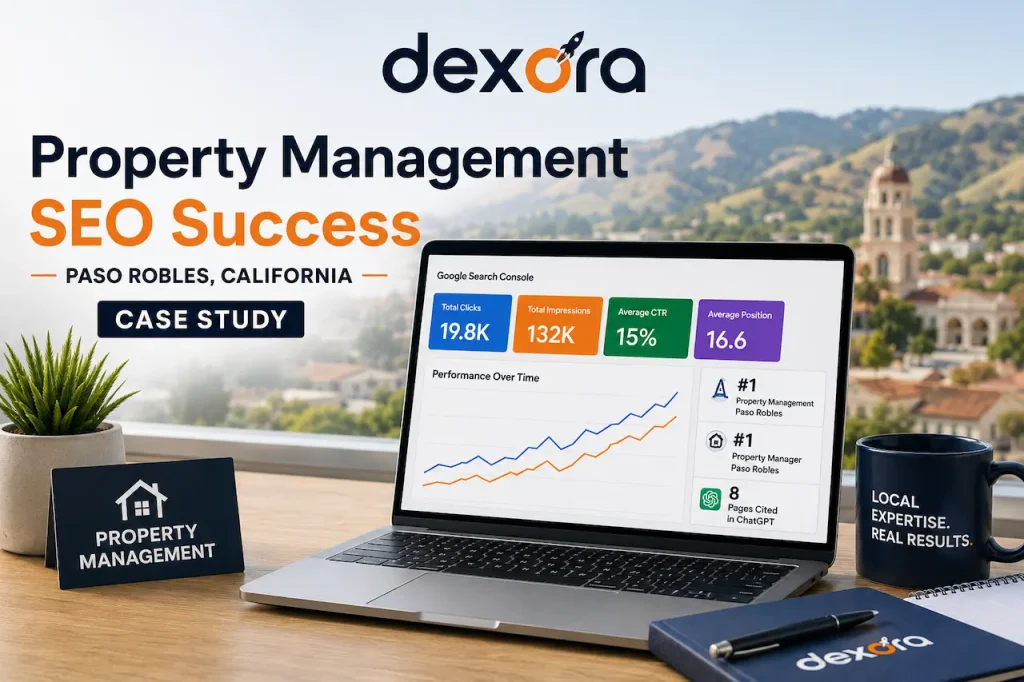
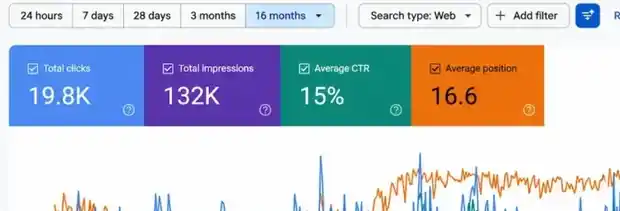
In the supplied project report, Google Search Console shows 19,800 organic clicks, 132,000 impressions and a 15% average click-through rate within the selected 16-month reporting window. The report also describes 255 ranking keywords, 123 referring domains, eight pages cited in ChatGPT and top positions for the client’s main commercial terms.
Request a free SEO and AI visibility audit →
The challenge: competing for valuable local property-management searches
Property management companies depend on being discovered by property owners, landlords and other prospective customers searching within specific service areas. A business can offer strong services while still losing visibility to competitors whose websites and local profiles better match relevant search intent.
The documented challenge was to compete for the client’s primary commercial keywords in California’s Central Coast market. That required more than a single landing-page update: the campaign combined technical website work, local content, business-profile management and off-site authority development.
Regional search intent mattered
Property owners looking for management services often compare local providers and evaluate whether they serve a particular city or area. The strategy therefore centered on commercially relevant regional search coverage, rather than simply driving broad, untargeted traffic.
Organic search and map visibility needed coordinated attention
Local visibility spans website results and local business listings. The scope included Google Business Profile work and conventional SEO, allowing both channels to be considered in the broader program.
Our local SEO strategy
1. Technical SEO and website foundations
Technical SEO was one of the five documented workstreams. Its role in a local campaign is to make important service content accessible to search engines and avoid preventable discovery issues. The supplied PDF does not provide an itemized audit, so this article does not claim particular crawl, redirect or Core Web Vitals fixes as completed.
2. Local SEO and content development
Content and local SEO supported the effort to establish relevance for the company’s primary commercial terms across its regional market. Useful location and service information can help prospective customers understand coverage and offerings without relying on repetitive keyword-stuffed pages. The report does not give a count of pages created, and none is invented here.
3. Google Business Profile optimization
The campaign included management of the client’s Google Business Profile, an important part of how eligible local businesses present themselves in Google Search and Maps. The source report states a 15% Google Maps click-through rate; however, its displayed 15% screenshot is from Google Search Console, not Google Business Profile Performance. We therefore treat the Maps-specific figure as a project narrative claim that requires separate GBP evidence.
4. Backlink and referring-domain development
Backlink building was also included in the three-year engagement. The source reports 123 referring domains and an Authority Score of 9. These are third-party snapshot metrics, not a verified count of newly acquired links or a guarantee of authority.
5. AI search optimization
The project also covered AI search optimization. The narrative reports that eight site pages were cited in ChatGPT. That is an AI discoverability measurement, distinct from organic clicks or enquiries. Being mentioned or cited by AI-generated answers cannot be guaranteed.
Results: what the evidence shows
Google Search Console: 19,800 clicks from 132,000 impressions
The GSC screenshot on page 1 of the supplied report shows the 16-month view with 19.8K total clicks, 132K total impressions, 15% average CTR and 16.6 average position. Click-through rate is calculated from clicks divided by impressions, and the reported totals are consistent with a 15% rounded rate.
These metrics demonstrate substantial organic discovery during the selected reporting period. They do not by themselves measure calls, signed management agreements or revenue.
Commercial keywords: reported #1 rankings
The project narrative states that the company reached position one for its primary commercial keywords. The accompanying screenshot does not list each query or provide keyword-by-keyword ranking evidence. We report the claim as stated without extending it to every search term or every location.
255 ranking keywords and 123 referring domains
The report provides these as summary figures. Its performance screenshots show traffic and referring-domain trends over time, but do not independently disclose the complete list of ranking terms or linking sites.
Eight pages cited in ChatGPT
The supplied narrative reports eight pages cited in ChatGPT. The PDF does not include an AI visibility platform screenshot documenting those eight URLs or the queries involved; this remains a reported project outcome rather than independently validated page-level evidence.
Understanding the timeline and the performance charts
The client relationship is described as a three-year ongoing partnership. The visible Search Console totals, however, are filtered to 16 months, while the wider SEO charts show multi-year trends. They measure different intervals and must not be interpreted as one identical reporting period.
The source charts show changes in estimated organic traffic, referring domains and traffic by search intent. The intent chart separates informational, navigational, commercial, transactional, branded and local classifications. These categories are useful context, but the PDF does not supply exact totals for each segment.
Why this approach matters for property management firms
Local commercial intent should drive priorities
Searches that closely match the services a company sells are often more valuable than traffic from broad informational subjects. A regional strategy should connect services, coverage areas and helpful business information.
Website SEO and GBP optimization complement each other
Organic results and local listings offer different points of discovery. Keeping business information and service descriptions clear across both channels supports a more coherent digital presence.
Long-term visibility requires ongoing work
This case describes sustained campaign management over three years. Performance depends on competition, market conditions, implementation and external changes, and similar results cannot be promised to other businesses.
Methodology and evidence notes
Source document: AI SEO & Local SEO Growth: 19,800 Clicks, 15% CTR, #1 Rankings — California, a two-page client project report supplied for publication.
- Verified visually in the provided GSC screenshot: 19.8K clicks, 132K impressions, 15% average CTR, 16.6 average position; 16-month selected window.
- Reported in the written project narrative: three-year engagement, #1 positions for primary commercial terms, 255 ranking keywords, 123 referring domains, eight pages cited in ChatGPT and a 15% Google Maps CTR.
- Not supplied: a separate Google Business Profile CTR report, list of individual ranking queries, list of AI-cited URLs, conversion reporting, revenue or attributed sales.
Note: The claim that a 15% Maps CTR compares against a 2–5% industry average appears in the supplied narrative, but no supporting benchmark source is included. It is not treated here as a verified industry standard.
Frequently asked questions
How many organic clicks did the property management website receive?
Google Search Console shows approximately 19,800 clicks in the selected 16-month period.
What does the 15% click-through rate represent?
The screenshot confirms a 15% average CTR in Google Search Console. The case narrative separately calls it a Google Maps CTR, but that Maps-specific designation is not supported by a GBP screenshot in the supplied PDF.
How long was the SEO campaign?
The narrative describes a three-year ongoing engagement. The key GSC screenshot uses a shorter 16-month performance window.
Did the business rank #1 for every property management search?
No such universal claim is supported. The source reports number-one rankings for the client’s primary commercial keywords, without listing each term.
What activities were included in the campaign?
The documented program covered technical SEO, content, Google Business Profile optimization, backlink building and AI search optimization.
What does eight pages cited in ChatGPT mean?
It is a reported count of pages referenced in ChatGPT outputs at the measurement point. It does not guarantee future inclusion or recommendation for all relevant queries.
Are referring domains the same as backlinks?
No. Referring domains count distinct linking websites, while backlinks count individual links. The report states 123 referring domains, but does not provide a full linking-domain inventory.
Can the same local SEO approach work in Finland?
The strategic principles can be adapted to Finnish markets, but competition, language, service areas, Google Business Profile eligibility and website condition must be assessed individually.
Want stronger local search visibility?
Dexora Digital helps businesses connect technical SEO, local relevance, content and AI discoverability. Based in Oulu, Finland, we work with businesses targeting Finnish and wider European markets.
Request a Free AI & SEO Audit → Local SEO Services AI Search & Organic Growth